


Developing a Design Thinking mindset
Management problems are often complex and not clearly defined. What users say they need may not reflect the underlying problem, different stakeholders may understand the same situation differently, and an obvious problem may only be a symptom of something deeper. Design Thinking provides an approach to understanding such problems and developing solutions around user’s needs and experiences.
At SPJIMR, Design Thinking is approached not simply as a set of tools or steps, but as a way of thinking about problems. Participants learn to observe before making assumptions, understand the user and context before defining the problem, consider multiple possibilities before selecting a solution, and use experimentation to refine their ideas.


Learning by doing
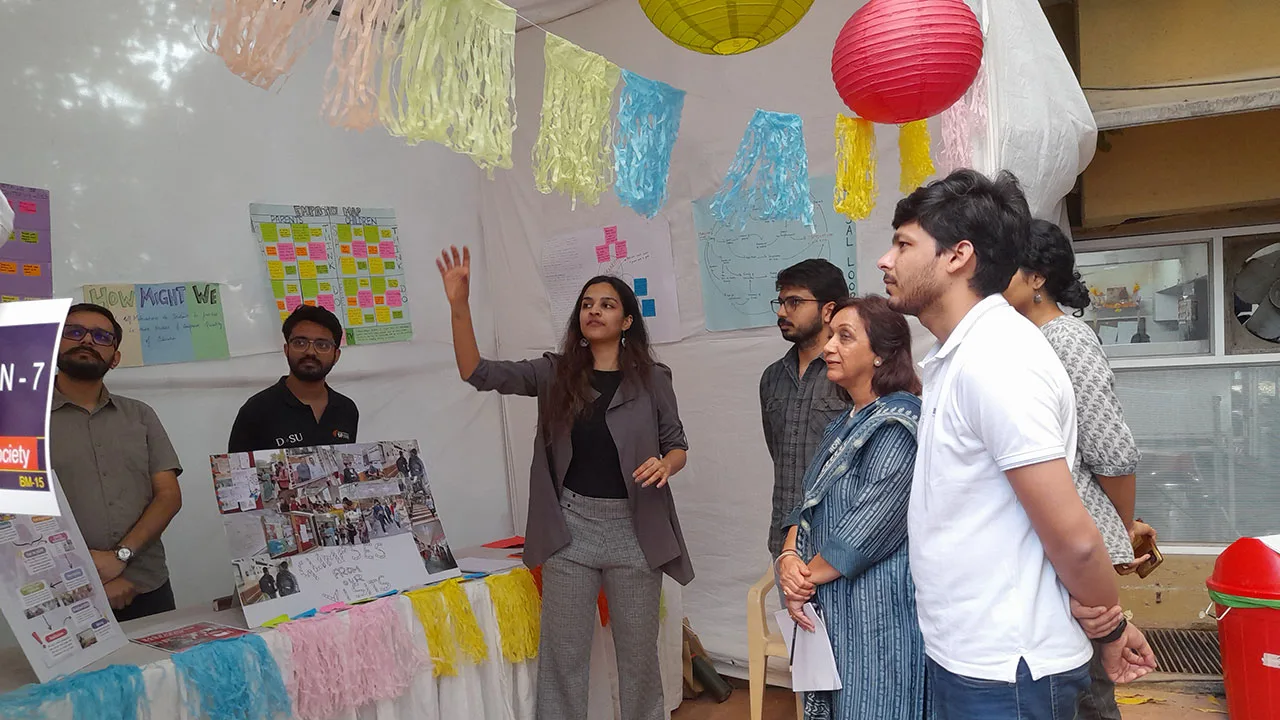
The Design Thinking experience at SPJIMR is largely experiential. Classroom discussions are combined with observation exercises, user interviews, group activities, problem-framing exercises, ideation and prototyping. Participants move between conceptual inputs and their application, followed by reflection on what they have learnt. SPJIMR’s Design Thinking Lab facilitates this process.


Design Thinking is also part of SPJIMR’s broader approach to problem-solving. Its human-centred perspective is complemented by Systems Thinking, which helps participants examine relationships, interdependencies, feedback loops and unintended consequences, and Critical Thinking, which encourages them to examine assumptions, evidence and alternatives.
Together, these approaches encourage participants to ask:
- Are we solving the right problem?
- How is the problem connected to the larger system?
- Does the proposed solution hold up to critical examination?
Objectives and outcomes
Through the Design Thinking experience, participants:
- Understand users and their contexts through observation, conversations and empathy-driven approaches.
- Define and reframe problems, moving beyond initial assumptions to identify problems worth addressing.
- Generate alternative ideas using divergent and convergent thinking before evaluating possibilities.
- Use prototypes to test assumptions and obtain feedback before committing to a solution.
- Iterate based on evidence and feedback, recognising that unsuccessful experiments can also generate useful learning.
- Develop feasible and implementable solutions while remaining attentive to user needs and the wider context.
The objective is not simply to teach participants the Design Thinking process, but to develop their ability to approach unfamiliar and unstructured problems systematically while remaining open to revising their initial understanding of both the problem and the solution.
Design Thinking helps participants ask better questions, learn through experimentation, and develop solutions grounded in a deeper understanding of users and their contexts.
Events