Executive Programme in Artificial Intelligence and Generative AI for Managers
Lead AI-driven business transformation
About the programme
The Executive Certificate Programme in Artificial Intelligence and Generative AI for Managers is a 5-month online programme designed for early-to-mid managers, business heads, strategy leaders, entrepreneurs, and consultants leading AI-driven transformation. Designed by SPJIMR faculty, the programme is delivered through a blend of pre-recorded faculty sessions, weekly live mentored learning sessions led by industry practitioners, monthly live masterclasses by SPJIMR faculty, assessments, and hands-on projects. It combines strategic insight with practical execution and doesn’t require candidates to have prior coding knowledge.
The curriculum is designed to equip learners with the skills to lead the transition from a traditional ‘+AI’ to an ‘AI+’ operating model. It covers high-impact, real-world themes, including Generative AI and LLMs, advanced prompting techniques, RAG systems, embeddings and semantic search, Agentic AI workflows, AI economics and ROI, production readiness, and responsible AI governance. The content is aligned with India’s regulatory and digital ecosystem. With a strong case study-led approach, learners complete structured mini-projects and capstones, supported by practical assessments that reinforce key concepts and enable real-world application. Upon successful completion, learners will earn a Certificate of Completion from SPJIMR.
Reputation
SPJIMR is consistently in the top 10 of Indian B-school rankings, and is establishing a global reputation as a school dedicated to fostering responsible innovation that benefits society.
Immersive learning
Engage in weekly mentored learning sessions with industry practitioners and monthly masterclasses by leading SPJIMR faculty.
No prior coding knowledge required
Designed for managers and business leaders seeking to understand and apply AI without requiring prior programming experience.
Flexible learning for working professionals
A fully online format designed to enable professionals to learn alongside their work commitments.
Industry-relevant curriculum
Covers emerging enterprise AI topics including GenAI, LLMs, RAG systems, AI economics, governance, and production deployment.
Build an AI project portfolio
Through hands-on projects and practical use cases, develop a portfolio that showcases your ability to apply AI in real-world business scenarios.
Programme objectives
Equip business leaders with the strategic knowledge and practical frameworks required to adopt, evaluate, and scale AI and Generative AI initiatives within their organisations.
Programme outcomes
On successful completion of the programme, the learners will be able to –
Formulate AI strategy
Formulate AI strategy using the automate–optimise–predict framework and enable AI+ operating model transformation.
Design and evaluate generative AI systems
Design and evaluate Generative AI systems, including LLMs, prompting techniques, embeddings, semantic search, RAG, and fine-tuning approaches.
Build robust AI business cases
Build robust AI business cases through ROI modelling, token economics, cost estimation, and clearly defined value metrics
Architect agentic AI workflows
Architect Agentic AI workflows incorporating tool use, permissions, human-in-the-loop controls, and failure management mechanisms.
Scale AI initiatives
Scale AI initiatives from pilot to production using structured monitoring, evaluation frameworks, and lifecycle governance.
Implement responsible AI frameworks
Implement Responsible AI frameworks addressing fairness, compliance, privacy, explainability, and regulatory alignment in India.
Participant profile: Who is it best suited for
This programme is designed for professionals who want to understand and apply AI strategically within their organisations.
Ideal participants include:
Early-to-mid managers driving digital or AI transformation initiatives
Business leaders and strategy professionals responsible for innovation and growth
Entrepreneurs and founders exploring AI-enabled business models
Consultants and advisors supporting organisations in technology adoption
Product and technology leaders working on AI-enabled products and platforms
Academic credibility
Prof. Abhishek Kumar Jha
Programme director Assistant Professor, Information Management and Analytics, SPJIMR
Prof. Jha’s research focus lies at the intersection of artificial intelligence, natural language processing, information privacy, and behavioural science.
Associate Professor, Information Management and Analytics, SPJIMR
Prof. Desai brings 27+ years of experience building greenfield technology-driven financial services businesses in the Middle East, Africa, and South Asia.
Niharika is an assistant professor in the marketing area at SPJIMR. She has a PhD. from the Faculty of Management Studies (FMS), University of Delhi, and a master’s degree from IIT Bombay.
The curriculum, designed by the faculty of S P Jain Institute of Management and Research, Great Learning, and leading industry practitioners, is taught by the best-in-class professors and practising industry mentors.
It is divided into four modules and is delivered through a blend of pre-recorded lectures, weekly live mentored learning sessions led by industry practitioners, monthly live faculty masterclasses, assessments, and hands-on projects.
Module 1: Foundations of AI and GenAI for managers
This module builds a shared vocabulary and practical intuition for AI and GenAI. Grounded in the AI Value Creators concept of moving from plus AI (AI as a feature) to AI plus (AI as the operating model), participants develop managerial literacy, decision confidence, and the ability to scope early opportunities without technical jargon. The module introduces core GenAI concepts, demonstrates everyday business applications, and establishes a common language across leadership cohorts.
Topics covered
AI and machine learning basics for managerial decision making
Why AI now: From rule-based systems to Modern GenAI
GenAI fundamentals, prompting, and everyday business use cases
Chatbots as business systems: Scope, rollout, and trust basics
Module 2: Advanced GenAI systems and agentic workflows
This module develops capability in customisation and automation-oriented GenAI. Moving from retrieval-based systems into agentic workflows, participants learn to design systems that take actions, not just generate text. The emphasis is on reliability, evaluation, permissions, and safe autonomy. By combining embeddings, RAG, fine-tuning, and agent design, learners understand how organisations build enterprise-grade AI systems that go beyond response generation to handling complex, multi-step business processes.
Topics covered
Embeddings and semantic search: How systems represent meaning
RAG systems and enterprise chatbots: Grounded answers at scale
Fine-tuning and small language models: Customisation choices and trade-offs
Agentic AI workflows: Tool use, process redesign, and evaluation
Agent design in practice: Permissions, failure modes, and controls
Module 3: Strategy, value, and core system building blocks
This module connects business value to technical feasibility. Alternating between strategic framing and system-level understanding, participants learn to evaluate build-versus-buy decisions, estimate ROI, and understand the architectural components that make enterprise GenAI reliable and scalable. Learners apply frameworks for competitive advantage, cost management, execution readiness, and production monitoring across the full lifecycle of a GenAI initiative.
Topics covered
From plus AI to AI plus: Strategy and competitive advantage
Value creation and economics: ROI, cost, and measurement for GenAI
Execution and scaling: Teams, data readiness, and operating model
Production readiness: Monitoring, quality evaluation, and lifecycle
Module 4: Functional applications, India context, and responsible Scaling
This module translates GenAI capabilities into domain-specific adoption across marketing, finance, operations, and human resources. Grounded in India’s regulatory and infrastructure context, participants design use cases that create measurable value, manage risk, and scale responsibly. The module closes with a governance capstone that integrates responsible AI into an enterprise operating model, covering fairness, explainability, privacy, safety, and accountability frameworks.
Topics covered
Marketing and growth with GenAI: Content, insights, and experimentation
Finance and risk: Fraud detection, forecasting, and decision support
India and BFSI focus: India Stack, DPDP Act, and regulated GenAI
Responsible AI and governance: Controls, compliance, and enterprise scale
*Note – The above curriculum and tools are under the purview of the academic team and subject to change to ensure alignment with evolving industry requirements.
Practice-focused learning
The programme is taught through a case-study methodology, focusing on business scenarios that illustrate AI implementation across industries.
Image generator review
AI content moderation
Ads on AI platforms
AI shopping agents
Agentic AI and commerce
AI in HR and organisation building
AI models cost disruption
×
*Note – Case studies are under the purview of the academic team and subject to change to ensure alignment with evolving industry requirements.
Hands-on exercises and mini projects
Structured activities to apply concepts using AI tools and frameworks.
The programme features module-level group projects. Module projects are domain-flexible and evaluated on business framing, technical implementation, and responsible design, not just on coding skills.
As part of the programme, learners will complete a series of mini-projects to reinforce practical learning and application.
Some of the sample projects are:
Project 01
Local RAG chatbot
Build a fully local RAG system for a domain-specific document set, such as an HR policy manual, product catalogue, regulatory FAQ, and so on. The system must handle 20+ realistic queries, return grounded answers with source citations.
Project 02
Production-simulated AI system
Extend the previously developed RAG chatbot into a production-simulated deployment: adding a logging layer, a quality evaluation rubric (automated plus human), a monitoring dashboard, and a 30-day maintenance plan
Capstone project
Enterprise responsible AI framework
This capstone project focuses on designing a comprehensive Responsible AI Framework that covers use-case inventory and risk classification, governance structure and roles, data governance requirements, model evaluation standards, an incident response plan, a stakeholder communication plan, and a 12-month implementation roadmap.
*Note – The above projects are under the purview of the academic team and subject to change to ensure alignment with evolving industry requirements.
Technical tools covered
Participants will gain exposure to tools and frameworks used in modern AI and Generative AI ecosystems.
Tools and technologies covered
AI Prompting, Exploration and Workflow Tools
Claude.ai
Copilot
Copilot Studio
Google AI Studio
ChatGPT
Notebook LM
n8n
Private AI, RAG and Local Deployment Tools
LM Studio
Ollama
AI Deployment, Interface and Application Development Tools
Hugging Face Model Hub
Gradio
*Note – Tools are subject to change. Equivalent tools or frameworks may be substituted based on availability, compatibility, or advancements in the field.
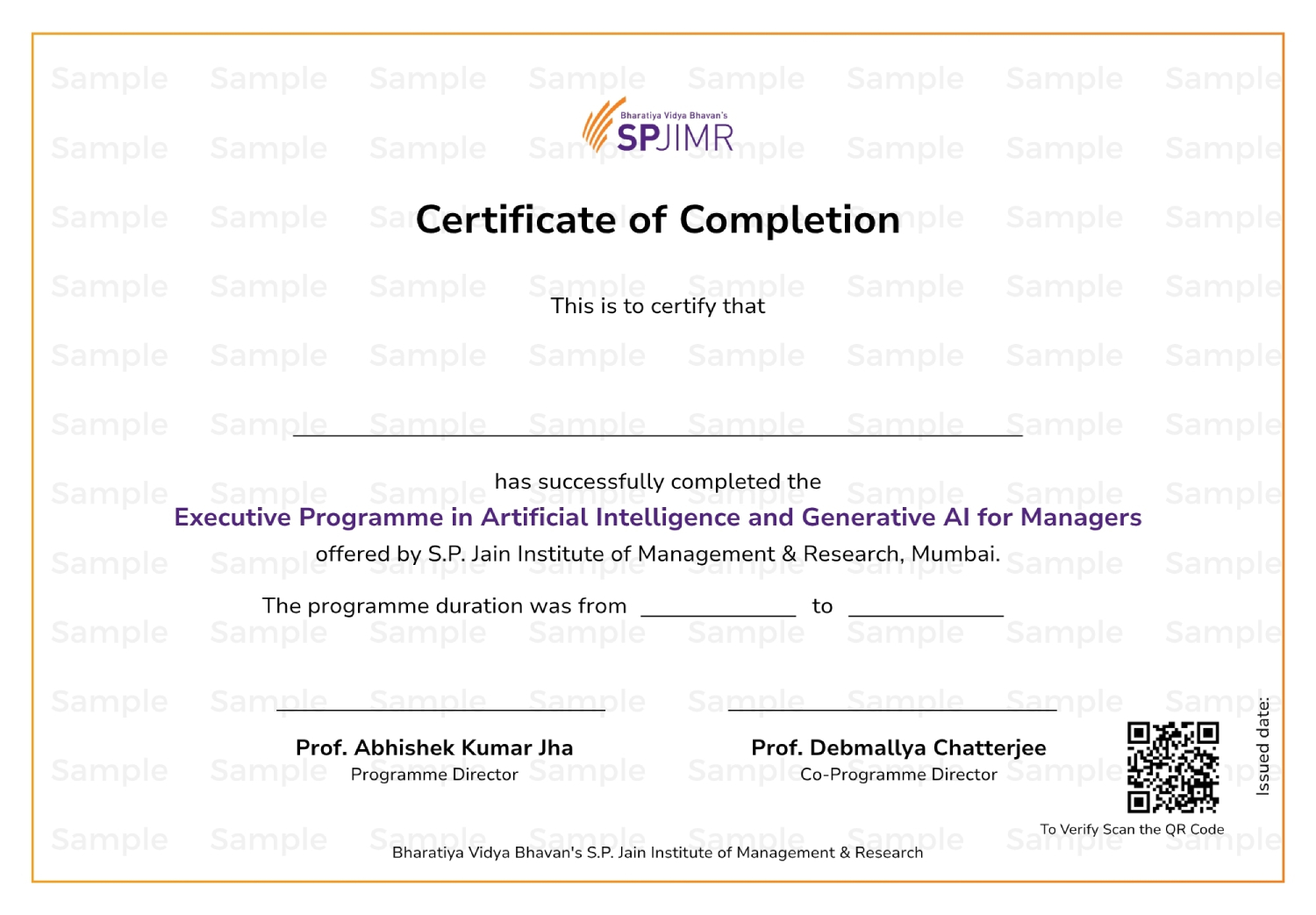
Certificate
On successful completion of the programme, participants will get the following certificate.
Join the programme
Eligibility
Candidates should hold a Bachelor’s or Master’s degree. OR The candidate should have substantial/relevant work experience.
S. P. Jain Institute of Management & Research (SPJIMR) has partnered with Great Learning to offer the Executive Certificate Programme in Artificial Intelligence and Generative AI for Managers. Great Learning is a leading global ed-tech company for professional and higher education, serving over 14 million learners across 170+ countries, with 500 million+ learning hours delivered, a 91% course completion rate, and a 4.8/5 learner rating, supported by 8,200+ industry mentors.
Great Learning manages enrolments and delivers end-to-end learner support, programme management, and industry-led mentorship. The programme draws on SPJIMR’s academic rigour and practice-oriented approach, combining faculty-led insights with real-world application to enable professionals to drive AI-led business transformation.
FAQs
Does the Executive Programme in AI and Generative AI for Managers from S.P. Jain Institute of Management & Research (SPJIMR) require prior coding or programming experience?
No. The SPJIMR Executive Programme in AI and Generative AI for Managers does not require any prior coding or computer science background. SPJIMR designed the programme for senior managers, product leaders, and strategy consultants, and it focuses on non-coding execution, business architecture, and organisational transformation through artificial intelligence (AI). Learners gain practical exposure to modern low-code and no-code tool stacks, including Copilot Studio, n8n, LM Studio, Ollama, and Hugging Face, to evaluate and deploy generative AI systems effectively without writing software from scratch.
Which advanced topics, such as retrieval-augmented generation (RAG) systems and agentic AI, does the SPJIMR Executive Programme in AI and Generative AI for Managers cover?
Over 5 months, the SPJIMR Executive Programme in AI and Generative AI for Managers moves learners from a traditional +AI tool-use model to an embedded AI+ operating model. Key modules cover generative AI foundations, vector embeddings, semantic search, fine-tuning of large language models (LLMs), and the design of complex RAG systems. Participants also learn to architect agentic AI workflows with autonomous tool integrations, human-in-the-loop controls, and error recovery protocols suitable for enterprise deployments.
How does the SPJIMR Executive Programme in AI and Generative AI for Managers teach leaders to calculate AI return on investment (ROI) and analyse token economics?
The SPJIMR programme prepares business decision-makers to build defensible financial models and evaluate the total cost of ownership for AI initiatives. Learners master token economics, application programming interface (API) call forecasting, vector database hosting expenses, and compute latency trade-offs. Using the automate-optimise-predict strategic framework, participants learn to estimate ROI, justify cloud infrastructure spend, and present high-impact AI business cases directly to C-suite stakeholders. The curriculum and tools mentioned are indicative and subject to change.
What practical capstone projects do participants complete in the SPJIMR Executive Programme in AI and Generative AI for Managers?
Learners in the programme build a portfolio through hands-on, domain-flexible projects, which SPJIMR evaluates on business strategy rather than code syntax. Deliverables include building a private, local RAG chatbot for proprietary documents, scaling it into a production-simulated AI deployment with quality evaluation rubrics, and designing a comprehensive enterprise responsible AI framework featuring use-case risk classification, data governance, and a 12-month implementation roadmap.
What is the schedule and weekly time commitment for working executives in the SPJIMR Executive Programme in AI and Generative AI for Managers?
SPJIMR designed this 5-month online programme for working professionals, and it requires approximately 6 to 8 hours per week. The structured learning experience includes pre-recorded faculty video lectures, weekly live mentored sessions with industry practitioners, and monthly live masterclasses with SPJIMR professors. SPJIMR collaborates with its delivery partner, Great Learning, to provide complete programme management and learner support.
How does the SPJIMR Executive Programme in AI and Generative AI for Managers address Indian data privacy laws and ethical AI compliance?
SPJIMR explicitly aligns the governance curriculum of the programme with India’s digital ecosystem and regulatory landscape, including compliance with the Digital Personal Data Protection (DPDP) Act. Participants explore algorithmic bias mitigation, model explainability, data sovereignty, and ethical risk management, equipping leaders to implement institutional governance standards that satisfy corporate audits while fostering innovation.
What credentials do graduates receive, and what is the fee for the SPJIMR Executive Programme in AI and Generative AI for Managers?
On successfully completing all assessments and projects, graduates earn a formal certificate of completion from SPJIMR. The total fee for the programme is ₹1,65,000 plus applicable goods and services tax (GST). SPJIMR’s delivery partner, Great Learning, offers flexible financial assistance and equated monthly instalment (EMI) options.
Why should business leaders choose the SPJIMR Executive Programme in AI and Generative AI for Managers over general management programmes or technical bootcamps?
Unlike theoretical executive programmes or syntax-heavy coding bootcamps, the SPJIMR Executive Programme in AI and Generative AI for Managers bridges high-level business strategy with functional technical execution. A top-ranked Indian business school backs the programme, and industry practitioners mentor participants. It empowers leaders to design agentic workflows, model financial token economics, and guide AI transformation projects without becoming software engineers.