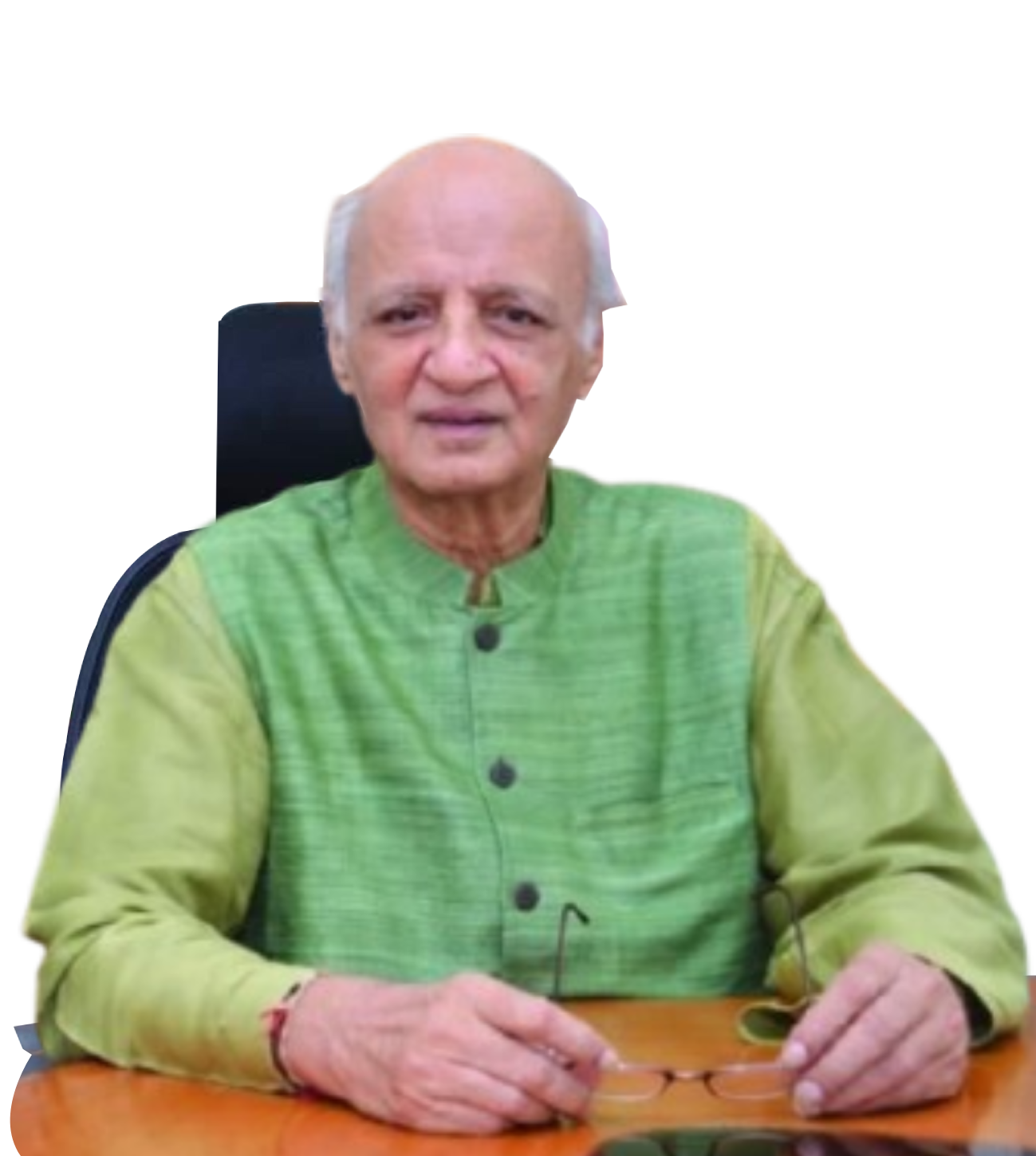


We teach that material success is important, but it can ring hollow without an understanding of the deeper purpose that must guide our decisions and a spirit of service that must lead us to action.
Honorary Dean, SPJIMR (1986 – 2014)
Bharatiya Vidya Bhavan (BVB), India’s premier non-profit educational institution, established S.P. Jain Institute of Management and Research (SPJIMR) in 1981 with a clear purpose: to adapt the concepts, techniques and practices of modern management to the needs and realities of a developing India.
Dr. K.M. Munshi founded BVB in 1938 with the support of Mahatma Gandhi. Today, it is a worldwide cultural, educational and ethical movement, built on nearly nine decades of public service and the goodwill that service has earned.
In 45 years, SPJIMR has grown into one of India’s leading management schools, with a global reputation for societal impact. Our Legacy Wall traces that journey, from our first batch in 1981 to the milestones we celebrate today. Walk through it with us.
We teach that material success is important, but it can ring hollow without an understanding of the deeper purpose that must guide our decisions and a spirit of service that must lead us to action.
In 45 years, SPJIMR has grown into one of India’s leading management schools, with a global reputation for societal impact. Our Legacy Wall traces that journey, from our first batch in 1981 to the milestones we celebrate today. Walk through it with us.
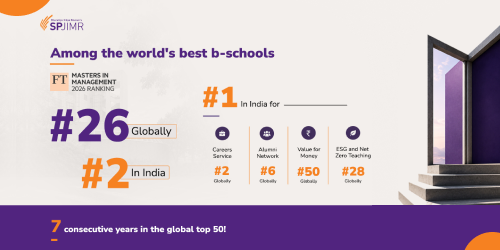
SPJIMR rises to #26 globally, ranks #2 in India in FT Masters in Management 2026 ranking.

SPJIMR achieved ‘Level 5 Pioneering School’, the highest rating in the Positive Impact Rating (PIR), for the sixth consecutive year. The recognition, announced at the PIR Global Summit 2026, acknowledged our institute’s commitment to societal impact and sustainability. SPJIMR was one of 87 business schools from 32 countries that participated in the seventh edition of the rating.

(SPJIMR) has retained its position at #35 globally and is ranked #3 in India in the Financial Times Masters in Management (FT MiM) 2025 global ranking. This marks the sixth consecutive year that SPJIMR has featured in the global top 50.

SPJIMR has once again been recognised for its societal impact and commitment to sustainability in the sixth edition of the Positive Impact Rating (PIR).

(SPJIMR) was re-accredited by the Association of MBAs (AMBA) and, for the first time, accredited by the Business Graduates Association (BGA). With this recognition, SPJIMR is now among just 45 business schools worldwide and one of only three in India to hold both AMBA and BGA accreditations.

SPJIMR’s Fellow Programme in Management (FPM) is recognised as equivalent to a Doctor of Philosophy (Ph.D.) by the Association of Indian Universities (AIU).

SPJIMR ranked as India’s top business school in the Financial Times Masters in Management (FT MiM) global ranking for second consecutive year.

With the EQUIS accreditation, SPJIMR has earned the prestigious ‘Triple Crown’, a distinction held by only four Indian business schools. This accomplishment places SPJIMR among the top 1% of business schools globally, positioning it within an elite group of institutions worldwide.

SPJIMR’s Centre for Family Business and Entrepreneurship (CFBE) launched Sashakt, a transformative programme designed to empower micro-business entrepreneurs from Mumbai’s Andheri K-West Ward.

Centre for Family Business and Entrepreneurship (CFBE) welcomed its first cohort of the Ladies in Family Enterprise (LiFE) programme on 3 September 2024.

SPJIMR unveiled the Wise Innovation Studio for Emerging Technologies (WISE Tech) on 13 May 2024. WISE Tech’s goal is to be the knowledge and community hub for all matters related to tech-based wise innovation and entrepreneurship.

SPJIMR earned a 5-year extension of the AACSB accreditation, synonymous with excellence and continuous improvement. It emphasised our commitment to quality business education and acknowledged our ongoing efforts towards advancing wise innovation and creating positive societal impact in India and globally.

SPJIMR’s Post Graduate Executive Programme in Fintech, Blockchain, AI/ML and Data Science (PGEPF) welcomed its first cohort on 27 January 2024. The virtual ceremony brought together professionals, industry leaders and academic experts.

SPJIMR inaugurated the first cohort of PGDM Online on 30 November 2023, which added a significant milestone to our legacy. The inaugural cohort exemplified diversity, with participants from various geographical locations, including New York and Prague, and multiple sectors.

SPJIMR has been recognised as the top Indian business school in the Financial Times Masters in Management (MiM) global rankings for 2023.

SPJIMR Centre for Financial Innovation (CFI) inaugurated the Sunil Bhatia Start-up Resource Hub on 15 July 2023. Sunil Bhatia, SPJIMR PGDM 1989 alum, Board member, investor and former CEO of Infogain, committed ₹10 crore to launch the Hub, envisaged as a comprehensive ecosystem to support budding start-up founders.

For the third consecutive year, SPJIMR was recognised as a pioneering school in the Positive Impact Rating (PIR) 2023 report ‘Accelerating the societal impact of business schools’ by the UN PRME Global Forum in New York.

SPJIMR’s GCPE (now called EnPower) welcomed its inaugural cohort on 11 June 2023. This uniquely crafted programme aims to empower undergraduates and fresh graduates with the skills and mindset needed to thrive in the entrepreneurial world.

The Centre for Financial Innovation (CFI) launched the SPJIMR FinNovate Accelerator in partnership with Mumbai Angels to support the BFSI industry by bringing together promising start-ups, experienced mentors and industry corporates.

Viraasat, the marquee event hosted by SPJIMR’s Centre for Family Business & Entrepreneurship (CFBE) celebrated the success of family businesses in India. The event was graced by the Hon’ble Minister of Road Transport & Highways, Government of India, Shri. Nitin Gadkari.

SPJIMR expanded its executive education portfolio with the Executive Programme in Business Management (EPBM), now called the Post Graduate Programme in Marketing & Business Management (PGPMBM). The first batch began their SPJIMR journey on 30 May 2022.

The first PGDM Business Management (BM) batch was inaugurated on 29 August 2022. The AICTE-approved PGDM (BM) is SPJIMR’s new postgraduate diploma in management programme with a general management focus.

To enhance managerial practices within specific professional communities, SPJIMR established four Centres of Practice (CoP) — Centre for Innovation in Sustainable Development (CISD), Centre for Family Business and Entrepreneurship (CFBE), Centre for Financial Innovation (CFI), and Centre for Wisdom in Leadership (CWIL).

The Positive Impact Ratings (PIR) Association announced at the UN PRME Global Forum that for the second consecutive year, SPJIMR was one of only four management schools across 21 participating countries awarded the highest ‘pioneering school’ rating.

SPJIMR was ranked the #1 private business school in India by Fortune India and Business World, among others. Overall, it features in the top 5 best business schools.

SPJIMR unveiled its rebranded identity and its new Northstar: Innovation for Societal Impact

The Financial Times 2021 rankings placed SPJIMR at rank 39 for its flagship two-year PGDM programme, making it one of only three Indian schools and the only private Indian school of management to feature in the FT Masters in Management top 50 for the year.

In his inaugural address, Prof. Nagaraj stated, “We have the privilege of building on an amazing foundation as we look to take our institute to even greater heights of student and alumni success, faculty thought leadership and societal impact.”

SPJIMR was recognised as a ‘pioneering school’ with the highest ‘Level 5’ rating for its social impact and sustainability achievements in the 2021 edition of the Positive Impact Rating at the UN PRME Global Forum.
SPJIMR received the Tier-1 status under the AICTE ‘graded autonomy scheme’, the highest tier possible for institutions affiliated with it.

SPJIMR ranked #36 globally in the Financial Times Masters in Management Rankings 2020 for its two-year full-time PGDM programme.

A new building opened, featuring state-of-the-art classrooms, group work rooms, a Design Thinking Lab, a three-storey library, an MDP room and a new auditorium named after Dr. M.L. Shrikant.

The erstwhile SPJIMR Centre for Financial Studies (CFS) was launched to provide perspectives and policy advice in Financial Innovation and Markets and Risk. It is now called the SPJIMR Centre for Financial Innovation.

SPJIMR won the award for ‘Excellence in Institutional Social Responsibility’ at the 6th Federation of Indian Chambers of Commerce and Industry (FICCI) Higher Education Excellence Awards 2019.

PGMPW won the ‘MBA Innovation Award’ at the 2019 edition of the Association of MBAs (AMBA) Excellence Awards.

SPJIMR’s Post Graduate Programme in General Management (PGPGM) is a 24-month alternate weekend programme for working professionals. It targets executives with more than 4 years of work experience who wish to pursue an Executive MBA without taking a career break. Initially, it was offered only at SPJIMR’s New Delhi campus; it is now also delivered at our Mumbai campus.

SPJIMR was featured among the five Indian management institutes in the Quacquarelli Symonds (QS) Global MBA rankings.

SPJIMR received the Innovative Practices Award 2018 from the United Nations Global Compact Network India (GCNI) during the 13th National Convocation of GCNI. The award recognised the Abhyudaya and DoCC initiatives, which address two Sustainable Development Goals of quality education and partnership for the goals.

SPJIMR was awarded accreditation by the Association to Advance Collegiate Schools of Business (AACSB), International, the oldest global accrediting body for management schools and the largest business education network connecting students, educators and businesses worldwide.

The Delhi Centre of SPJIMR, spread over 13,000 square feet in the Bharatiya Vidya Bhavan, focuses on executive education, offering both long-term and short-term programmes designed for middle to senior-level executives.

AACSB, International, named SPJIMR one of the 35 innovative global schools for engaging a diverse community through its innovative Post Graduate Management Programme for Women (PGMPW).

SPJIMR was invited to the UN Global Compact as one of eight global B-schools recognised for initiating the Development of Corporate Citizenship (DoCC) over two decades ago.

SPJIMR became one of the first Indian B-schools to set up a Design Thinking lab to enhance the relevance and practicality of learning. The lab enables participants, partner corporates, faculty, professionals and alumni to prototype their innovative ideas in a makers’ environment.

SPJIMR won the ‘Innovations That Inspire’ award for its #IamSPJIMR campaign. This voluntary initiative by faculty, participants and alumni shared their experiences of how SPJIMR impacted their lives. The campaign was voted one of the world’s Top 30 innovations for 2015.

SPJIMR launched the Fellow Programme in Management (FPM) to prepare the next generation of academic researchers and thought leaders. This programme combines rigorous methods with practice orientation to research pressing business challenges.

The Post Graduate Management Programme for Women (PGMPW) was introduced as an accelerated career management programme for women returning to the professional world after a career break.

SPJIMR collaborated with Harvard Business School (HBS) Publishing, becoming the national training partner for teaching with simulations.

SPJIMR has unveiled its new logo, featuring refreshed brand colours, five upward strokes, and a stronger emphasis on its association with Bharatiya Vidya Bhavan.

Abhyudaya won the Gold Award for ‘Innovations in Teaching Methodology’ at the 6th Indian Management Conclave (IMC) in 2015, held in Hyderabad.

Dr. Ranjan Banerjee took over as Dean of SPJIMR. He described SPJIMR as “a B-school with a history of being innovative, value-based and with the courage to carve its own path.”

Global Fast Track (GFT) was introduced to give PGDM participants an edge in specialisation through advanced courses at leading international business schools.

Abhyudaya won the jury award at the World Education Summit 2013, New Delhi, in the category of ‘Innovation by Management Institution’.

SPJIMR launched the Alumni Awards to recognise and celebrate outstanding alumni contributions. Held annually, these awards applaud achievements in leadership, innovation and impact.

In the ‘Ideas to Innovate’ Challenge, the GMAC MET Fund 2012 awarded a US$163,000 grant to SPJIMR for its pedagogic innovation, Abhyudaya.

The International Immersion programme for PGPM was launched to give participants an edge through advanced courses at leading global institutions such as Michigan State University, The University of Texas at Austin, and Cornell University.

The Post Graduate Programme in Development Management (PGPDM) was launched to introduce professional management practices to the development sector. The programme received an ₹1.9 crore grant from the Tata Trusts.

The Global Management Programme (GMP), initially known as the Post-Graduate Certificate in Management (PGCIM), is a full-time residential programme with an international focus. Participants spend six months at SPJIMR and then transfer to partner universities in Europe and the US, including Brandeis International Business School, Robert H. Smith School of Business, Stevens Institute of Technology School of Business, EBS Business School, IESEG School of Management, and Nyenrode Business Universiteit.

SPJIMR’s PGDM, PGPM, PGEMP, PGPFMB and PGPDM programmes earned AMBA accreditation, the global standard for MBA and Master’s degrees.

The SPJIMR Business Academia Conclave was launched for businesses and academia to connect, share experiences and learn from each other amidst evolving business dynamics. It brought together distinguished academicians, leading corporates and students to collaborate and innovate.

The Alumni Relations office was set up to engage and collaborate with the SPJIMR alumni network, helping alumni connect and expand their professional networks.
SPJIMR initiated the International Exchange (INTEX) module for its PGDM participants to provide them with global exposure from leading business schools. Partner institutions include IT Bandung, Indonesia; Université Paris Dauphine, France; IESEG School of Management, France; Kühne Logistics University, Germany; LUISS Business School, Italy; ESIC, Spain; NUCB, Japan; SKEMA Business School (France); and EDHEC Business School, France.

SPJIMR was the first, and perhaps the only Indian B-school, to include such an initiative in its core curriculum. Abhyudaya is a unique pedagogic innovation aimed at fostering social responsibility among B-school participants through experiential learning. Abhyudaya is a year-long mentorship course through which first-year students at SPJIMR mentor underprivileged children (referred to as ‘Sitaras’ or Stars) from neighbouring schools.

The SPJIMR PGDM programme was accredited by the National Board of Accreditation (NBA), one of the two major bodies responsible for accrediting higher education institutions in India.

SPJIMR launched the Post Graduate Programme in Management (PGPM), a full-time, one-year accelerated management programme for professionals with more than five years of work experience.

SPJIMR partnered with Virginia Tech for a two-year programme in Post Graduate Diploma Systems Management-Management Information Technology (PGDSM-MIT), which led to a master’s degree in Information Technology from Virginia Tech and a Post Graduate Diploma in Systems Management from SPJIMR. PGDSM-MIT was discontinued recently.

The Wadhwani Foundation selected SPJIMR as a co-founder of the National Entrepreneurship Network (NEN) along with IIM Ahmedabad, BITS Pilani, and IIT Bangalore. NEN’s aim is to promote entrepreneurship as a career and develop first-generation entrepreneurs.

The Post Graduate Executive Management Programme (PGEMP), a 21-month modular programme, was designed for working professionals with more than five years of work experience. Participants can continue to work while attending the programme in 10-day modules every three months.

The Post Graduate Diploma in Information Technology (PGDIT) aimed to develop well-rounded capabilities suitable for potential ‘team leaders’ for IT projects. The programme was equivalent to a Master’s in Information Technology and was later renamed Post Graduate Diploma Systems Management-Management Information Technology (PGDSM-MIT).

SPJIMR introduced the concept of Autumn internships, where its PGDM participants interned with leading corporates after completing their specialisations in the third semester. This ensures participants make meaningful contributions to their respective organisations and become industry-ready.
SPJIMR introduced Gita Shibir in its curriculum to develop self-awareness in its participants and help them learn to manage themselves before managing others. The course was led by honorary Dean Dr. M.L. Shrikant, and the first session was conducted by Swami Viditatmanandji. The course has since been revised and is now called the Science of Spirituality.

SPJIMR established its Centre for Family Managed Business and launched the Post Graduate Programme in Family Managed Business (PGPFMB), the pioneering management programme for scions of family-managed businesses in India.

SPJIMR started the Assessment & Development of Managerial & Administrative Potential (ADMAP) to help participants develop their managerial potential by working as a part of committees empowered to run various functions of the institute.

SPJIMR introduced its pioneering pedagogical initiative, the Development of Corporate Citizenship (DoCC). Through DoCC, full-time management participants intern with various non-profits in rural India for about six weeks, engaging with grassroots communities and learning experientially from them.

SPJIMR’s PGDM programme received approval from the All India Council of Technical Education (AICTE) in 1994, followed by the PGPM programme in 2013 and the FPM programme in 2016.

SPJIMR built a new academic block, which houses several classrooms, including the Domes, the library and the Computer Centre.

SPJIMR introduced the Personal Growth Lab (PGLab), an experiential learning module aimed at promoting self-awareness and appreciating team dynamics. This was one of the first outdoor experiential learning programmes introduced in a B-school.

SPJIMR delinked from the University of Mumbai to acquire autonomous status in 1992. This granted SPJIMR the freedom to design its curriculum, making it more relevant to contemporary times, and the freedom to hire faculty and choose participants based on a unique mix of performance and values. After delinking, the then Master of Management Studies (MMS) programme became the Post Graduate Diploma in Management (PGDM).

Dr. M.L. Shrikant led the institution for almost three decades, guiding it to become a top-ranked school that transformed management education in India. Dr. Shrikant stated, “We teach that material success is important but it can ring hollow without an understanding of the deeper purpose that must guide our decisions and a spirit of service that must lead us to action.”

SPJIMR’s first batch, the Class of 1983, successfully concluded their on-campus placements. Top companies including A F Ferguson & Co., BPCL, HDFC Ltd., Johnson & Johnson, Wipro, Goodlass Nerolac Paints Ltd., Hindustan Lever and Lloyd Insulations India Limited participated in the first on-campus recruitments.

The institute inaugurated its first batch of students for the erstwhile Master of Management Studies (MMS) programme, operating from classrooms and offices above the chemistry lab in the Bhavan’s College building.

Margaret Thatcher, the former British Prime Minister, laid the foundation stone of SPJIMR, on 17 April 1981. It was then known as Bharatiya Vidya Bhavan’s Institute for Master of Management Studies. Every year, 17 April is celebrated as SPJIMR Day.

Kulapati Dr. Kanhaiyalal Maneklal Munshi founded the Bharatiya Vidya Bhavan (BVB) nearly a decade before India became independent. The founding ceremony on 7 November 1938, marked “the beginning of an adventure in faith”—a faith in India’s past, present and future.
The BVB came into being with the blessings of Mahatma Gandhi and the active support of several eminent leaders such as Sardar Patel, Dr. Rajendra Prasad, Pandit Jawaharlal Nehru and other scholars and professionals.
BVB’s ideal is ‘Vasudhaiva Kutumbakam’: The world is one family. Its motto is ‘Aa no bhadraah kratavo yantu vishwatah’: Let noble thoughts come to us from every side.