




Artificial intelligence (AI) has moved far beyond experimentation. It is now influencing how organisations make decisions, serve customers, manage operations, and plan for growth.
Across industries, businesses are embedding AI into everyday workflows. Some are using it to automate repetitive processes, while others are applying it to analytics, customer engagement, forecasting, and strategic planning. But alongside these technological shifts, another transformation is taking place quietly: the expectations placed on professionals are changing just as rapidly.
Experience and technical expertise still matter, but on their own, they are no longer enough.
Professionals today are expected to adapt continuously, think across functions, interpret complex information, and navigate environments that are becoming more unpredictable. In many ways, AI is not only transforming businesses. It is also reshaping what long-term professional relevance looks like.
This is why continuous learning is increasingly becoming a business and career necessity rather than an optional exercise.
Key takeaways
- AI is changing job roles, leadership expectations and business models.
- Continuous learning is becoming essential for long-term career growth.
- Organisations increasingly value cross-functional thinking and learning agility.
- Executive education helps professionals build strategic leadership capabilities while continuing to work.
- Programmes such as PGPGM (Executive) prepare professionals for AI-driven business environments.
Why AI-led transformation is changing workforce expectations
The impact of AI on the workplace is already visible across sectors. Routine and process-driven work is gradually becoming more automated, allowing professionals to spend more time on problem-solving, strategic thinking, collaboration, and decision-making. At the same time, organisations are redesigning roles around agility and adaptability rather than narrowly defined functional expertise.
According to the World Economic Forum’s Future of Jobs Report 2025, employers expect technological change, particularly AI, to significantly reshape job roles over the next five years, increasing demand for analytical thinking, resilience, leadership and lifelong learning.
This shift is influencing expectations across leadership levels. Professionals are increasingly expected to:
Work effectively with data and insights
Understand the business implications of technology
Collaborate across functions and teams
Navigate uncertainty and organisational change
Learn continuously as industries evolve
Importantly, AI is not simply replacing people with technology..
Instead, many organisations are finding that the nature of work itself is changing. As technology takes over repetitive tasks, human contribution is moving towards judgement, leadership, communication, creativity, and strategic thinking.
For professionals, this means the future workplace may demand broader capabilities than ever before.
Why continuous learning is becoming essential in AI-driven workplaces
As AI adoption accelerates, many organisations are discovering that technology transformation is often moving faster than workforce readiness.
Businesses may invest heavily in automation, analytics, and digital tools, but professionals can still struggle to adapt if learning does not evolve alongside technology. LinkedIn’s Workplace Learning Report shows that organisations increasingly view learning as a strategic driver of adaptability and internal mobility rather than simply employee development. Organisations increasingly report capability gaps in areas such as:
Digital literacy
Data-informed decision-making
Strategic leadership
Change management
Cross-functional collaboration
AI understanding and application
This challenge is particularly relevant for experienced professionals. Many built their expertise in business environments that operated very differently from today’s fast-changing digital landscape.
At the same time, careers themselves are becoming less linear.
Professionals today often move across industries, leadership roles, functions, and business environments multiple times during their careers. In such an environment, relying only on past experience or static qualifications can quickly become limiting.
Continuous learning is therefore becoming closely linked to long-term adaptability.
Leadership in today’s AI world
Leadership expectations are evolving significantly in the AI era. Senior professionals are no longer expected to simply manage teams or deliver operational outcomes. Increasingly, they are expected to understand how technology affects business models, customer expectations, organisational culture, and workforce transformation.
Microsoft’s Work Trend Index highlights that leaders increasingly expect AI to change how knowledge work is performed, requiring employees to develop new collaborative and decision-making capabilities.
AI adoption also introduces broader leadership challenges around ethics, communication, governance, trust, and organisational alignment. These areas require thoughtful leadership as much as technical understanding.
Cross-functional leadership and business understanding
AI transformation rarely affects a single function in isolation. Technology decisions now influence operations, finance, marketing, HR, customer experience, and long-term business strategy simultaneously. As a result, professionals who can connect different business functions and think at an enterprise level are becoming increasingly valuable.
This growing need for cross-functional understanding is changing how organisations approach leadership development.
Learning agility: the defining skill of the AI era
Perhaps one of the most important capabilities emerging in today’s environment is learning agility.
The ability to learn quickly, adapt to change, and remain open to new ways of thinking is becoming a defining characteristic of long-term professional success.
In industries shaped by continuous disruption, the professionals who thrive are often not those with the most static expertise, but those who can evolve consistently alongside changing business realities.
This is one reason why organisations increasingly view learning and development as a strategic business priority rather than simply an HR initiative.
Why organisations are investing more in executive education
As transformation becomes more constant, organisations are moving beyond one-time training interventions towards long-term capability building.
Executive education and management programmes are increasingly being used to help professionals strengthen leadership capability, strategic thinking, and broader business understanding while continuing to work.
This reflects an important shift in how organisations view workforce development. The challenge is no longer simply teaching employees how to use new tools or technologies. Organisations also need leaders who can:
- Lead through uncertainty
- Align teams during transformation
- Think strategically across functions
- Balance technology decisions with business priorities
- Build organisational adaptability
For many organisations, executive education is becoming closely tied to leadership pipeline development and long-term business resilience.
Why Executive MBA offerings like PGPGM (Executive) matter in the AI era
AI is transforming more than technology; it is reshaping how businesses operate, compete, and create value. As AI becomes integrated across functions, leaders need to understand its impact on strategy, finance, operations, marketing, and organisational performance. At the same time, they must navigate change, make sound decisions in uncertain environments, lead cross-functional teams, and ensure the responsible use of AI.
Executive education helps experienced professionals build these capabilities by strengthening strategic thinking, cross-functional business understanding, and leadership skills. By continuing to work while they learn, professionals can apply new perspectives directly to workplace challenges, preparing them to lead confidently in an AI-driven business environment.
How Microsoft and Amazon are approaching AI-era learning
Several global organisations have demonstrated that successful AI transformation depends as much on workforce capability as technology investment.
Microsoft has consistently emphasised a culture of continuous learning under CEO Satya Nadella, encouraging employees to move from a ‘know-it-all’ mindset to a ‘learn-it-all’ mindset. As AI capabilities expanded across the organisation, Microsoft increasingly invested in cross-functional collaboration, digital capability building, and leadership adaptability.

Image credit: Microsoft
Amazon has similarly invested heavily in workforce upskilling initiatives to help employees adapt to evolving technology environments. Its programmes have focused not only on technical skills but also on preparing employees for evolving operational and leadership responsibilities.
These examples highlight an important shift taking place across industries: Organisations increasingly recognise that AI transformation is not only a technology challenge. It is equally a people and capability challenge.
Image credit: Amazon
How the PGPGM (Executive) at SPJIMR supports professionals in evolving business environments
The Post Graduate Programme in General Management (Executive) at S.P. Jain Institute of Management & Research (SPJIMR) is designed for experienced professionals seeking broader managerial capability and leadership growth while continuing their careers.
Rather than focusing only on technical or functional expertise, the programme encourages participants to develop a strategic perspective, cross-functional understanding, and business decision-making capability.
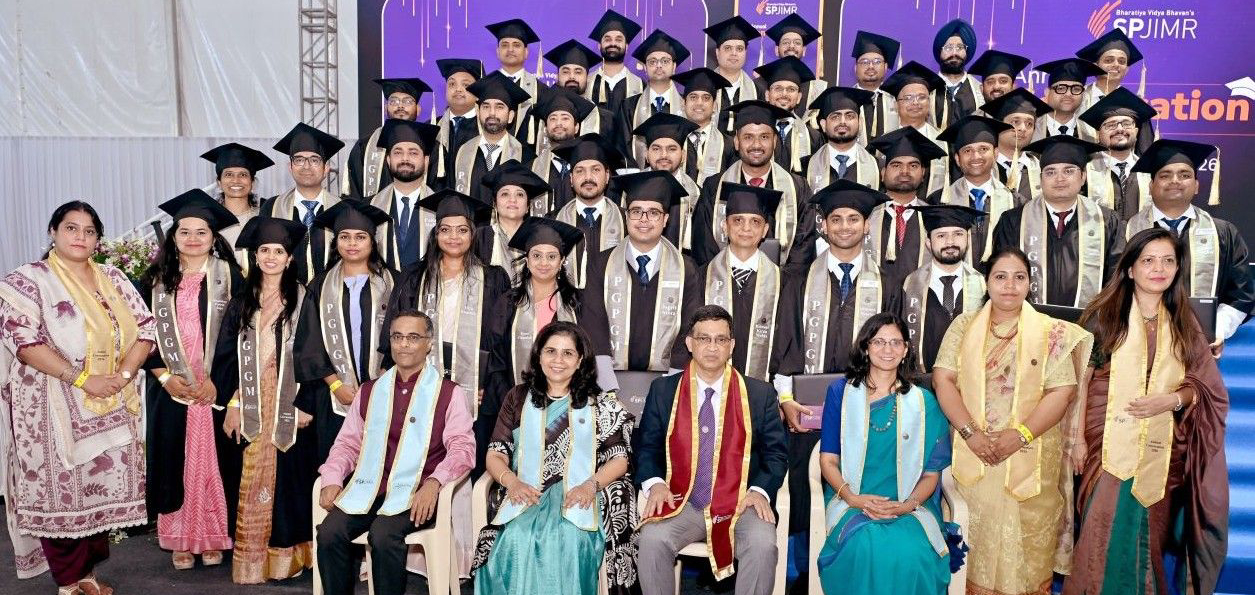
To prepare participants for today’s technology-driven business environment, AI-related decision-making is integrated across multiple courses, alongside specialised courses in Digital Transformation, Design Thinking, AI/ML, and AI-driven Digital Marketing. This equips participants to leverage technological disruptions, drive innovation, and make informed business decisions within their organisations.
The programme also helps participants strengthen strategic thinking, make informed decisions in uncertain business environments, foster innovation, lead organisational change, and develop an enterprise-wide perspective, all capabilities that are increasingly important as businesses navigate AI-driven transformation.
One of the important advantages of the programme structure is that participants continue working while learning. This allows professionals to apply classroom concepts directly within workplace contexts, helping create stronger connections between management education and real business challenges.
Shruti Puri, Manufacturing HR L&OD, Head, Havells India Limited, shares: “PGPGM (Executive) has been personally transformative, propelling my career with added responsibilities and promotions & helping me drive strategic goals”
The programme also creates opportunities for peer learning across industries and functions. Participants engage with professionals from varied organisational backgrounds, allowing them to gain exposure to different leadership experiences, business models, and approaches to problem-solving.

Mukul Arora, VP – Global Program Manager, JPMorgan Chase & Co, shares his experience with the programme: “The way we thought earlier and the way we think now has changed significantly. The Professors in the PGPGM (Executive) had a key role in shaping this. The way managerial concepts were linked to real life made it easy to understand and these have now become embedded in our minds.”
Its emphasis on experiential learning and application-oriented management education aligns closely with the growing need for adaptability in AI-driven business environments.
As organisations continue to evolve in the AI era, the PGPGM (Executive) at SPJIMR helps experienced professionals build leadership capability, strengthen strategic perspective, and develop future ready skills while continuing to work. Explore the programme and take the next step in your leadership journey.