



Perception recency trumps ideology
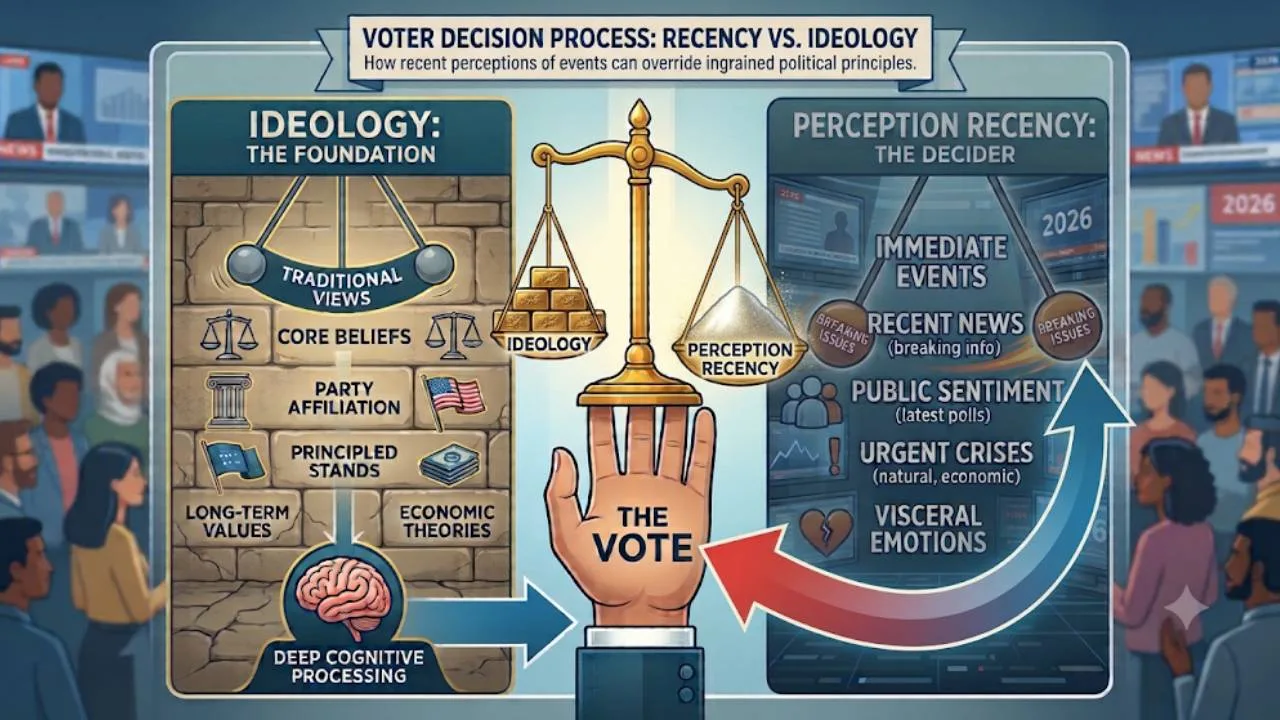
This month’s United States (US) mid-term election has an important takeaway. The political party that convincingly won the presidential election just two years ago was handed a humiliating result. There was an incredible pendulum swing in voter mood from 2024 to 2026. It is the first time in US history that the reigning party lost the majority in both chambers.
Two years ago, the Make America Great Again (MAGA) campaign was received with great enthusiasm. Campaign MAGA turned into a movement once President Trump took over in 2024. The immigration rhetoric, taxation reliefs to the working class, ‘America First’, economic protection, etc. were well connected to the masses. The president’s rhetoric on a progressive, most powerful America and his efforts in war mediation were admired.
However, over time the original enthusiasm gave way to disappointment and dissatisfaction. The ideological base of the modern Republican Party is around reduced taxes, advancing economic freedom, protecting workers and jobs. However, during the past few months the cost of living kept climbing, most visible in the rising gas prices at the pumps, giving daily reminders. The tightened immigration norms did not go well with some sections; add to it an offending statement about Asians, the main target being India and Indians.
In politics, the ideology of a party provides guiding principles to the direction, strategy and tactics of the party faithfuls. In some cases, political parties had to align with stronger leaders such as Gandhi, Mao and Lenin, who scripted their own way, influencing followers. At the country level, the personality and the beliefs of leaders are known to be shaping the country’s policies and party communications.
And then for the masses, the digression of party ideology from ground reality becomes visible. The voter who usually keeps quiet during the interim period reacts in the poll booth at election times. For voters, it is the recency of day-to-day living experiences that matters most. No wonder Indian parties offer freebies just before an election, promises galore. The common voter who generally keeps away from politics decides his choice based on the present situation. Past victories and gains are forgotten. A political party’s strategists need to realise that election strategy has to be distinct from the governing strategy of the country.
Perception recency wipes out past gains.
Election strategy must be formulated keeping in view ground reality.
About the faculty

Anil V. Vaidya
Prof. Anil Vaidya holds a Doctor of Business Administration from the University of Bradford, UK. His dissertation was in Information Systems and Technology Strategy. He has pursued his MBA from the University of Akron, Ohio, USA. He has more than 45 years of overall experience, with 35 years of industry engagement in senior IT management and leadership roles.
More from Anil V. Vaidya
Recent faculty blogs
Most read faculty blogs
-
Organisational responses to hybrid work—Rethinking culture and civility in India
Read more -
When Amazon arrived late to India’s quick commerce party
Read more -
The 2013 RBI FCNR(B) Swap Window – Review & Takeaways
Read more -
Reimagining travel through AI: Making every journey smarter and more personal
Read more -
Budget 2025: Unlocking opportunities for the private sector
Read more