



Part III – Kṛṣṇa is not cunning: The freedom to act without anything to gain
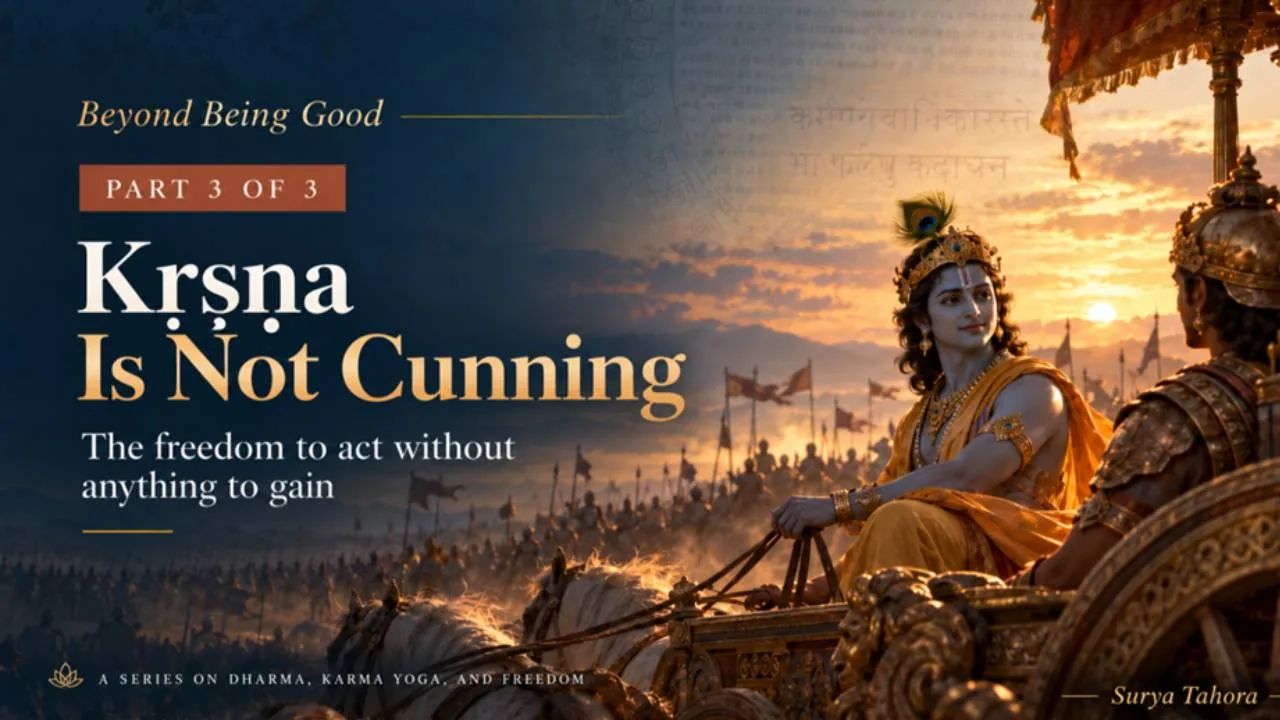
There is a serious accusation against Kṛṣṇa in the Mahābhārata, and it deserves to be taken seriously. Across the epic, particularly during the Kurukṣetra war, Kṛṣṇa repeatedly supports actions that appear to violate the very rules of honourable warfare. He advises Arjuna to confront Bhīṣma with Śikhaṇḍī placed before him, knowing that Bhīṣma will refuse to fight Śikhaṇḍī. He proposes the deception concerning Aśvatthāmā that leads Droṇa to lay down his weapons. He creates the appearance of sunset to expose Jayadratha. And he supports Bhīma’s decision to strike Duryodhana below the waist, in violation of the accepted rules of mace combat. These are not minor incidents. Nor can they be dismissed simply because Kṛṣṇa is on the side of the Pāṇḍavas. A sceptical reader might reasonably ask: what distinguishes Kṛṣṇa from a brilliant political strategist who is willing to bend the rules whenever it serves his purpose? Is this divine wisdom, or merely the ancient Indian equivalent of Machiavelli?
The question matters because it brings us to the deepest distinction in our four-stage framework. At the first stage, personal desire overrides dharma. At the second, a person consciously values dharma but struggles with its application and remains inwardly dependent on the results of action. At the third, karma yoga transforms that dependence and prepares the mind for self-knowledge. But what lies beyond this? What does action look like when it is no longer driven by the need to secure personal adequacy? To approach that question, we must first understand something about the Mahābhārata itself. The epic does not present dharma as a simple collection of rules that can be mechanically applied to every circumstance. Universal values matter, and their violation has consequences. Yet situations arise in which different obligations conflict, established conventions become instruments of injustice, and even conscientious individuals struggle to determine what is appropriate. This is the challenge of viśeṣa-dharma, the intelligent application of dharma in particular circumstances.
But the complexity of dharma does not mean that anything can be justified in its name. That would empty the concept of all meaning. Nor does being on the side of a just cause automatically make every action permissible. The Mahābhārata is too morally serious to offer such an easy escape. Its characters must confront difficult choices, and the consequences of those choices do not simply disappear because their intentions were admirable. This is the background against which Kṛṣṇa’s actions must be examined.
Before the war: the one who seeks peace
We tend to remember Kṛṣṇa as the strategist of Kurukṣetra. Yet one of his most revealing actions takes place before the war begins. He travels to Hastināpura as a messenger seeking peace between the Pāṇḍavas and the Kauravas. The dispute concerns a kingdom that has been taken through deception, followed by years of exile and humiliation. The Pāṇḍavas are entitled to seek the restoration of what is rightfully theirs. Yet the negotiations reach the point where even a settlement involving five villages would be acceptable. Duryodhana refuses to concede even that much, insisting that he will not yield land sufficient to accommodate the point of a needle. Consider what this reveals about the two sides. For Duryodhana, possession has become inseparable from identity. Conceding even a little is experienced as defeat. He cannot distinguish his personal need to prevail from what the situation requires. Kṛṣṇa, by contrast, seeks a peaceful settlement rather than insisting upon the complete restoration of the Pāṇḍavas’ claims. The concern is not personal vindication, but the possibility of resolving the conflict without the destruction of countless lives. The peace mission fails, but its failure is significant. Kṛṣṇa does not rush towards war merely because he has the intelligence to win it. He first makes a serious effort to prevent it. The capacity to prevail is not the same as the desire to dominate.
There is another revealing episode. When Arjuna and Duryodhana approach Kṛṣṇa for support, he offers them a choice. One side may have his formidable army; the other may have Kṛṣṇa himself, unarmed and committed not to fight. Duryodhana chooses the army, delighted to acquire the greater military advantage. Arjuna chooses Kṛṣṇa, who becomes his charioteer. The contrast is striking. Duryodhana evaluates the situation in terms of resources, power, and the probability of victory. Arjuna chooses the presence and guidance of Kṛṣṇa. More importantly for our argument, Kṛṣṇa accepts the position of a charioteer, a role of service rather than command, although he possesses the power and intelligence to direct the entire enterprise. Here is a form of leadership that conventional notions of authority can easily overlook. Kṛṣṇa does not need the highest visible position in order to exercise the greatest influence. He can guide without seeking the throne, serve without diminishing himself, and participate fully without needing recognition as the central actor. These episodes do not resolve every ethical question raised by his later conduct. But they establish something important about Kṛṣṇa’s involvement. His actions cannot be adequately understood as the pursuit of personal power, recognition, or possession.
Bhīṣma: when loyalty becomes complicity
Consider Bhīṣma, one of the most revered figures of the Mahābhārata. His life is marked by extraordinary sacrifice, commitment to his vows, and dedication to the Kuru dynasty. Yet this very commitment becomes part of his predicament. Despite recognising the moral failures of Duryodhana, he remains bound to the Kaurava throne and eventually leads its army against the Pāṇḍavas. Bhīṣma is a powerful illustration of a difficult ethical problem: can fidelity to a particular obligation become a failure to recognise a larger responsibility? His vow and loyalty are not trivial matters. They are expressions of values that deserve respect. But loyalty is not an absolute value detached from the circumstances in which it operates. When allegiance to an institution requires the protection of injustice, the very virtue of loyalty can become entangled with adharma. During the war, Bhīṣma proves almost impossible to defeat. Kṛṣṇa therefore guides Arjuna towards a strategy involving Śikhaṇḍī, against whom Bhīṣma has resolved not to fight. Arjuna can then bring down the great warrior. Bhīṣma himself is aware of the circumstances that make this possible.
To the conventional observer, the tactic appears to exploit an opponent’s vulnerability. And it does. But the ethical question is not exhausted by that observation. Bhīṣma’s continued participation sustains an unjust cause, and his individual commitments cannot be considered independently of the larger consequences of that participation. There is a lesson here that extends well beyond the battlefield. A leader may be impeccably loyal to an organisation, faithful to established procedures, and personally honourable, while contributing to decisions that are deeply harmful. We see this when executives defend questionable practices by appealing to institutional obligations, contractual commitments, or the familiar claim that they are merely doing their duty. Dharma cannot be reduced to the faithful performance of one’s assigned role. It requires the intelligence to examine whether that role, in the circumstances, continues to serve what is right. Yet this does not mean that Kṛṣṇa is teaching us to disregard rules whenever they become inconvenient. The lesson is more demanding: no individual rule, vow, or institutional commitment can substitute for the discernment required by dharma.
Droṇa: when the right cause does not make the choice easy
The death of Droṇa presents an even more troubling case, and here we should resist the temptation to make Kṛṣṇa’s actions appear uncontroversial. Droṇa is the teacher of the Pāṇḍavas and the Kauravas, a formidable warrior whose continued assault threatens to destroy the Pāṇḍava army. The narrative describes his devastating use of weapons against soldiers unable to withstand them. Kṛṣṇa recognises that he cannot easily be defeated while he continues fighting. A plan is therefore devised to make him believe that his beloved son Aśvatthāmā has been killed. Bhīma kills an elephant bearing the same name. When Droṇa seeks confirmation from Yudhiṣṭhira, whose commitment to truthfulness is legendary, Yudhiṣṭhira declares that Aśvatthāmā is dead, adding an indistinct qualification that it was the elephant. Droṇa, overwhelmed by grief, lays down his weapons and is subsequently killed by Dhṛṣṭadyumna.
What are we to make of this? One interpretation emphasises the urgent need to stop a warrior whose actions have become destructive and who cannot otherwise be defeated. Another points to the deliberate deception of a teacher and the killing of a man who has laid down his weapons. Both considerations belong to the ethical difficulty of the episode. The epic itself refuses to erase the tension. In the traditional account, Yudhiṣṭhira’s chariot, which had previously remained slightly above the ground, descends to earth following his misleading declaration. Whatever the symbolism, the narrative does not allow us to conclude that the action was ethically uncomplicated. Dharma cannot always be determined by isolating one value from the total situation. Truthfulness is fundamental, but so is the protection of life. Preventing widespread destruction may require choices that are deeply troubling. Yet recognising the complexity of such a situation does not make deception an ordinary instrument of convenience.
The Mahābhārata asks us to confront this difficulty rather than escape it through a slogan. It does not give us permission to abandon ethical principles in pursuit of desirable outcomes. It reminds us that the application of dharma requires sensitivity to circumstances, consequences, and competing obligations, together with freedom from the personal interests that so readily corrupt our judgment. And that last qualification matters enormously. There is a profound difference between someone who bends a rule to preserve a personal advantage and someone who must confront a genuine conflict of duties without being motivated by private gain. But the absence of selfish motivation alone does not make an action right. Discernment of dharma remains indispensable.
Jayadratha and Duryodhana: when strategy meets dharma
The episode of Jayadratha brings another dimension into view. During the war, Abhimanyu, Arjuna’s young son, is trapped within the Kaurava formation and killed after being attacked by several warriors. Jayadratha has played a crucial role in preventing the other Pāṇḍavas from coming to his rescue. Arjuna subsequently vows to kill Jayadratha before sunset the following day or enter the fire himself. The Kauravas respond by protecting Jayadratha and delaying Arjuna until the appointed time. In a well-known account, Kṛṣṇa creates the appearance that the sun has set. Believing the danger has passed, Jayadratha becomes exposed, and Arjuna kills him before the actual sunset. The episode is often told as a brilliant example of tactical deception. But it also reveals the difficulty of separating strategy from the ethical circumstances within which strategy is employed. Jayadratha has helped make possible the unjust killing of a young warrior. The Kauravas now seek to exploit Arjuna’s vow to bring about another death. Kṛṣṇa intervenes to prevent that outcome.
Still, the fact that a strategy serves a just cause does not eliminate the need to evaluate the means employed. The important point is not that every deception becomes legitimate when undertaken by the right side. It is that ethical judgment cannot be reduced to the mechanical application of one rule without consideration of the larger situation. The final encounter between Bhīma and Duryodhana is still more controversial. Duryodhana is an exceptional mace fighter, and Bhīma struggles to overcome him in a fair contest. Kṛṣṇa supports the strategy of striking Duryodhana on the thighs, recalling Bhīma’s earlier vow after Duryodhana’s humiliation of Draupadī. The blow violates the accepted conventions of mace combat, and the objection is explicitly raised within the epic itself. Duryodhana is not an innocent victim. His refusal to restore what belonged to the Pāṇḍavas, his complicity in the humiliation of Draupadī, and his repeated acts of injustice have helped bring about the war. Yet those facts do not make the violation of the combat rule disappear.
What emerges from these episodes is not a convenient principle that the good may do whatever is necessary to defeat the bad. It is something far less comfortable: dharma operates in a world where choices are consequential, obligations may conflict, and action sometimes takes place under conditions already deeply compromised by adharma. The Mahābhārata is not a manual for winning at any cost. It is an inquiry into the difficulty of acting rightly in a world that refuses to present us with morally tidy alternatives.
The deeper question: what does Kṛṣṇa stand to gain?
But even after examining the circumstances of these episodes, a fundamental question remains. What distinguishes Kṛṣṇa’s participation from the ambition of an exceptionally gifted strategist? To understand this, we must turn from the question of particular actions to the nature of the one who acts. Consider again Kṛṣṇa’s conduct. He does not claim the throne after defeating Kaṃsa; Ugrasena is restored to kingship. When he releases the kings imprisoned by Jarāsandha, he does not seek to absorb their kingdoms into an empire of his own. When the Kurukṣetra war ends, he does not demand the kingdom of Hastināpura as the price of his indispensable contribution to victory. Nor does he seek the position of ruler over the Pāṇḍavas. These episodes are significant not because the absence of personal gain automatically proves that every action was ethically appropriate. It does not. Their significance is that they reveal a consistent absence of the need to establish personal adequacy through possession, status, or achievement.
Here lies an important contrast with the ordinary ambitious person. We undertake actions to accomplish goals, obtain security, gain recognition, or improve our circumstances. None of this is necessarily inappropriate. But underlying much of our activity is the assumption that the next achievement will somehow make us more complete. We may act ethically, generously, even selflessly in certain situations, while still depending on the results of our actions for a sense of personal worth. Kṛṣṇa’s conduct invites us to consider an entirely different possibility: what if one could act with complete intelligence, commitment, and effectiveness, without seeking anything through action for one’s own completeness? The Bhagavad Gītā gives us a remarkable answer, and it does so in two closely related passages in Chapter 3.
The jñānī and Kṛṣṇa: nothing to gain, yet action continues
In Gītā 3.17, Kṛṣṇa describes the person who has discovered satisfaction in the self: yas tv ātma-ratir eva syād ātma-tṛptaś ca mānavaḥ ātmany eva ca santuṣṭas tasya kāryaṃ na vidyate “The person who delights in the self, is satisfied in the self, and is content with the self alone has nothing that remains to be accomplished for personal fulfilment.”
The next verse, 3.18, makes the point even more explicit: naiva tasya kṛtenārtho nākṛteneha kaścana. “For such a person, nothing is to be gained through performing an action, nor is anything lost through not performing it.” The verse goes on to indicate that the person is no longer dependent upon anything in the world for the fulfilment of a personal purpose.
These verses describe the freedom of the jñānī, the person whose knowledge of the self has resolved the fundamental sense of incompleteness. The significance is easily missed. Kṛṣṇa is not describing someone who has achieved every possible worldly goal, accumulated sufficient wealth, or reached a stage of life where responsibilities have disappeared. The freedom described here does not arise from having acquired enough. It arises from the recognition that the self was never lacking in the first place. The jñānī may continue to participate in the world, make decisions, fulfil responsibilities, and respond to circumstances. But action is no longer necessary to establish a sense of personal completeness. There is nothing that must be acquired to make the self more than it already is.
Now consider what Kṛṣṇa says a few verses later, in 3.22: na me pārthāsti kartavyaṃ triṣu lokeṣu kiñcana nānavāptam avāptavyaṃ varta eva ca karmaṇi “O Pārtha, there is nothing whatsoever that I have to accomplish in the three worlds. There is nothing unattained that I need to attain, and yet I continue to engage in action.”
The correspondence is striking. In 3.17–18, Kṛṣṇa describes the freedom of the jñānī: nothing remains to be gained through action. In 3.22, Kṛṣṇa declares precisely this freedom with reference to himself, while emphasising that he continues to act. The one who has nothing to gain is not necessarily the one who has stopped acting. He may be the one who is most fully available for action.
This is a profound reversal of our usual assumptions. We tend to think that activity is driven by the need to obtain something, and that freedom would therefore consist in no longer having to act. But the Gītā distinguishes freedom from the cessation of activity. The issue is not whether action continues, but whether it arises from the need to overcome a sense of personal limitation. In this sense, Kṛṣṇa’s human presence in the Mahābhārata is especially meaningful. He is not presented to us merely through abstract philosophical statements. We encounter him in recognisable human situations: as a friend, counsellor, diplomat, charioteer, and participant in the most difficult ethical and political conflicts. He negotiates, persuades, serves, makes decisions, and acts with extraordinary intelligence. Yet he does not need these actions to establish his own worth, security, or completeness.
Kṛṣṇa’s actions are extraordinary, but the freedom they illuminate is not beyond the reach of human understanding. It is precisely the freedom that the Gītā teaches us to discover as our own nature. This is why Kṛṣṇa is not simply the most accomplished strategist in the Mahābhārata. The defining feature of his action is not cleverness, nor even effectiveness. It is the absence of personal incompleteness as its motivating force. He has nothing to gain for himself, yet remains fully engaged in the world. And this brings us to the final distinction in our four-stage framework.
Beyond the doer: what actually changes with knowledge?
The karma-yogī is still a person who understands himself as an individual doer, one who deliberates, chooses, acts, and receives results. Through Īśvara-arpaṇa-buddhi and prasāda-buddhi, the relationship with action becomes more mature. The hold of personal preferences weakens, emotional dependence on outcomes diminishes, and the mind becomes prepared for self-inquiry. But the fundamental identification remains: “I am this individual who acts, achieves, succeeds, and fails.” Self-knowledge addresses precisely this identification. Advaita Vedānta distinguishes between the individual functioning as a doer within the empirical order and the essential nature of the self, which is consciousness, free from action and limitation. The self is not an agent that becomes increasingly sophisticated until it finally stops acting. Rather, the individual recognises that the sense of being a limited doer belongs to the body-mind complex and not to the essential nature of the self.
The Gītā expresses this insight in 5.8–9, where the knower of truth understands, naiva kiñcit karomīti — “I do nothing at all” — even while seeing, hearing, touching, walking, speaking, and engaging in other activities. The point is not that the body and mind have become inactive. Actions continue within the order of the world. What has been resolved is the mistaken identification of the self with the individual agent. This is the meaning of akartṛtva, freedom from doership. It is not a psychological state in which the person feels less responsible, nor a licence to disregard the consequences of action. It is knowledge of the nature of the self. And because this knowledge resolves the fundamental sense of incompleteness, the wise person no longer needs action to establish personal adequacy. The body and mind may continue to act, responsibilities may continue to be fulfilled, and circumstances may still require difficult decisions. But action is no longer undertaken to resolve an imagined deficiency in the self.
Here we can understand why the teaching of Gītā 3.17–18 and Kṛṣṇa’s declaration in 3.22 belong together. Both reveal a freedom that is independent of achievement, possession, and the performance of action. This freedom does not make action impossible or meaningless. Rather, it removes the need to seek personal completeness through what action produces. The doer does not become perfect and thereby become free. Freedom is recognising that the essential self was never the doer in the first place.
Why Kohlberg’s ladder cannot take us all the way
We can now see why the Vedāntic framework cannot simply be placed above Kohlberg’s stages as though it were a more advanced version of the same theory. Kohlberg is concerned with how moral reasoning develops. His framework provides an account of the movement from reasoning based on punishment and reward, through social conformity and the maintenance of social order, towards reasoning grounded in more universal ethical principles. This is a valuable contribution to understanding moral development. Vedānta does not deny the significance of this progression. Indeed, the movement from behaviour governed by immediate personal preferences to a conscious commitment to dharma represents a genuine form of maturity. Karma yoga itself presupposes the importance of dharma. One cannot claim to offer action to Īśvara while knowingly disregarding what is right.
But the Vedāntic inquiry goes further by asking questions that Kohlberg’s model was not designed to answer. Does acting ethically free the person from dependence on results? Does moral maturity resolve the sense of personal inadequacy? And can increasingly refined moral agency, by itself, remove the fundamental identification with being a limited doer? The answer to all three is no. This is not a failure of Kohlberg’s theory. It is a recognition of its scope. A framework designed to explain the development of moral reasoning cannot be expected to explain liberation from self-ignorance. The two inquiries address different dimensions of the human condition.
Here the distinctive contribution of Vedānta becomes clear. Three ideas are central to its account of human growth. The first is Īśvara, understood not merely as an external authority issuing commandments, but as the intelligent order within which the universe, human action, ethical values, and the results of action have their place. Dharma is therefore not simply a set of social conventions or personally chosen principles. It reflects an order that we are called upon to understand and honour. The second is karma yoga, which transforms our relationship with action and its results. Its purpose is not merely to produce more ethically sophisticated individuals, but to cultivate the maturity and clarity necessary for self-knowledge. The third is mokṣa, freedom from the fundamental ignorance that makes the individual take himself to be limited, inadequate, and bound by action. This is not the perfection of the individual agent. It is the recognition that the essential self is already free.
These three ideas do not render Western accounts of morality irrelevant. They allow us to appreciate the value of such accounts while recognising that Vedānta is pursuing a different and more fundamental question. We are no longer asking only how to become a good person. We are asking why even a good person continues to experience bondage, and what kind of knowledge resolves it.
Four stages, four relationships with dharma
We can now return to the four stages with which this essay began. At the first stage, dharma is repeatedly overridden by personal likes and dislikes. The individual acts primarily according to immediate preferences, with little willingness to consider what is right when it conflicts with personal interest. At the second stage, dharma becomes a conscious commitment. The person seeks to act ethically, but struggles with its application in complex situations and remains inwardly dependent on the outcomes of action. This is already a significant achievement, but moral goodness has not removed insecurity or the sense of limitation. At the third stage, karma yoga transforms the relationship with action. Responsibilities are fulfilled as an offering to Īśvara, and results are received with prasāda-buddhi. The mind becomes less governed by rāga-dveṣa, more capable of ethical discernment, and increasingly prepared for self-knowledge. At the fourth stage, self-knowledge resolves the fundamental identification with the limited doer. Dharma is not abandoned, and ethical responsibility does not become irrelevant. Rather, action continues without the need to establish personal completeness through what is done or obtained.
The first three stages concern the growing maturity of the individual who acts. The fourth is of a different order. It does not merely improve the individual. It removes the fundamental error about the nature of the self. And here we can finally appreciate why Kṛṣṇa occupies such a distinctive place in the Mahābhārata. His conduct cannot be reduced to the cleverness of a political strategist, nor explained simply by the pursuit of victory. He acts with extraordinary intelligence, sometimes in situations of profound ethical complexity, but without the personal insecurity, ambition, or need for recognition that so often govern human action. His presence in the epic gives us a powerful illustration of something the Gītā teaches explicitly: complete engagement in action need not arise from a sense of personal incompleteness.
For us, the journey begins more modestly. We learn to recognise dharma, to act in keeping with it, to receive results with maturity, and to prepare the mind for the knowledge that reveals freedom as our very nature. The culmination of the journey is not a human being who has finally become good enough to deserve freedom. It is the recognition that freedom was never something to be produced through action, however noble. Being good is indispensable. But being free is knowing that one’s essential nature was never inadequate to begin with.
And perhaps that is the most unsettling insight of the entire Gītā: the problem was never simply that we were not good enough. It was that we were trying to become complete through what we did, without recognising that the completeness we sought was already the truth of who we are.
Recent faculty blogs
Most read faculty blogs
-
Organisational responses to hybrid work—Rethinking culture and civility in India
Read more -
When Amazon arrived late to India’s quick commerce party
Read more -
The 2013 RBI FCNR(B) Swap Window – Review & Takeaways
Read more -
Reimagining travel through AI: Making every journey smarter and more personal
Read more -
Budget 2025: Unlocking opportunities for the private sector
Read more