



The demands on senior leaders have changed. Leading a function successfully is no longer enough when decisions increasingly cut across technology, people, markets, and the wider organisation. AI is reshaping how businesses operate, while uncertainty originating from the external environment is making strategic judgement more important.
For experienced leaders, the question is therefore not whether they need more management knowledge. It is whether they have the perspective and capabilities to lead at the next level.
A well-designed Senior Leadership Programme should address that question. It should help experienced leaders step back from day-to-day responsibilities, examine how they lead, sharpen strategic thinking and prepare for broader organisational responsibility.
The Senior Leadership Programme (SLP) at S.P. Jain Institute of Management & Research (SPJIMR) is designed around this stage of leadership, with four integrated pillars covering leadership, strategy, AI and innovation, and change. SLP Programme Director Prof. Varun Nagaraj, Dean, SPJIMR, explains:
“Leadership module focussing on contemporary leadership frameworks, Strategy module focussing on decision-making under uncertainty, Innovation module focussing on structured process of innovation and Change Management module focussing on personal and organisational change.”
Why experienced leaders still need structured development
Historically, domain-focused experience is greatly valued by organisations, because it is assumed to create perspectives and capability to lead better in the future. However, this causality may not be effective in a constantly evolving, VUCA-style business environment.
The move from heading a domain to leading a business brings a different set of demands. Leaders need to anticipate market shifts, make high-stakes decisions amid uncertainty, work across functions, and lead organisation-wide transformation.
This is where structured executive education can add value. Rather than revisit the fundamentals of management, a Senior Leadership Programme can provide a setting to examine complex leadership questions with faculty and peers who bring substantial experience of their own.
Who is the Senior Leadership Programme (SLP) for?
SPJIMR’s SLP is aimed at leaders who are already leading teams or businesses within their organisations and are preparing for broader organisational responsibilities. The programme is designed for professionals with 15+ years of work experience who are targeting C-suite, top leadership, or board-level roles.
The programme is particularly relevant to leaders who want to drive strategic transformation across the organisation as the next challenge in their careers.
Four areas senior leaders need to develop
Leadership and self-awareness
At a strategic level, leadership extends beyond managing individual teams. Leaders need to understand their own leadership style, equip themselves with alternate leadership styles suited to different situations and build the gravitas to influence others and inspire diverse teams at scale.
The SLP’s leadership pillar focuses on contemporary leadership frameworks, self-awareness, and leadership style. It is led by Vidyut Lata Dhir, Professor, Organisation and Leadership Studies, SPJIMR.

Strategic decision-making
Senior leaders rarely have complete information when making consequential decisions. A leadership programme needs to help them work with uncertainty rather than assume it can be overcome.
The SLP’s strategy pillar focuses on strategic thinking under uncertainty, anticipating market shifts and making high-stakes decisions with clarity. Malay Krishna, Professor of Strategy at SPJIMR, leads the strategy module.
Innovating with AI
Dealing with AI has become more of a leadership question than a technology question. Senior leaders need to understand where emerging technologies can affect products, processes and business models, and how those possibilities translate into business decisions.
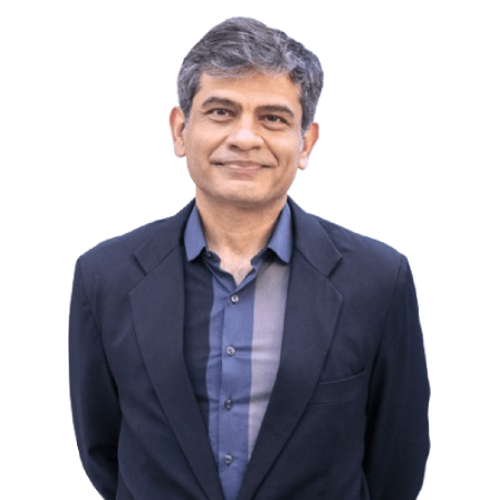
The SLP approaches AI and emerging technology from a practical perspective, with its innovation pillar focused on using these technologies to reimagine products, processes and business models. The module is led by Prof. Varun Nagaraj, Dean, SPJIMR, Professor of Information Management and Analytics, and SLP Programme Director.
Leading change
Organisations are facing change internally – as business models change to respond to technology and AI; and externally – as the business environment continues to pose unseen risks. Managing and leading such change requires capabilities different from managing structured established businesses. Senior leaders may need to realign systems and reconfigure teams while maintaining business performance.
The SLP’s change management pillar focuses on leading organisation-wide change and is led by Dr. Snehal Shah, Professor and Department Chair, Organisation and Leadership Studies, SPJIMR.
Together, these four areas reflect the broader shift in senior leadership: from managing a domain to shaping the organisation.
Personalised Leadership Development Plan and Organisational Possibilities Plan
Whereas open programmes benefit from cross-organisational peer learning, they may lack the participant-level customised impact assessment. SLP overcomes this by adding two unique participant-level interventions – Leadership Development Plan (LDP) and Organisational Possibilities Plan (OPP)
LDP is a personalised leadership blueprint that each senior leader participant develops through the programme. It consists of the self-leadership analysis and understanding of various leadership styles and how to incorporate agility in one’s leadership style to suit situational challenges
OPP is a blueprint that each senior leader participant works on, focusing on how the strategic impact of their current or potential domain/business vertical can be expanded.
Having worked on LDP and OPP at a personalised level, each senior leader participant obtains unique actionable insights into not only their own leadership effectiveness but also organisational impact they can create in their roles.
How should senior leaders learn?
In any leadership intervention, the channels of intervention and engagement matter as much as the programme content. Senior executives bring years of experience into the classroom. They should have opportunities to test ideas against real situations, learn from peers and reflect on their own leadership and strategic decisions.
The SLP uses reflective and group exercises, case analysis, peer learning and networking, panel discussions and fireside chats with industry CXOs, and application learning. It also includes 1:1 coaching, giving participants an opportunity to connect broader leadership ideas with their own development.
This combination ensures that leaders’ learnings converge via different pedagogical tools, combining instructional pedagogy with experiential reflections and ‘outside-in’ perspectives from other industry leaders
Learning from faculty and industry leaders
Academic frameworks provide one perspective. Leaders who have navigated complex business situations provide another.
SLP combines SPJIMR faculty sessions with industry-leader masterclasses and executive networking dialogues. Its leadership insight masterclasses have featured leaders including Shiv Shivakumar, Operating Partner, Advent International; Anant Talaulicar, Executive-in-Residence, SPJIMR and ex-MD, Cummins India; Yogi Sriram, Senior Vice President – Corporate Human Resources, Larsen & Toubro Limited; and Gautam M. Mehra, Partner, PwC.
For senior participants, these interactions can add context to classroom learning and expose them to different approaches to leadership, strategy and organisational change.
A format that works alongside a leadership role
Senior leaders cannot always step away from their organisations for long periods. The SLP is structured as 10 days of learning spread across five months, a format designed to accommodate the demands of a senior leadership role.
What should you look for in a Senior Leadership Programme?
The programme itself is only one part of the decision. Leaders comparing executive leadership programmes should consider whether they offer:
A focus on enterprise-level leadership rather than only functional management.
Strategic decision-making for uncertain business environments.
Practical engagement with AI and emerging technology.
A meaningful approach to organisational change.
Peer learning with leaders at a comparable career stage.
Opportunities for individual reflection and coaching.
Exposure to both faculty and experienced business leaders.
A format that can work alongside professional responsibilities.
The right programme should address the leadership challenges a participant is preparing to take on, rather than simply add another credential to an already substantial career.
What comes after the programme?
For senior leaders, the value of executive education can extend beyond the classroom. The SLP offers one-on-one coaching/mentoring sessions with senior SPJIMR professors and executive alumni status, giving participants an ongoing connection with the SPJIMR community.
That complements the relationships built during the programme through peer learning, executive networking and interactions with faculty and industry leaders.
Choosing development for the next stage
Senior leaders already bring experience, expertise and a track record of decisions to the classroom. The purpose of a leadership programme at this stage is to build on that foundation.
The strongest programmes give experienced leaders room to question established approaches, broaden their perspective and prepare for responsibilities that extend beyond their current role.
SPJIMR’s Senior Leadership Programme brings that development around four areas — leadership, strategy, AI and innovation, and change — supported by peer learning, coaching, faculty expertise and industry perspectives.
For a leader preparing for the next stage of responsibility, that broader perspective may be the most useful outcome of all.
Learn more here.
Register your interest for this programme
Please fill in the following details