



Shaping changemakers through purpose and innovation
19 August 2026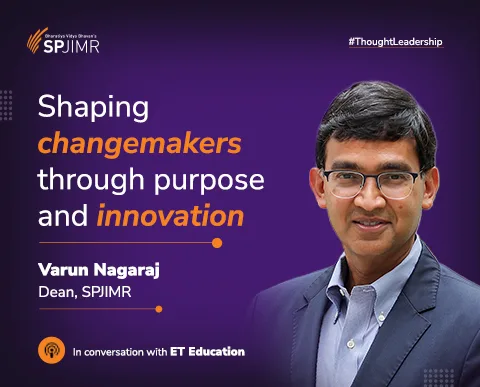
What does it take to prepare leaders for a world defined by rapid technological change, complex societal challenges and growing uncertainty? For Prof. Varun Nagaraj, Dean, SPJIMR, the answer lies in going beyond conventional management education.
In ‘How Education Leaders Think’, Dean Nagaraj speaks with Devina Lason, Editor, Video Initiatives and Senior Anchor, ET Education, about how purpose-driven education, experiential learning and innovation can shape a new generation of leaders who create impact beyond themselves.
“The future of leadership is not just about what you can achieve for yourself or your organisation. It is about what you can create for society,” believes Dean Nagaraj.
At the heart of the conversation is SPJIMR’s belief that management education must prepare students not only to navigate change, but also to actively shape it. This means developing leaders who can connect business decisions with their wider impact on people, communities and society.
Dean Nagaraj reflects on the institution’s focus on wise innovation, where innovation is not pursued for its own sake, but with a clear understanding of its purpose and consequences. He also discusses the importance of encouraging future leaders to think critically about the choices they make and the systems they help create.
The conversation also brings this philosophy to life through SPJIMR’s experiential approach to learning.
Manoj Mohan, Executive Director, WISE Tech, shares how students are encouraged to explore technology and innovation through the lens of real-world challenges and societal impact. The focus is on moving beyond technology as an end in itself and asking a more fundamental question: What problem are we trying to solve, and who does the solution serve?
A similar philosophy underpins the Maker Lab, a mandatory, hands-on experience for PGDM participants. Prof. Abhishek Kumar Jha explains how the course takes students from identifying a genuine user problem to designing and building a working prototype. Rather than beginning with technology, students begin with people, needs and context, learning to use emerging tools such as large language models, workflow automation and low-code development to address real organisational challenges.
Student participants share how these experiences have changed the way they approach problems, encouraging them to move beyond theoretical knowledge and develop the confidence to experiment, build and learn from failure.
Together, these perspectives highlight a central idea that runs through Dean Nagaraj’s vision for management education: the leaders of tomorrow must be equipped not just with the knowledge to succeed, but with the wisdom to use that knowledge responsibly.
As technology continues to transform industries and societies, the role of business schools is evolving too. The challenge is no longer simply to prepare students for the jobs of today, but to develop the judgement, curiosity and sense of purpose needed to navigate the unknown.
Through purpose-driven education, experiential learning and a commitment to wise innovation, SPJIMR continues to explore what it means to develop leaders who can create meaningful and lasting impact.