


SPJIMR’s Maker Lab
20 March 2026Beyond presentations. To prototypes.
SPJIMR’s Maker Lab
Where management students build real
AI-enabled solutions
Students work on live organisational challenges, engage with real stakeholders, build working prototypes using current AI tools, and test those prototypes with the people who need them. The final deliverable is never a slide deck. It is always something
that works.
What the Maker Lab is
The Maker Lab is a studio-format course in Term III of SPJIMR’s full-time management programme. It runs for 16 sessions and carries 2 credits. The course is taught by Prof. Abhishek Kumar Jha and Prof. Dhruven Zala.
The lab is not a coding course. Nor is it an elective for students with a technical background. It is a required experience for every PGDM student, built on the conviction that defining a real problem, designing a solution, and building a working prototype are core management skills, not specialist ones.
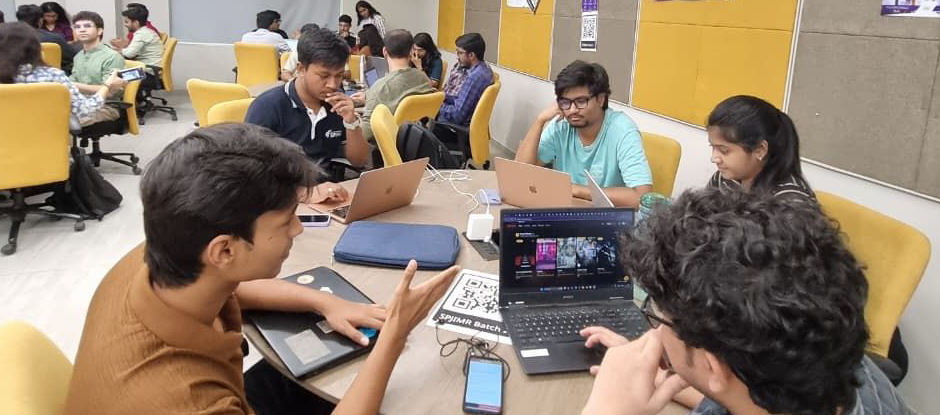
What distinguishes the Maker Lab from a typical technology or innovation course is the sequence. Students begin with the user and the problem, not the algorithm or the tool. They spend time with the people who will use what they build. They map genuine needs, understand where existing systems fall short, and define what a better outcome would look like. Only then do they begin building.
The course introduces students to large language models, retrieval-augmented generation, workflow automation, and low-code development, but always in service of a clearly understood problem. The result is prototypes grounded in genuine organisational needs rather than the novelty of the technology itself.
The lab operates on a single principle: a working prototype that addresses a real problem is worth more than a polished presentation that describes one.
What students actually learn
By the time students complete the Maker Lab, they have done something few MBA graduates have experienced. They have taken a complex organisational problem, broken it down into components a machine can help with, built a functional tool, and demonstrated it to the person facing the challenge.
The process develops capabilities that are difficult to learn in any other way.
The first and most transferable skill the lab builds is the ability to turn ambiguity into clarity. Students learn how to take a broken process, an undefined gap, or a persistent frustration and convert it into a well-specified problem. What is the input? What should happen to it? What does a successful output look like? How would failure be identified and measured?
This type of structured problem decomposition separates effective technology leaders from ineffective ones, genuine AI strategy from AI theatre, and useful digital transformation from expensive failure. Students practise these skills on real organisational challenges rather than case studies.
Every project begins with a stakeholder conversation. Students identify the person who experiences the problem they are trying to solve, whether a counsellor, registrar, factory manager, or NGO programme coordinator. They meet with that stakeholder to understand existing processes, identify pain points, and define what success looks like from the stakeholder’s perspective.
This is not a warm-up exercise. Students return to stakeholders throughout the project to validate their understanding, test prototypes, and refine solutions. Stakeholders are not a passive recipients of a solution. They are active participants in the design process.
Man students report that the most challenging and valuable lesson is learning to listen before building. The temptation to jump straight to a solution is strong, particularly when powerful technology is readily accessible. The lab deliberately creates friction around that impulse.
Students use many of the same tools employed by practitioners building AI-enabled products. These include large language models (LLMs) accessed through APIs, retrieval-augmented generation pipelines, workflow automation tools, and low-code platforms that enable rapid deployment.
They also learn to work within real-world constraints. Institutional data often cannot be shared directly. Students therefore create synthetic datasets and personas that replicate the statistical properties of the original data without exposing sensitive information. Many projects in the 2025–27 cohort were built to run entirely on-premise, with no external data transmission. This requirement came from stakeholders, not the course.
Experiencing a real constraint and redesigning a solution around it provides a form of learning that no case study can replicate.
One of the most neglected skills in AI product development is evaluation. Students learn how to define what a ‘good’ output looks like in a specific context and how to test against that standard systematically.
Each team designs evaluation criteria for its prototypes, establishes quality criteria, and logs failure modes. Students identify which prompts produce poor outputs, which data gaps cause hallucinations, and which workflow steps break under edge cases.
The result is a strong sense of accountability for AI outputs, a discipline that is rare even among experienced practitioners.
The final assessment is not a presentation about a prototype. It is a demonstration of a working prototype. Students show their systems in action using real inputs and outputs, often in the presence of stakeholders. They explain the design choices they made, the constraints they worked within, the failure modes they identified, and the improvements they would prioritise next.
The shift from describing a solution to demonstrating one changes both the quality of the feedback and the standards students set for themselves. It is the difference between proposing an answer and defending one.
What students built — Project domains
The 2025–27 PGDM cohort produced 20 live, deployed prototypes across two divisions. Every prototype addressed a real problem, was built with a named stakeholder, and was publicly demonstrated.
The projects span five broad domains.
and administration
and health
social impact
Campus operations and administration
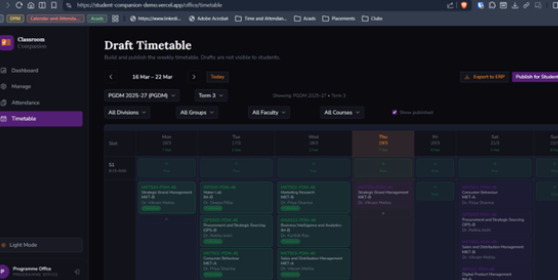
Six teams tackled operational challenges within SPJIMR. These were the everyday issues that institutions often live with but rarely examine systematically: fragmented timetable management, room-booking inefficiencies by email, underutilised ERP systems, and the administrative burden that accumulates across departments.
Two teams, one from each division, addressed the same underlying challenge from different perspectives.
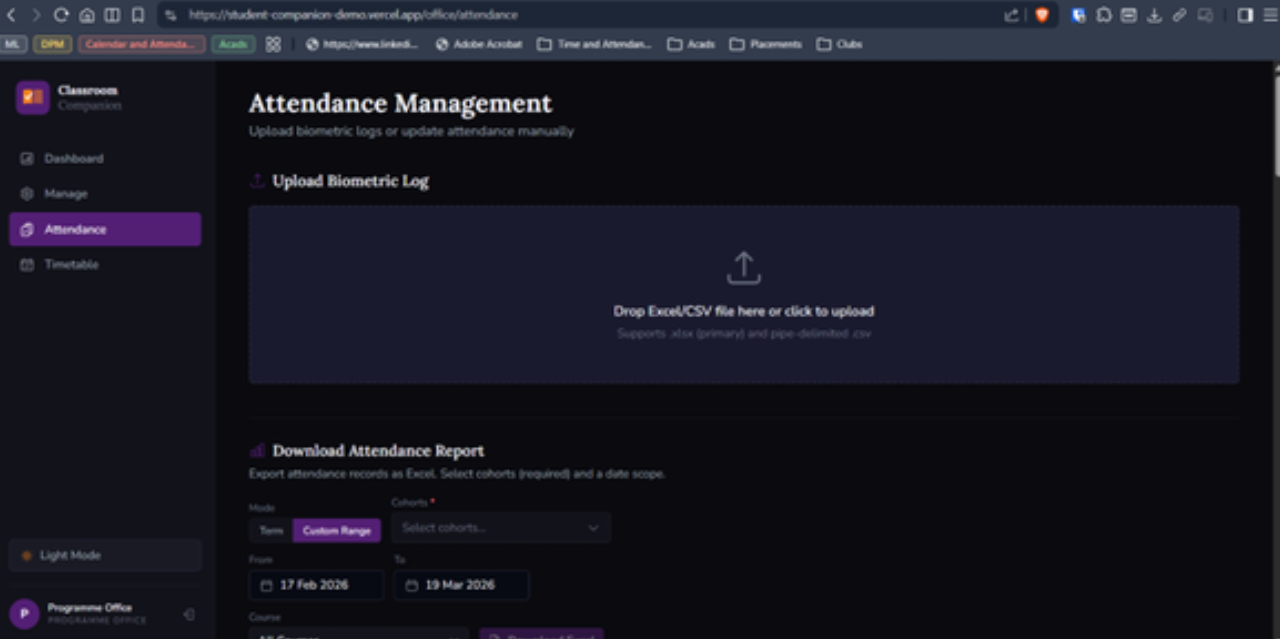
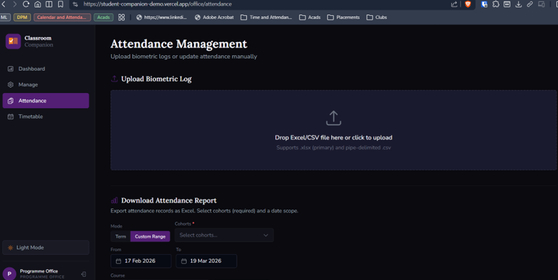
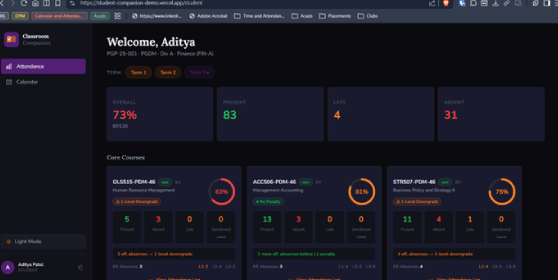
The PGDM office manages attendance through TCS ION, the institute’s ERP platform. However, biometric data often contains duplicate records that must be cleaned manually before attendance can be processed accurately. Faculty and students work on parallel spreadsheets, creating inefficiencies and inconsistencies.
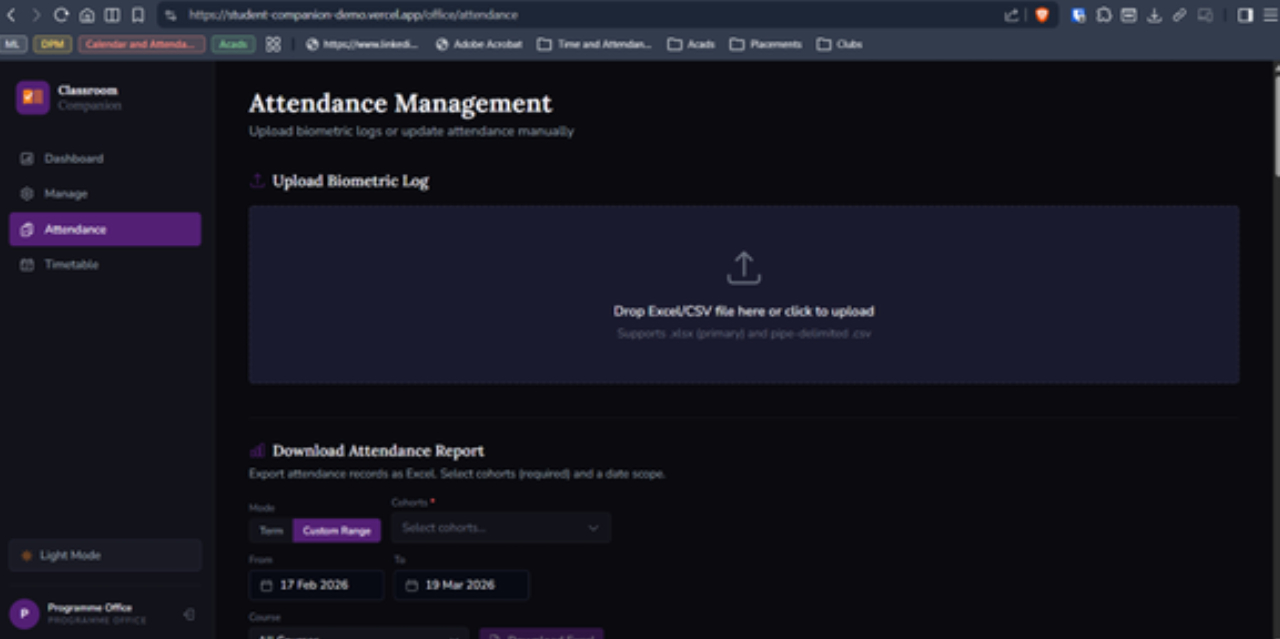
One team built an AI-powered chatbot integrated with TCS ION. The tool allows staff to run queries, remove duplicate attendance records, and update timetables using natural language commands rather than manual data entry.
The second team focused on automating attendance data cleaning and creating a unified student dashboard that displays accurate attendance records without requiring students to cross-check multiple systems.
Both teams worked closely with the PGDM office staff throughout the project, validating requirements, testing early versions, and refining their solutions based on user feedback.
A third team built a faculty-focused platform that provides a single interface for managing classroom activities. Faculty members can view attendance, generate teaching materials using AI, run basic sentiment analysis on student responses, and share content without navigating multiple systems.
A parallel team built a student-facing version that provides a simplified interface for attendance tracking and course-related information while drawing on existing ERP data.
The existence of two teams working on related challenges reflects an important principle of the Maker Lab. Rather than combining projects, students were encouraged to distinguish them through stakeholder needs. By identifying different primary users, they arrived at different priorities, features and design choices.
Room and facility bookings at SPJIMR were largely managed through email. The process created uncertainty for students, significant administrative effort, and no reliable audit trail for facility managers and security staff.
One team designed and built a centralised booking portal that supports conflict checking, approval workflows, automated notifications, security logs, and Google Calendar integration.
The system was developed in collaboration with the Registrar, Central Administration, faculty members and students, all of whom contributed to defining the minimum viable product (MVP).
Student well-being and health
Four teams focused on student wellbeing, an area where the gap between need and available support can be significant. These projects required students to engage with important ethical questions around privacy, escalation protocols, and responsible use of technology.
Two teams worked with the institute’s counsellor to address student mental health challenges. They identified a common problem. Campus counselling systems are reactive by design. Counsellors have limited visibility into student wellbeing trends, while students in distress often face barriers to seeking help. Informal channels, such as peer groups and messaging platforms, carry a significant emotional burden without adequate support infrastructure.
The first team built a system that uses AI-enabled micro-surveys to track student wellbeing. Smart triage logic identifies students who may require counselling support and directs them towards appropriate resources. A dashboard provides counsellors with visibility into wellbeing trends and workload patterns, enabling a more proactive approach.
The second team focused on streamlining counselling operations. Their solution replaced fragmented email and messaging-based threads with a dedicated platform for scheduling, resource management, and automated student engagement.
Both prototypes were reviewed by counsellors and student users before the final demonstration.
The teams also had to address complex ethical questions. Who should have access to personal data? Under what conditions should concerns be escalated? How can support systems be created without introducing new forms of surveillance?
These questions shaped the projects from the outset rather than being considered as an afterthought.
The campus medical facility ran almost entirely on informal communication. Students contacted the clinic through messages and calls, appointments were managed manually, and consultation records were maintained offline.
One team built a digital health management platform that supports appointment scheduling, queue management, and consultation record-keeping. The solution moves clinic operations from informal processes to structured and auditable workflows. It was developed in collaboration with the campus medical officer and tested across student, administrative and healthcare-user interfaces before the final demonstration.
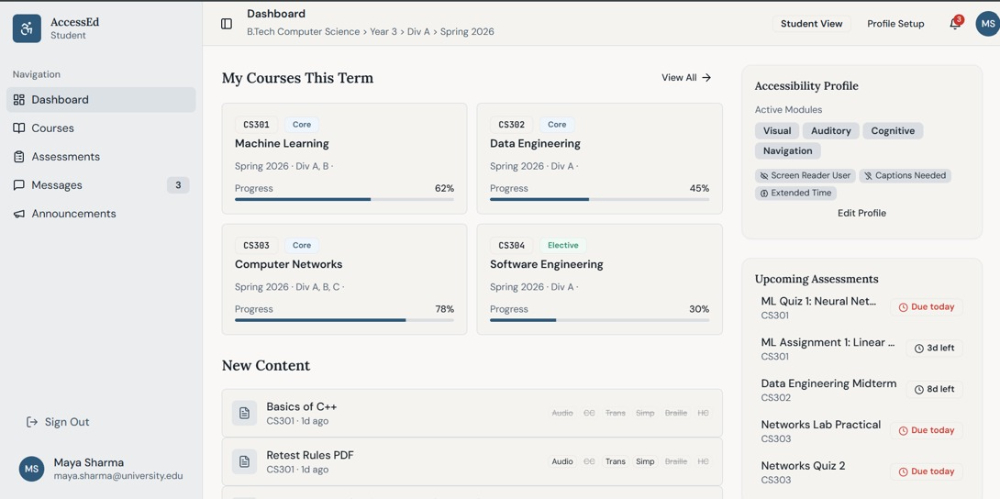
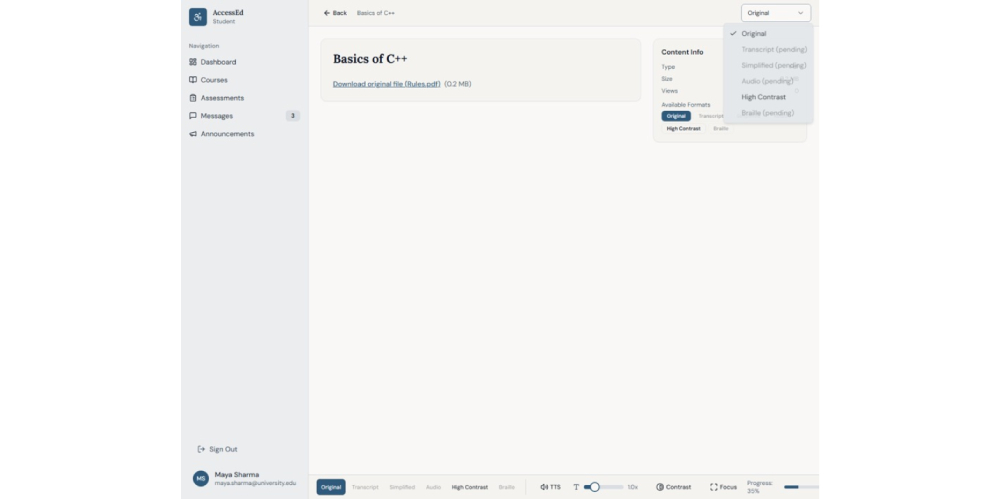
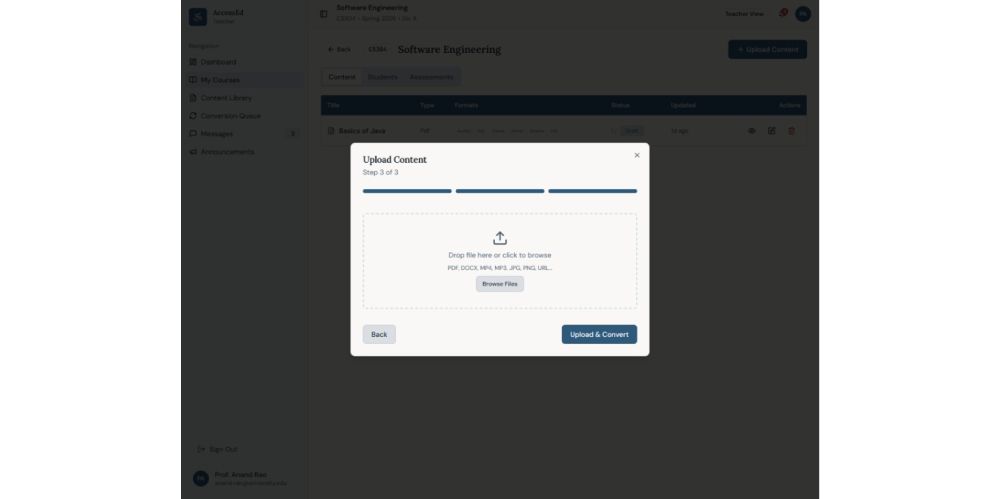
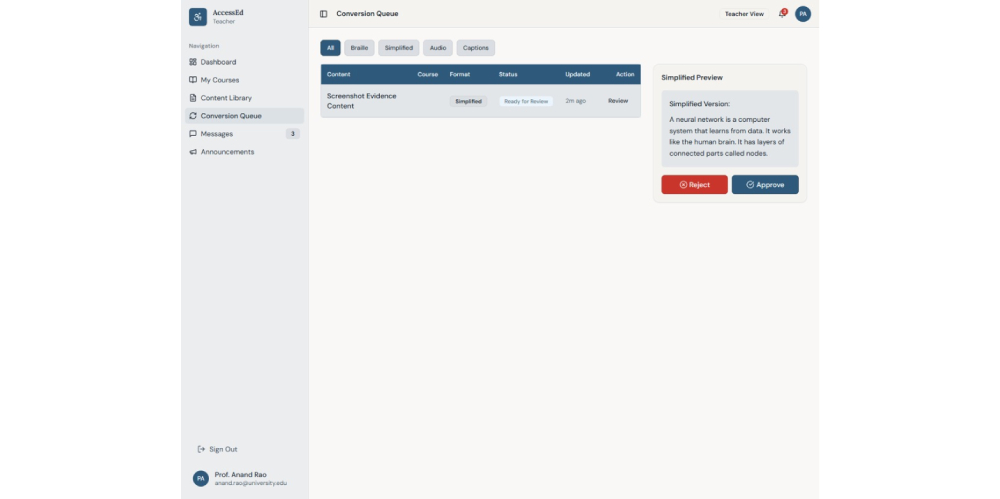
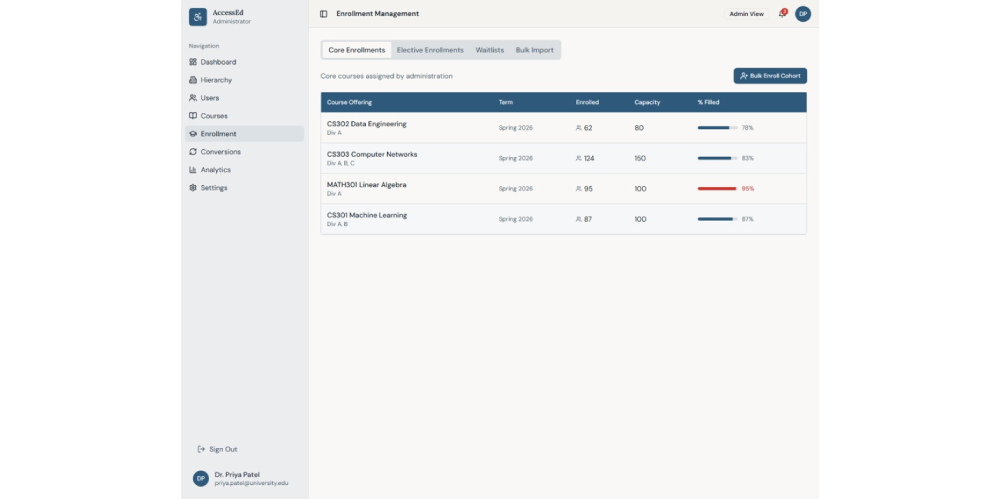
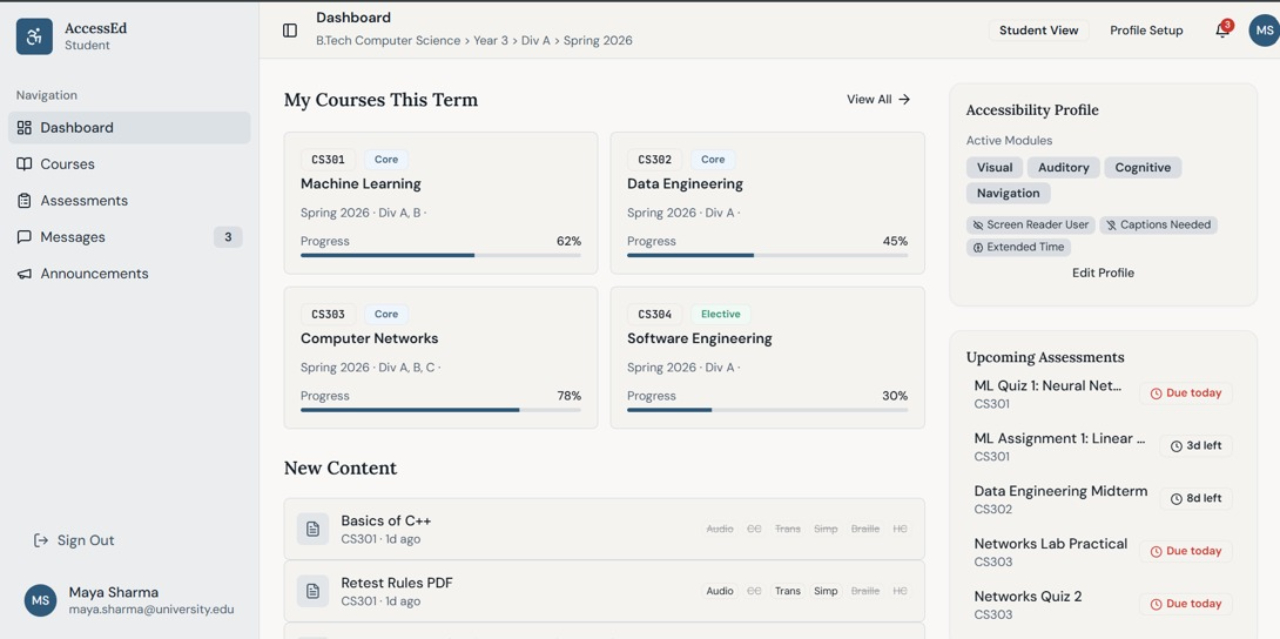
One of the cohort’s most ambitious projects addressed a challenge that remains underrepresented in educational technology. Most learning management systems (LMS) are not designed with accessibility as a primary consideration. Students who are visually challenged, hearing impaired, dyslexic, motor-impaired or managing ADHD often face barriers that require constant workarounds.
The team built an accessibility-first learning interface from the ground up. Students complete a single onboarding process that captures their accessibility requirements. The platform then automatically activates the appropriate tools whenever they log in. Content can be accessed through audio, simplified text and high-contrast formats. Students with motor impairments or dyslexia can navigate the platform using voice commands.
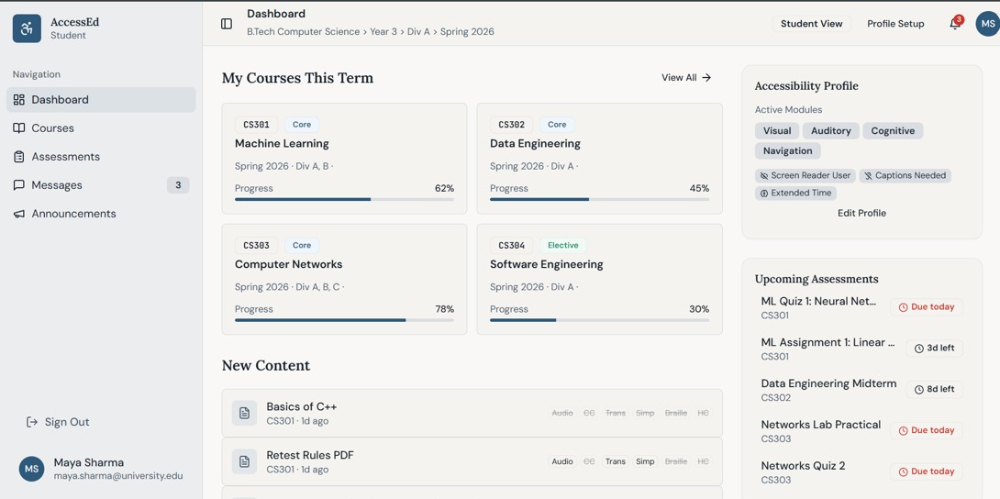
The team worked closed with SPJIMR’s Development of Corporate Citizenship and Sustainability Committee (DoSu) office and students throughout the design and testing process.
Hostel and campus living concerns, including maintenance requests, safety issues, and facility complaints, were often reported through WhatsApp messages or verbal conversations with wardens. As a result, issues could be difficult to track, accountability was limited, and little data existed to identify recurring patterns.
One team developed a structured issue-reporting and resolution platform. Students raise tickets through a web interface, wardens manage prioritised workflows, and every issue follows a documented resolution process.
The system was designed with Campus Living Committee (CLC) members and hostel wardens serving as primary stakeholders.
Learning, teaching, and knowledge management
Five teams worked on challenges within the learning environment itself. Their projects explored how students access and engage with content before class, how the institute’s library surfaces knowledge, and how communication skills can be developed beyond the formal curriculum.
SPJIMR uses WiseNet as its LMS. Two teams identified the same structural gap. While the platform is primarily a repository for course content and end-of-course feedback, it does little to support engagement before class or provide faculty with timely insights into student learning.
Both teams built AI-powered enhancement layers on top of the existing WiseNet infrastructure. Although their implementations differed, both solutions included pre-read summarisation, automated quizzes to test comprehension, and early feedback tools that help faculty understand student learning during a course rather than after it ends.
The teams worked closely with faculty, students, and the IT and ERP teams throughout the design and validation process.
Two teams tackled library services from different angles.
The first built a smart discovery interface for the library’s physical and digital catalogue. It provides not only search results and availability information but also AI-generated summaries, related recommendations and links to relevant academic resources.
The second team built a research-focused chatbot designed for postgraduate and doctoral students. Using natural language queries, researchers can explore related articles across disciplines, identify related literature across disciplines, and reduce the time spent on manual bibliographic search.
Both teams worked directly with library staff to understand user needs and validate their designs.
One of the most consistent gaps in management education is the lack of opportunities to practise impromptu communication. Students often prepare extensively for group discussions and structured presentations. However, responding clearly and confidently to unexpected questions in interviews, a boardrooms or client meetings requires repeated practise.
One team developed an AI-powered speaking coach that generates random prompts across different topics and difficulty levels. The platform records responses and delivers structured feedback on clarity, structure, pacing, and content. The system simulates real-world situations such as interviews, elevator pitches, and business conversation.
Developed in collaboration with Business Communication faculty, the system was tested with student users. One of the team’s key challenges was ensuring making that feedback was specific and actionable rather than generic and encouraging.
Sustainability and environmental accountability
One team addressed a challenge that sits at the intersection of institutional ambition and operational reality: the gap between sustainability commitments and the ability to measure, manage, and communicate progress effectively.
In many organisations, sustainability data lives in disconnected spreadsheets managed by different departments. Reporting is often retrospective, manual, and disconnected from day-to-day decision-making. Those responsible for generating waste or consuming resources rarely have visibility into their own performance.
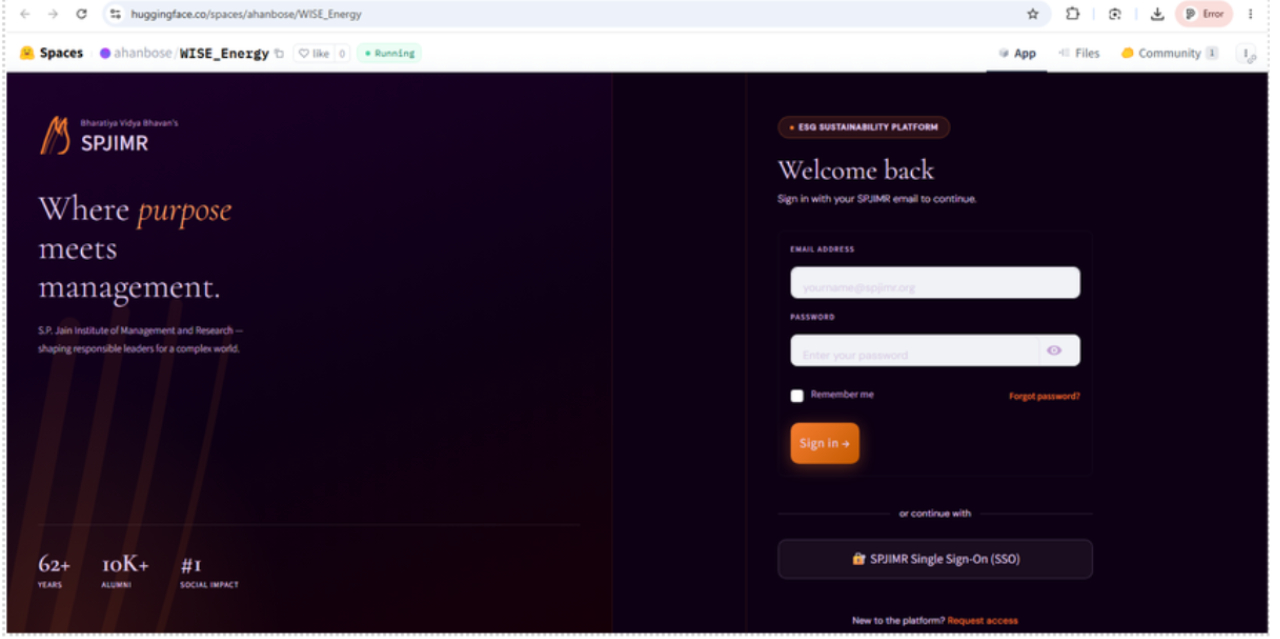
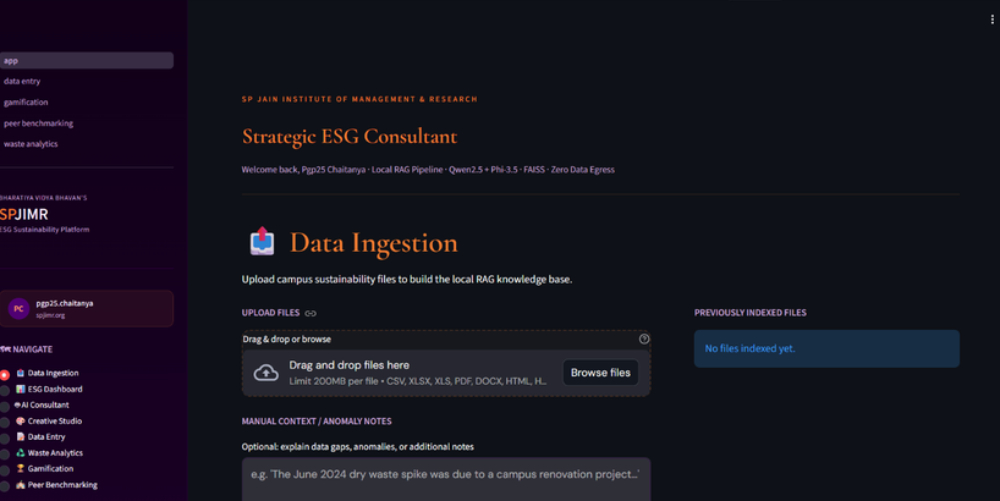
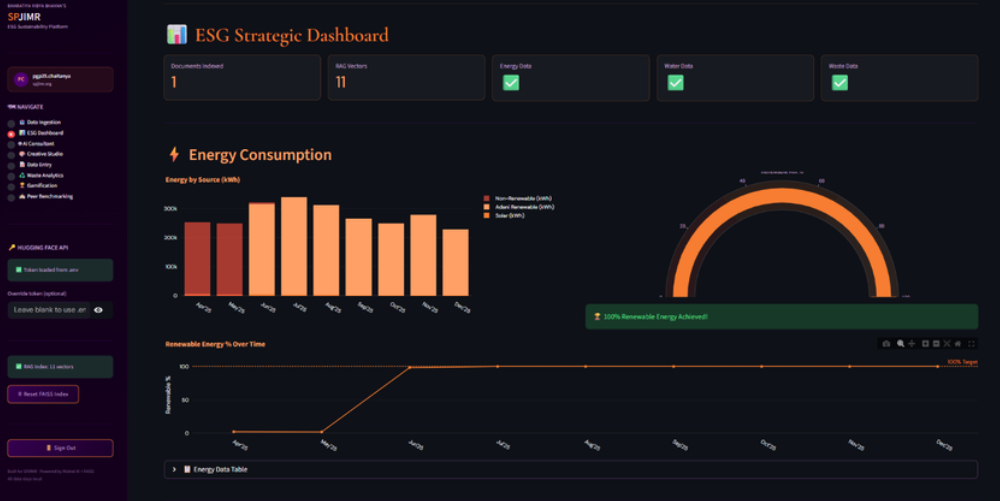
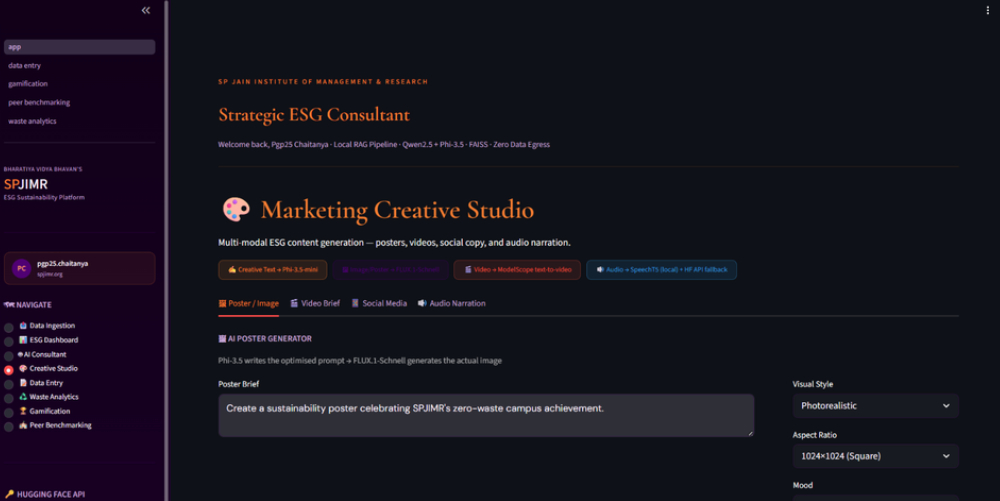
The WISE Energy Portal was designed to address this challenge through a fully integrated sustainability intelligence platform.
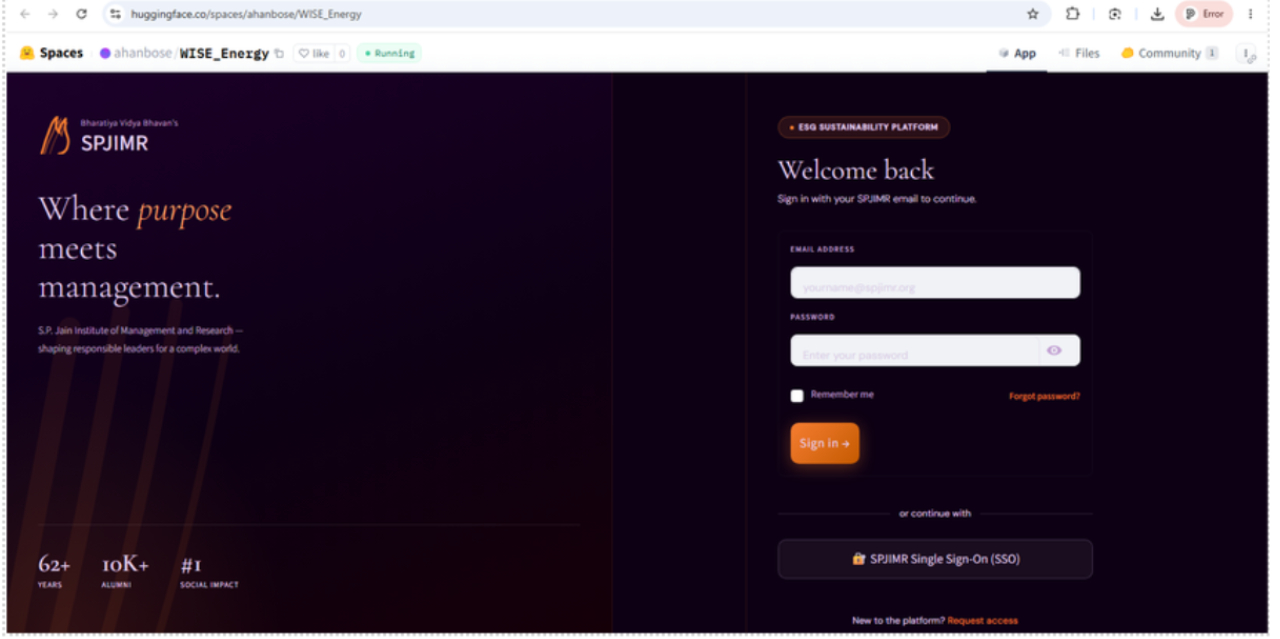
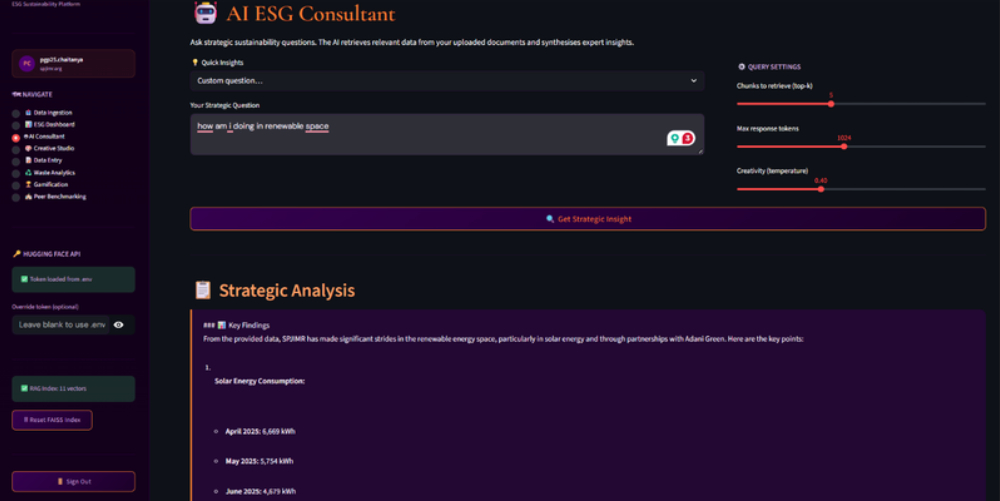
Daily waste data entered through a browser-based interface replaces manual spreadsheet processes and feeds directly into live analytics, forecasts, and block-level gamification scores in real time. The platform also includes a leaderboard and badge system that creates accountability by connecting sustainability outcomes to the people and units responsible for them. An AI layer generates ESG reports and sustainability narratives using institution-specific data rather than generic templates. The entire system runs on-premise. FAISS indexing, SQLite storage, and text-to-speech synthesis all run locally, ensuring that sensitive institutional data remains within the organisation’s infrastructure.
The team also adopted specialised models for different functions, including strategic analysis, content generation, image creation, and speech synthesis. Independent fallback mechanisms ensure that a failure in one component does not affect the performance of the wider system.
This level of architectural thinking demonstrates what can be achieved when students are held accountable to stakeholder requirements rather than just course rubrics.
Industry and social impact
Three teams worked on projects that supported an NGO, a textile manufacturing business, and the institute’s admissions process. These projects required students to understand unfamiliar contexts, build relationships with external stakeholders, and design solutions for real-world challenges.
Abhyudaya’s Sitara programme pairs mentors from the professional community with students from underserved backgrounds. The matching process was conducted manually, relying heavily on individual judgement, institutional memory, and significant administrative effort.
One team automated the mentor-mentee matching process using structured compatibility criteria. The team worked closely with the Abhyudaya team to understand what make a good match, identify common challenges, and account for operational constraints.
The resulting system reduces the matching process time from days to minutes while maintaining alignment with programme objectives.
Diksha Knitwear Private Limited operated without a centralised data infrastructure. Key decisions relating to production, inventory, and market strategy depended on information spread across informal records and disconnected communication channels.
One team developed a unified strategic dashboard that provides real-time visibility into operations, market intelligence, and AI-supported decision-making. The solution was designed to work within the company’s existing environment, requiring no additional hardware or IT investment.
Students worked directly with the CEO to understand business requirements, validate assumptions, and test the system against real operational scenarios.
Two teams addressed challenges within the PGDM admissions process. Admissions teams manage large volume of candidate queries across multiple channels, while interview scheduling and coordination often require significant administrative overhead.
Both teams developed solutions that automate query resolution and interview scheduling, reducing administrative burden while improving responsiveness for applicants.
The systems were developed in collaboration with the Admissions Committee and Central Admissions Office and tested against real admissions workflows and candidate interactions.
The stakeholder dimension
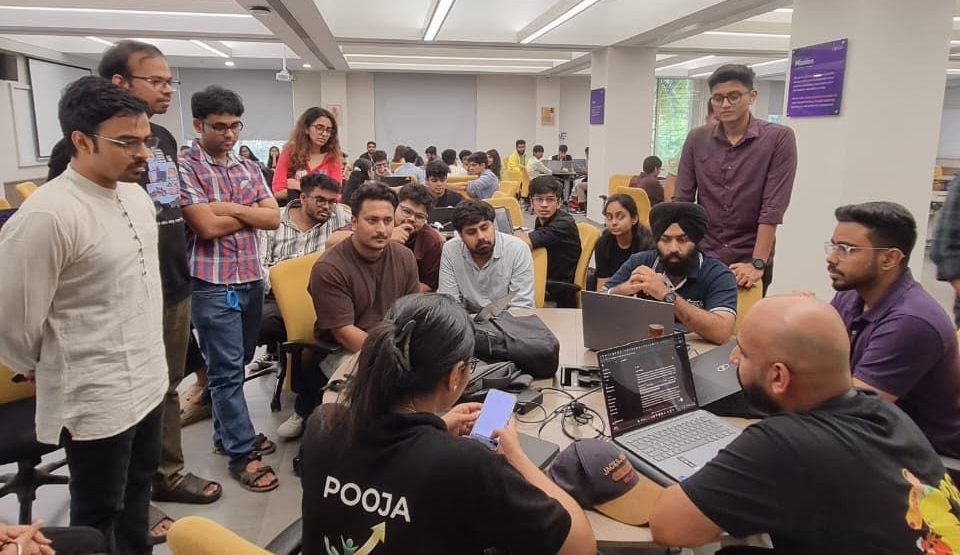
The most consistent feedback from students at the end of the Maker Lab is not about the technology. It is about the experience of working with a real stakeholder.
Every team in the 2025–27 cohort identified a stakeholder before development began. Students met with them, asked questions, tested assumptions, and returned with prototypes for feedback. The counsellor who reviewed the mental health prototypes at the final demonstration was the same person who helped define the challenge at the start. The CEO of Diksha Knitwear who attended the dashboard demonstration had been involved throughout the design process.
This changes the nature of student accountability.
When a stakeholder is sitting in front of a working prototype and assessing whether it solves a genuine problem, students quickly realise that success depends on usefulness rather than persuasion. The stakeholder relationship also creates a feedback loop that is difficult to replicate in a traditional classroom. People who have lived with a challenge for years can quickly distinguish between solutions that addresses root causes and those that only treat symptoms.
Much of the learning in the Maker Lab actually happens through these conversations between those building solutions and those who need them.
Responsible AI by design
The Maker Lab does not treat ethics as a standalone module or a checklist. Responsible AI practices are embedded throughout the design process. This is particularly evident in projects involving sensitive data.
Teams working on mental health prototypes had to design access controls, escalation protocols, and data governance protocols before developing their interfaces. Students building the accessible education platform worked closely with users to validate whether their designs genuinely improved accessibility rather than assuming they would.
Similarly, the sustainability platform was designed to operate entirely on-premise because stakeholders required sensitive operational data to remain within institutional systems.
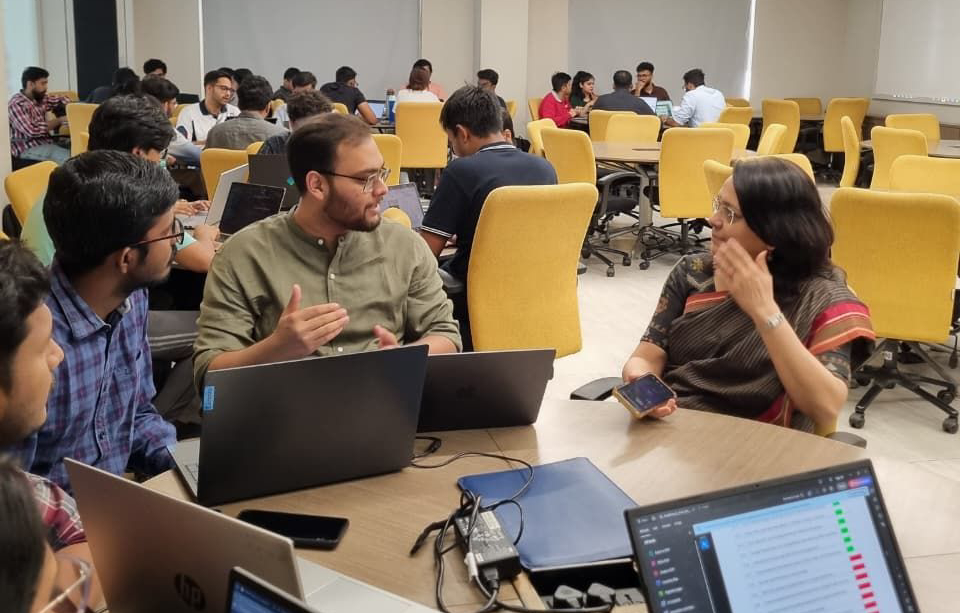
Across all projects, students were required to identify human-in-the-loop checkpoints where AI-generated outputs must be review by a human before it triggers an action. They also documented potential failure modes and designed safeguards to address them. Rather than assuming technology would work perfectly, they were expected to anticipate risks and build systems that could manage them responsibly.
This reflects a broader belief that understanding the opportunities and risks of AI is not solely a technical capability. It is a management competency that can only be developed through practice with real problems.
What makes the Maker Lab different
Several features distinguish the Maker Lab from conventional approaches to technology education in management programmes.
- It starts with the problem, not the technology. Students are not taught a tool and then asked to find an application. They begin by understanding a real problem through stakeholder engagement and then identify tools that can help solve it.
- It requires a working prototype. The final deliverable is not a presentation describing a solution. It is a functional prototype that can be demonstrated and tested.
- It involves stakeholders throughout. Stakeholder are not invited only for the final presentation. They participate throughout the process, shaping requirements, validating assumptions, and providing feedback.
- It covers the full innovation pipeline. Students learn more than how to use AI tools. They learn how to define a problem, structure data, design workflows, build interfaces, evaluate outputs, and document failures or risks.
- It treats responsible AI as a design principle. Ethics, governance, and accountability are incorporated into every project from the outset rather than added later as compliance requirements.
- It is required, not elective. Every PGDM student completes the Maker Lab. The skills it develops are treated as core management skills for an AI-enabled world rather than specialist technical knowledge.
Impact at a glance
20
Live prototypes
100+
Students
12+
Stakeholders
5
Project domains
100%
Public deployment
AI
Stack
Gemini, LangChain, Hugging Face and more
Zero
Textbooks
Fully hands-on learning
16
Sessions
2-credit Term III course
Collaborations
Industry, campus and NGO partnerships
SDG Alignment
SDGs 4 (Quality Education), 8 (Decent Work and Economic Growth), and 9 (Industry, Innovation and Infrastructure).
Student testimonials
Makers Lab gave me the opportunity to experience product management firsthand: engaging with stakeholders, understanding their challenges, and developing empathy for the problems they face. The programme motivated me to think critically about solutions and turn ideas into tangible outcomes. Receiving positive feedback from stakeholders at the end was especially rewarding. It also showed me the immense potential of Generative AI in transforming ideas into real, impactful products.
Generative AI has dramatically lowered the barriers to building and experimentation. My key takeaway from Makers Lab was that competitive advantage now comes from deeply understanding why a process exists and using AI to quickly validate ideas and arrive at better solutions
Maker’s Lab gave me two things. AI as a tool and product thinking as a discipline. My team and I built an education platform for students with disabilities entirely using AI, but what made it work was asking the right questions before writing a single prompt. That shift in thinking is what I will carry forward.