



America’s spaghetti-fied AI policy: Chowmein and chip bans
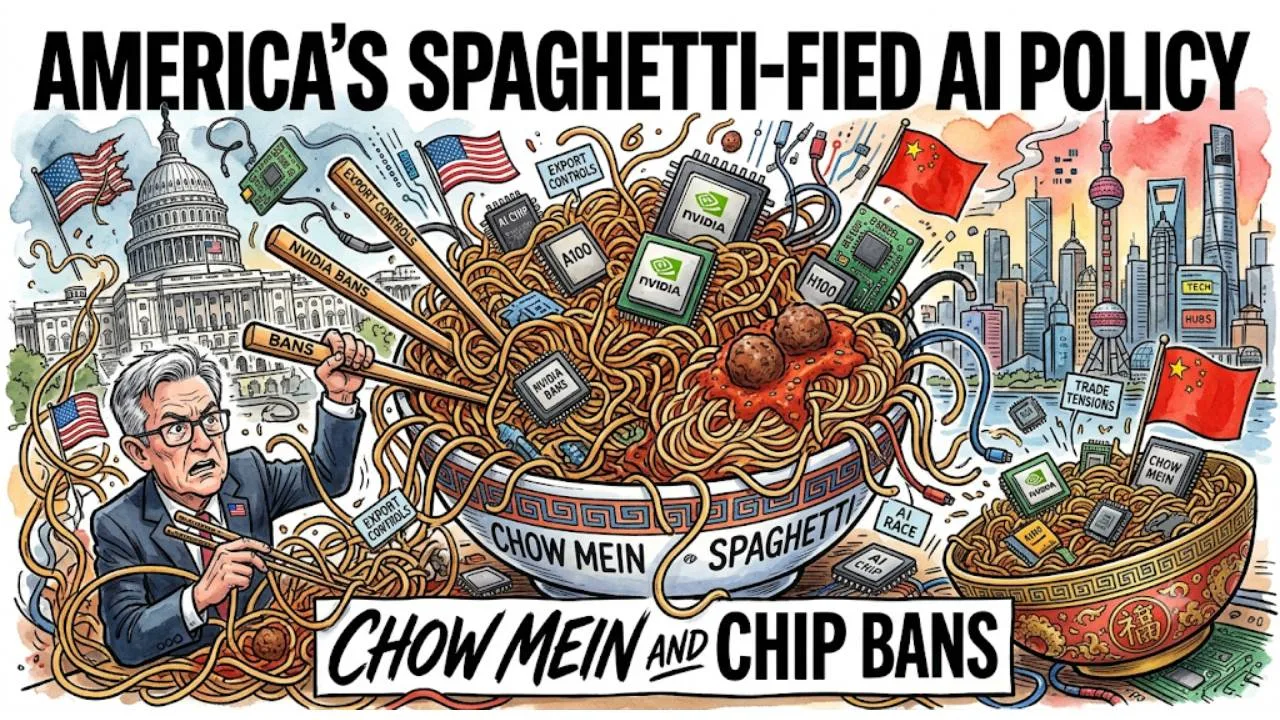
It’s an interesting situation developing in the US after mid-term elections. Firstly, it was the Vice President who said the Iran war was a mistake. In response, the President removed the VP from further talks with Iran, although the VP had led negotiations with Iran for the past several months. The strait open to all for the past several decades is now under threat, and there is no end to war in sight.
Then Nvidia’s Huang affairs and spy controversy emerged. The Treasury Secretary blamed the Department of Commerce, saying that the Secretary of Commerce had allowed advanced chips to be exported to China. Conversely, the philosophy of the Commerce Secretary was to make China dependent on the US for its AI development; now it is being challenged, questioning whether chips actually landed in the hands of the Chinese military.
Unpopular Iran war, increased cost of living and other factors leading to the mid-term election debacle of the GOP have brought to the fore fissures in the US political leadership that governs the country. The impeachment attempt against the Defence Secretary is another instance in which he narrowly survived, despite a Republican congressman tabling the motion.
The flip-flop, inconsistent chip export policies of the US under the lens now. From 2022 to 2023, the export regulations became tighter; nothing more powerful than H100 chips was to be exported to China. Then, following intense lobbying by Nvidia, in January 2026, U.S. policy allowed limited, regulated exports of Nvidia H200 and AMD MI325X to approved Chinese firms, under strict conditions. Then allegations of Nvidia CEO Jensen Huang’s links to Chinese spies emerged.
Although the chips were meant for commercial enterprises, doubts are being expressed about possible leakage to the Chinese military, the PLA, due to China’s policy of civil-military fusion. While the case is under investigation and no conclusion has been reached, Beijing has rejected any remark of spying.
What’s intriguing is the political manoeuvres of US politicians, especially after mid-term election results. Contrary views and blame games are in the open. With Democrats controlling both houses from January, one can expect more exposures and revelations from leaders. Inconsistent statements and policies have been a hallmark of this administration, but now the unity of top leaders is under strain.
Coerced dependence always backfires.
Mixed signals are routine; leadership fractures are new.
About the faculty

Anil V. Vaidya
Prof. Anil Vaidya holds a Doctor of Business Administration from the University of Bradford, UK. His dissertation was in Information Systems and Technology Strategy. He has pursued his MBA from the University of Akron, Ohio, USA. He has more than 45 years of overall experience, with 35 years of industry engagement in senior IT management and leadership roles.
More from Anil V. Vaidya
Recent faculty blogs
-
Perception recency trumps ideology
Read more -
India’s Foreign Policy transformed after USSR collapse
Read more -
Part III – Kṛṣṇa is not cunning: The freedom to act without anything to gain
Read more -
Liberal Europe is turning right in 2026!
Read more -
Part II – Karma Yoga: The missing dimension of moral development
Read more
Most read faculty blogs
-
Organisational responses to hybrid work—Rethinking culture and civility in India
Read more -
When Amazon arrived late to India’s quick commerce party
Read more -
The 2013 RBI FCNR(B) Swap Window – Review & Takeaways
Read more -
Reimagining travel through AI: Making every journey smarter and more personal
Read more - Read more