



From classroom to Chembiz: how an SPJIMR alumnus tackled nine business gaps in South Africa
Eesh Gupta, PGDM Class of 2026 alumnus
Eesh Gupta, a PGDM Class of 2026 alumnus of S.P. Jain Institute of Management & Research (SPJIMR), has been recognised as one of the standout pairs from the 2026 cohort of the DHL GoTrade GBSN Fellowship, run by the Global Business School Network (GBSN).
He shares the recognition with his fellowship partner, Wilma Alberts, owner of Chembiz in South Africa. Ahead of the fellowship’s closing ceremony on 10th September 2026, he reflects on the seven months in his own words.
Most of my work is with large enterprises, where a specialist team exists for nearly every problem. Chembiz gave me the opposite: limited resources, no in-house specialist to call on, and one problem to own from start to finish. We started with a problem Wilma was actually living with. She brought a deep understanding of the business and its customers, while I brought a research-driven approach to the problems we were trying to solve.
That combination helped us challenge assumptions and work towards solutions that made sense for the business. The number of gaps we worked through matters less to me than what the work itself taught me. That shift, from studying problems to owning them, is what I’m most looking forward to sharing at the ceremony.
How SPJIMR helped me solve real problems
The fellowship placed me with Chembiz, a laboratory instrumentation supplier operating across South Africa and 15 Southern African Development Community (SADC) markets. My mandate covered nine business gaps: landed cost calculation, freight and Incoterms strategy for SADC exports, HS tariff classification, marketing, fragile and heavy freight insurance, sourcing new trade partners, compliance, company policy and systems, and lithium-ion battery shipping guidelines.
SPJIMR gave me the technical foundation to work through areas such as HS tariff classification, Incoterms and Country of Origin certification without having to relearn the basics on the job. But the bigger advantage was the way the programme taught me to approach unfamiliar problems.
The design-thinking approach we were introduced to early in the programme became particularly useful at Chembiz. Instead of treating each challenge as a separate task, I could look at where the business was, where it needed to get to, and what needed to happen in between. That mattered because the nine challenges were interconnected — solving one often revealed another.
What the fellowship added was the opportunity to apply that thinking in a setting where the consequences of each decision were real.
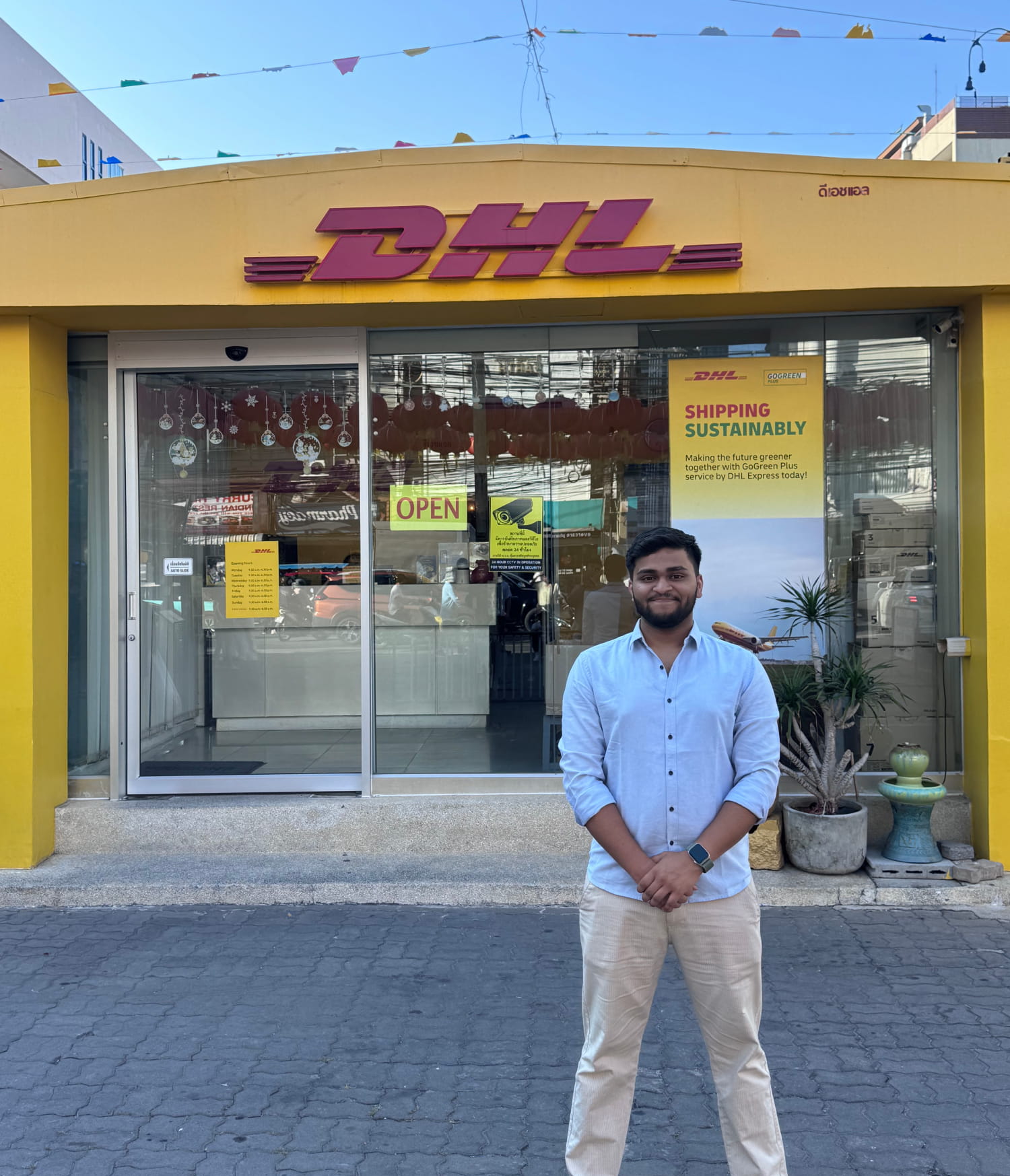
A classroom can give you the foundation, but working through the consequences of a decision in a real business teaches you something different. Having that structured approach helped me work through multiple problems at once, while still keeping sight of how each one affected the bigger picture.
The insight that changed the plan
The turning point came while I was building a competitor tracker for Chembiz’s marketing strategy. It started out as a simple benchmarking exercise.
That exercise found something Chembiz hadn’t been using: a strong presence in the education segment that none of its closest competitors had. That gap is now the centre of the company’s marketing strategy.
While we were working on a WhatsApp outreach plan, Wilma pointed out that many lab managers order from personal phones, not company phones. That single detail changed our plan from broad group messaging to direct, personal outreach.
What both moments showed me was that a differentiator only creates value if the business has the processes and systems to scale it.
Working without assuming
Some lessons had nothing to do with tariffs or freight. Chembiz exports on DAP terms, so it keeps control of a shipment through its own courier right up to delivery, instead of handing it off to the buyer’s local freight forwarder.
That’s different from what I had typically seen in Indian businesses, where control usually passes to the buyer’s side earlier. I also came across B-BBEE, South Africa’s economic transformation compliance framework, for the first time during the fellowship.
The lesson from both: don’t assume. A market and its rules can’t be understood fully from a report. They have to be worked through directly.
What the engagement produced
We secured better DHL freight rates on shipments of 50 kg and above, and closed a gap in Chembiz’s cargo insurance around hijacking.
We replaced manual landed cost quoting with a calculator that the business now runs on its own. We also advanced the business towards Country of Origin certification, with the potential to improve the competitiveness of its international trade.
One recurring problem was fragile and heavy freight arriving with the wrong kind of vehicle. We addressed it with three simple steps: setting vehicle requirements at the time of booking, using tilt indicators on fragile shipments, and photographing goods before handover.
The takeaway that’s stayed with me: practical problems rarely need complicated solutions. They need someone to spot the gap, understand why it exists, and follow through.
Carrying it forward
Before the fellowship began, Dean Varun Nagaraj told me, “Make us proud. Needless to say, I expect full effort and great outcomes from you.” I treated the seven months as a full commitment, not something to give partial attention to.
The standard I want to carry forward is the one I set for myself in South Africa: build something that keeps working after you leave. The landed cost calculator and supplier scorecard are still in use at Chembiz today.
My advice to SPJIMR students is to go in without assumptions, and check your work against one question at the end: can you point to something that changed because of your work?
A rate negotiated, a process improved, a certification advanced, or a solution that is still running without you.
If you can, you have a clear sign that your work created value. If you can’t, it may be worth asking whether you went deep enough.
That, for me, is the difference between participating in a fellowship and actually doing the work.