




In May 2026, as a scholar in SPJIMR’s Fellow Programme in Management (FPM), I had the opportunity to attend the Summer School on Grounded Theory and Qualitative Methods at the University of Pisa, Italy. I went hoping to strengthen my approach to analysing qualitative interview data. I returned with something more valuable: a deeper understanding of the methodological and philosophical assumptions that shape the way we conduct qualitative research.
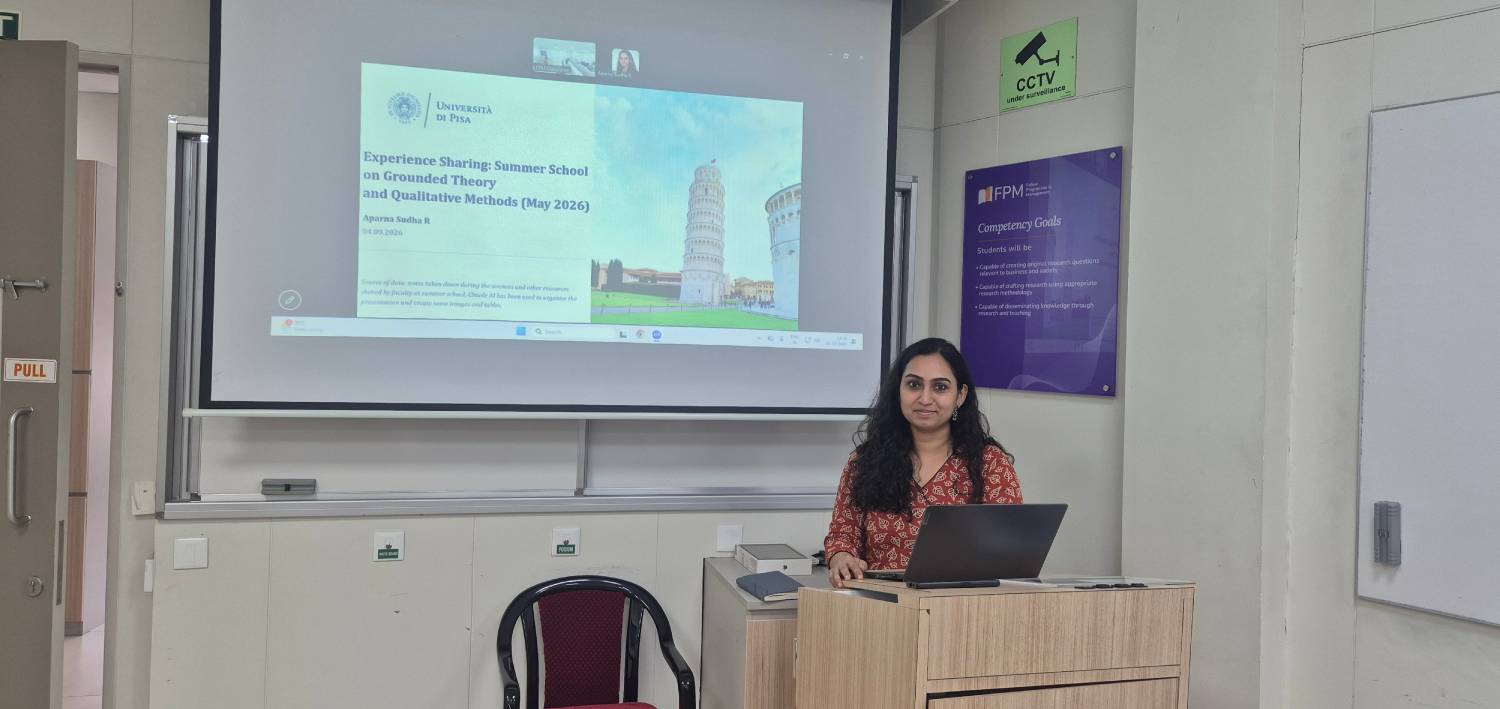
Organised by the Center for Advanced Studies in Symbolic Interactionism and Grounded Theory at the university’s Department of Political Science, the summer school has been held since 2016. Its early editions were led by Kathy Charmaz and David Altheide. This year, the sessions were facilitated by Thaddeus Müller (Lancaster University), Charlie Barnao (University of Palermo), and Irene Psaroudakis and Andrea Salvini (University of Pisa). The diversity of the cohort also led to rich discussions, as participants brought varied research contexts and experiences into the classroom.
We began with symbolic interactionism, the intellectual tradition from which grounded theory emerged. Herbert Blumer’s central argument that people act on the basis of meanings that develop through social interaction offered a useful way to revisit a fundamental aspect of interview-based research. When participants narrate their experiences, they are not simply reporting facts; they are interpreting and making sense of those experiences. As researchers, we then interpret these accounts. Interview data, therefore, is not a straightforward record of reality but an outcome of meaning-making between the participant and the researcher.

Another important takeaway was the idea of a theory-method package. Methods are not neutral tools that can be picked up and applied independently of our assumptions about the world. In constructivist grounded theory, the researcher is part of the knowledge-production process. Our motivations, positionality, and prior assumptions shape what we notice and how we interpret it. Reflexivity, then, becomes an integral part of doing qualitative research.
We also discussed the implications of rigorously applying grounded theory. The facilitators emphasised the importance of theoretical sampling, constant comparison, and theoretical saturation as core pillars of a rigorous grounded theory study. One discussion that particularly stayed with me was about encountering findings that do not align with existing literature. Many of us have experienced that moment when we wonder whether we are the only ones seeing something that does not quite fit. The advice was reassuring: this tension need not be resolved by forcing the data into familiar theoretical explanations. It may instead be precisely where new theoretical insights begin to emerge.

The sessions also included some practical qualitative coding exercises, allowing us to engage with these ideas beyond the conceptual discussions. The facilitators shared authentic interview data, allowing us to get our hands dirty and learn the reality of the coding process.
Put together, these learnings shaped how I approach qualitative research in my doctoral work. I am grateful to SPJIMR and the FPM Team for supporting my participation. I returned from Pisa with more than just techniques to apply to my interview data; I began thinking more carefully about the relationship between theory, method, and interpretation and about the responsibility that comes with producing knowledge through qualitative research.

Register your interest in this programme
Please fill in the following details