


SPJIMR faculty research featured in WTO-OECD report
29 October 2026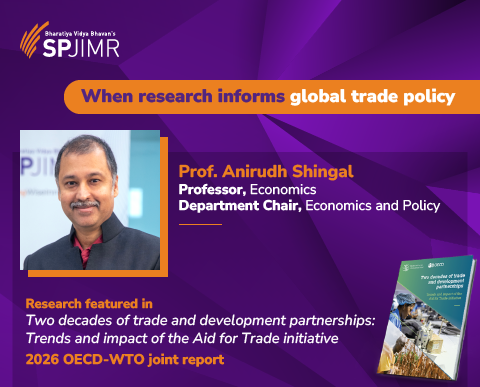
Research by Anirudh Shingal, Professor of Economics, and Department Chair, Economics and Policy at SPJIMR has been featured in the 2026 joint report by the Organisation for Economic Co-operation and Development (OECD) and the World Trade Organization (WTO), titled ‘Two decades of trade and development partnerships: Trends and impact of the Aid for Trade initiative’.
The report discusses the evolution of aid for trade over the last two decades, highlighting new trends and ways in which this assistance has supported countries’ integration into international trade.
Commenting on the research being featured in the report, Prof. Shingal said: “It was great to have the OECD and the WTO showcase findings from my research in their annual flagship report that reviews the evolution of aid for trade and its effectiveness for both donors and recipients.”
What does the research reveal?
Prof. Shingal’s research ‘Revisiting the impact of Aid for Trade’, examines the relationship between development assistance and trade, examining how different categories of Aid for Trade affect exporting sectors in both recipient and donor economies.
Using bilateral trade and Aid for Trade data from 2010 to 2023 within a structural gravity framework, the study finds that the impact of development assistance varies considerably depending on the type of support and the sector being examined.
Among the key findings for recipient economies:
Economic infrastructure
A doubling of Aid for Trade allocated to economic infrastructure is associated with a 2% increase in bilateral manufacturing exports.
Trade policy and regulation
A doubling of support in this category is associated with a 3.1% increase in bilateral manufacturing exports.
Digital services trade
A doubling of Aid for Trade allocated to non-services productive capacity building is associated with a 10% increase in digital services trade.
The research also identifies positive effects across several manufacturing industries and commercial services in donor economies, highlighting the varied trade outcomes associated with different forms of development assistance.
From research insights to policy impact
At SPJIMR, research impact is understood not merely through the production of academic knowledge, but through its ability to inform policy, influence practice and address real-world challenges. The inclusion of Prof. Shingal’s research in a major OECD-WTO publication reflects the institute’s commitment to scholarship that connects rigorous empirical inquiry with consequential questions facing economies, institutions and society.