


Six SPJIMR students recognised at FICCI Summit
31 July 2026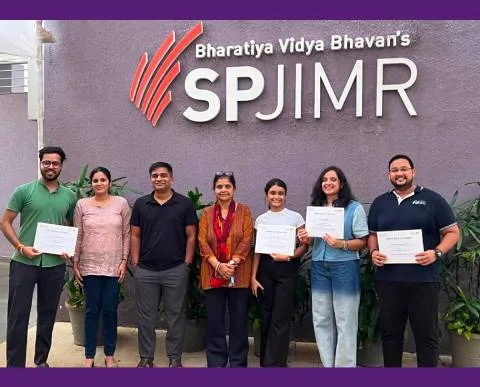
Six students from S.P. Jain Institute of Management & Research (SPJIMR) were recognised at the 4th Global Industrial Relations Summit 2026, New Delhi, organised by the Federation of Indian Chambers of Commerce and Industry (FICCI) on 30–31 July 2026.
Raghav Lonikar, a PGDM 2025–27 participant at SPJIMR, won second prize in the ‘Student’ category of FICCI’s Paper Writing Competition, becoming the first student from SPJIMR to receive the award. His paper, ‘Can Digital Public Infrastructure (DPI) become a new institutional mechanism for governing gig work in India’, examined the regulatory challenges emerging from the growth of platform-based work. It argued that while the gig economy is often viewed through the lens of informality, aspects of platform work also reflect characteristics of the formal economy. The paper explored how regulatory structures enabled by Digital Public Infrastructure (DPI) and the India Stack could contribute to a more structured framework for platform work.
Raghav’s interest in the lived realities of gig workers shaped the paper. “The primary motivation was that I had seen the exploitation of gig workers first-hand, and I wanted to do something to improve their lives,” he said. Discussions in Business in the Digital Age, a course taught by Prof. Ashish Desai, further sparked the idea for his paper.
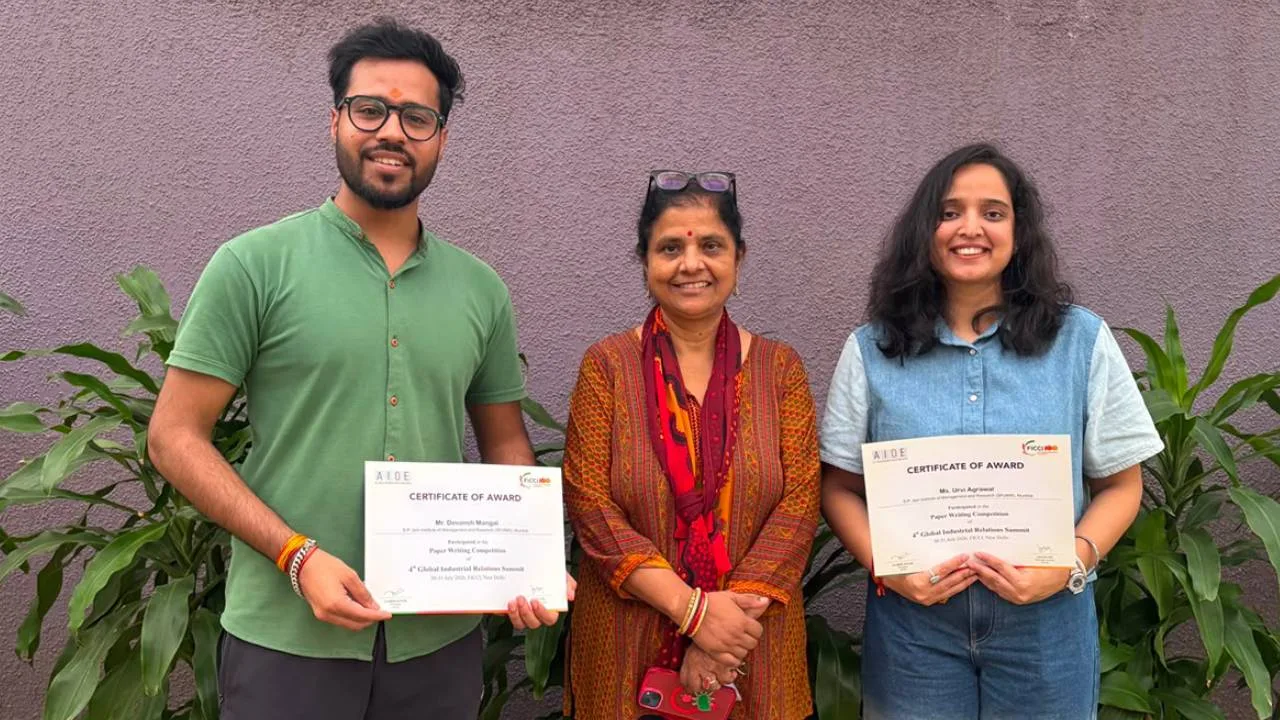
Five SPJIMR PGPM participants—Aarzoo Dewan, Anjali Thakur, Devansh Mangal, Shivam Kumar Gupta and Urvi Agrawal—also received Certificate of Award for their participation in the Paper Writing Competition. Their papers examined emerging questions around industrial relations and the changing nature of work:
- Devansh Mangal authored ‘Industrial Relations in AI-Powered Organisations: Managing the Shift’, with Urvi Agrawal as co-author.
- Urvi Agrawal also authored ‘Building Sustainable Industrial Relations in the Gig Economy: A Systems Lens’, with Devansh Mangal as
co-author. - Shivam Kumar Gupta authored ‘Industrial Relations in the Fast-Shifting Global Landscape’, with Anjali Thakur and Aarzoo Dewan as
co-authors.
Together, the papers examined issues ranging from the implications of artificial intelligence on organisations to the need for sustainable approaches to industrial relations in the gig and platform economy.
For the PGPM students, the competition provided a platform to take classroom learning into a wider dialogue with practitioners, academics and policymakers. Their work approached industrial relations not only as a labour-management function but also as a strategic organisational issue shaped by technology, governance, productivity, employee experience, and organisational sustainability.
The students credited Prof. Sushmita Srivastava and the Organisation Behaviour faculty team for encouraging them to explore contemporary questions around work and organisations. Prof. Srivastava also participated in the Summit as a panellist, bringing her academic and practitioner perspective to the discussions.
The recognition reflects SPJIMR’s emphasis on learning that connects rigorous academic inquiry with real-world challenges. By encouraging students to examine how technology, work, and institutions are changing, and to engage with these questions through research and dialogue, SPJIMR aims to develop thoughtful managers and future leaders equipped to contribute to organisations and society.