


Intelligence on trial: What Kafka, Sternberg, and Advaita Vedānta can teach us about possibility
Many years ago, when I was studying in France, I read Franz Kafka’s The Trial. I remember being deeply moved, almost unsettled, by the novel. It had the strange power of speaking about a world that was absurd and yet painfully recognisable. It was not only a literary experience; it was an existential one.
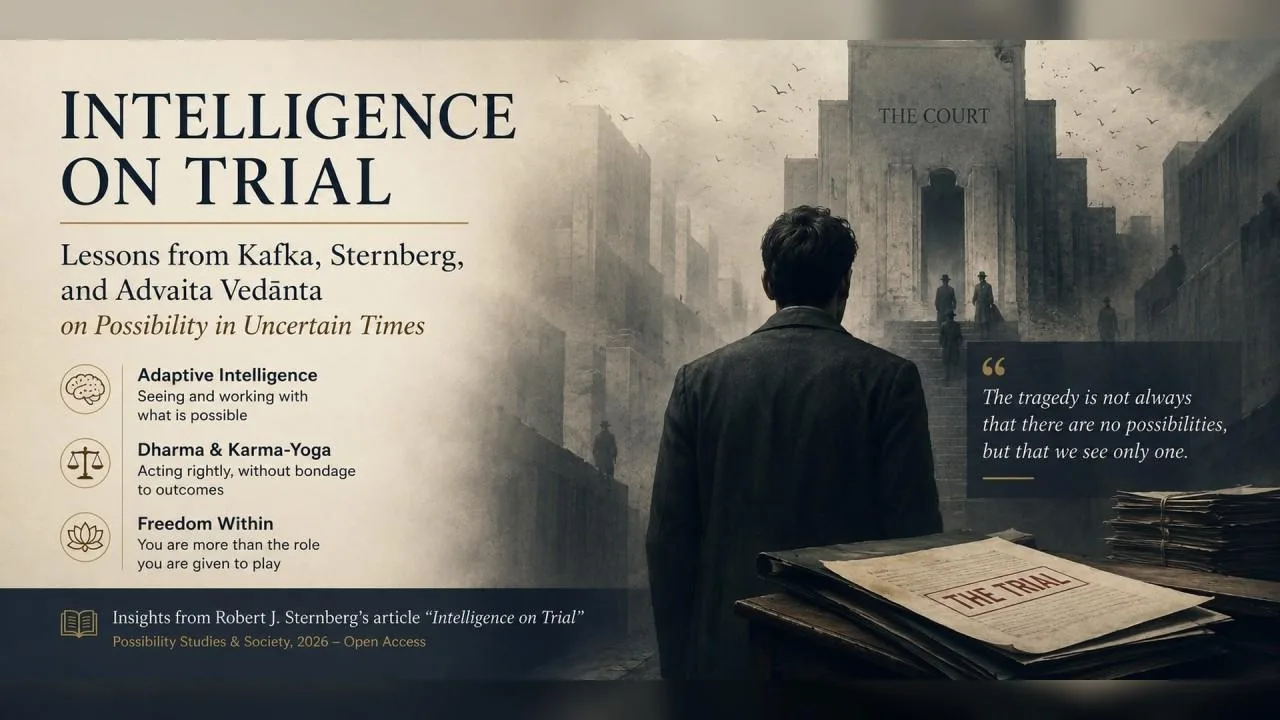
This reflection was renewed when I recently read Robert J. Sternberg’s article, “Intelligence on Trial: Intelligence and Its Relation to Possibility in Franz Kafka’s Novel, The Trial,” published in 2026 in Possibility Studies & Society. The article is open access, and I warmly invite readers to go to the link, either to refresh their memory of Kafka’s novel or to discover its disturbing relevance for the first time. Sternberg’s article offers a helpful summary of the novel and a thoughtful interpretation of it through the lens of intelligence, possibility, and human response under constraint.
Kafka’s The Trial continues to disturb us because it does not feel like a story from another time. It feels strangely familiar. A man wakes up one morning and discovers that he has been arrested. He is not told the charge. He is not imprisoned, yet he is not free. He is summoned by a court whose rules are opaque, whose officials are grotesque, whose authority is unquestioned, and whose process seems impossible to understand. He spends the rest of the novel trying to find out what he is accused of and how he can be acquitted. He fails on both counts.
At one level, Kafka’s novel is about bureaucracy, power, absurdity, and helplessness. But Sternberg reads it through another lens: adaptive intelligence.
His argument is not that Joseph K., the protagonist, is unintelligent. In fact, Joseph K. is professionally successful, analytical, and articulate. He holds a respectable position in a bank. He can reason. He can argue. He can detect the absurdity of the system that has trapped him. And yet, he fails.
This is where Sternberg makes an important distinction. Intelligence is not merely the ability to analyse. In difficult, uncertain, and unjust situations, what is needed is adaptive intelligence: the ability to understand the environment, work with available possibilities, relate intelligently to others, act for a larger good, and know when to adapt, when to shape the situation, and when to leave. Joseph K. does almost none of this.
He wants only one outcome: complete acquittal. But the world he is in does not seem to offer that possibility. Others suggest partial strategies, delays, compromises, alliances, or indirect ways of navigating the system. He rejects them because they do not give him the pure result he wants. He alienates potential helpers. He insults those who hold power. He refuses imperfect assistance. He acts alone. He wants vindication, but he does not create the conditions through which even limited relief may become possible.
Sternberg’s insight is profound: sometimes the tragedy of a person is not that there are no possibilities, but that the person is attached to only one possibility. When that one preferred outcome is unavailable, all other possibilities become invisible.
This is not confined to Kafka’s world
We see this in organisations when a capable leader insists on only one version of success — a promotion, a role, a public vindication — and therefore misses other possibilities: a lateral move, a new sponsor, a different team, or even a graceful exit from a toxic culture.
We see it in families when someone wants one apology, in one form, from one person, and because that does not come, all other forms of repair become invisible.
We see it in public life when citizens face institutions that are slow, opaque, or unresponsive. The frustration may be justified. But if the response is only anger, cynicism, or withdrawal, then the field of meaningful action becomes smaller.
We see it in health crises, too. A diagnosis, a chronic condition, or a sudden loss can make us long for one thing only: the return of life exactly as it was before. When that is not possible, we may overlook the possibilities that still remain — treatment, support, adaptation, prayer, acceptance, courage, and a new way of living.
This is where Advaita Vedānta can add something very important
Advaita does not begin by asking only, “What should I do?” It also asks, “From what inner place am I acting?” Is my action coming from clarity or hurt? From dharma or fear? From responsibility or ego? From steadiness or desperation?
In the Bhagavad Gītā, this is the difference between ordinary action and
karma-yoga. Karma-yoga does not mean passivity. It does not mean accepting injustice helplessly. It means acting intelligently and ethically in a given situation, while recognising that the result is never fully in my control. This distinction is crucial.
We are responsible for our actions. We are not the sole authors of the result. The result comes from a larger field of causes: other people, institutions, timing, past actions, social forces, laws, health, resources, and countless seen and unseen variables. Vedānta calls this larger order Īśvara, not as a distant deity arbitrarily rewarding and punishing people, but as the total order within which all action and result take place.
This understanding changes the way we act
Joseph K. is unable to accept the field as it is. He does not approve of the court, and rightly so. But he also refuses to recognise the actual conditions under which he must act. He wants the situation to conform to his expectation of justice. When it does not, he becomes reactive, contemptuous, isolated, and increasingly
self-destructive.
Vedānta would say that his problem is not merely strategic. It is existential. His intellect is sharp, but it is governed by a disturbed inner condition.
Two Sanskrit terms are helpful here: rāga and dveṣa. Rāga means binding attraction — the insistence that I must have a particular outcome in order to be okay. Dveṣa means binding aversion — the insistence that I cannot tolerate a particular situation, person, or outcome. When rāga and dveṣa dominate, the mind loses objectivity. We do not see what is. We see only what we want, fear, or resist.
Joseph K. has a powerful rāga for total vindication. He has dveṣa toward compromise, dependence, humiliation, and imperfect help. Therefore, he cannot see the real range of action available to him.
This is deeply relevant to our lives today
A professional who receives unfair feedback may become so focused on proving the manager wrong that they stop asking a more useful question: “What can I learn, whom can I speak to, and what is the wisest next step?”
A founder whose business model is failing may be so attached to the original idea that they cannot see the need to pivot.
A social activist may be so angry at the injustice of the system that they burn bridges with possible allies.
A student who does not get into a desired school may feel that life has closed, when in fact only one door has closed.
A person going through divorce, grief, or betrayal may understandably want life to be restored exactly as before. But healing often begins when one stops asking only, “How do I get back what I lost?” and begins asking, “What is still possible now?”
Advaita Vedānta does not ask us to become passive. It asks us to become inwardly mature.
A mature person asks: What is the reality of this situation? What is within my control? What is not? What is the dharmic action here — the action aligned with responsibility, fairness, proportion, and care? Who can help? Whom can I help? Is this a situation to adapt to, to change, or to leave? Can I act without being consumed by the outcome?
This is where Sternberg’s adaptive intelligence and Vedānta’s karma-yoga meet beautifully.
Adaptive intelligence expands the range of possible action. Karma-yoga frees the person from being psychologically imprisoned by one desired result.
There is another important Vedāntic contribution: dharma. Dharma is not merely morality in an abstract sense. It is the intelligent order of right action in context. It includes truthfulness, non-harm, fairness, responsibility, self-mastery, compassion, and appropriateness. It asks not only, “What works?” but “What is right?” and “What sustains order rather than adding to disorder?”
This matters because adaptation by itself can become dangerous. One can adapt to corruption. One can adapt to injustice. One can learn to survive in a broken system by becoming complicit in it. Vedānta would not call that wisdom. Action must not only be effective; it must be dharmic.
Joseph K. sees the disorder of the court but does not become an agent of dharma. He fights for himself, not for a larger order. He does not transform his personal suffering into solidarity with others. He does not build alliances. He does not become a voice for those similarly trapped. He wants his own name cleared, but he does not seem interested in healing the field itself.
The Gītā calls us to something larger: loka-saṅgraha — action that contributes to the holding together of the world. A wise person does not act only for private escape. One’s struggle becomes connected to the welfare of others. One’s intelligence becomes serviceable to the larger order.
Finally, Advaita adds the deepest freedom
Even when we act well, the world may not give us the outcome we want. Systems may remain unjust. People may misunderstand us. Efforts may fail. The body may suffer. Status may be lost. No teaching that is honest can promise that right action always produces pleasant results.
But Vedānta says: you are not reduced to the role under trial.
You are not merely the accused, the successful professional, the rejected person, the misunderstood leader, the one who won, or the one who lost. These are roles, experiences, and conditions. They matter at the practical level, and they must be addressed responsibly. But they do not define the truth of the self.
This recognition is not an escape from action. It is the basis for fearless action.
When I am not desperately trying to secure myself through one particular result, I become more available to reality. I can think better. I can listen better. I can seek help without humiliation. I can resist injustice without hatred. I can leave when leaving is wise. I can stay when staying is required. I can receive results without inner collapse.
Kafka shows us what happens when a human being is trapped in an opaque and dehumanising system. Sternberg shows us that intelligence must become adaptive if it is to meet such a world. Advaita Vedānta adds that adaptive intelligence becomes truly wise only when the doer is transformed — when action is guided by dharma, offered into the larger order, and freed from bondage to a single outcome.
The real trial, then, is not only outside us. It is also the trial of the ego that insists: “Life must unfold according to my demand.”
And the real possibility is not merely that the world changes. It is that, even in a difficult world, I learn to act with clarity, courage, humility, and freedom.
About the faculty

Surya Tahora
Surya Tahora is a professor in the area of general management at SPJIMR. He teaches Spirituality and Leadership to around six hundred MBA and Executive MBA students annually and conducts workshops for various organisations in India, Europe, and Asia.
More from Surya Tahora
- Read more
-
Flow vs. wisdom: What happens when the Zen monk meets the jazz saxophonist?
Read more -
The whole we belong to: A Vedāntic exploration of reality as the Total physical, subtle, and causal
Read more -
If I already trust life, what role does Īśvara play?
Read more -
Do we really need Īśvara? A dialogue with a secular humanist
Read more
Recent faculty blogs
Most read faculty blogs
-
Organisational responses to hybrid work—Rethinking culture and civility in India
Read more -
When Amazon arrived late to India’s quick commerce party
Read more -
The 2013 RBI FCNR(B) Swap Window – Review & Takeaways
Read more -
Reimagining travel through AI: Making every journey smarter and more personal
Read more -
Budget 2025: Unlocking opportunities for the private sector
Read more