


The bird always returns
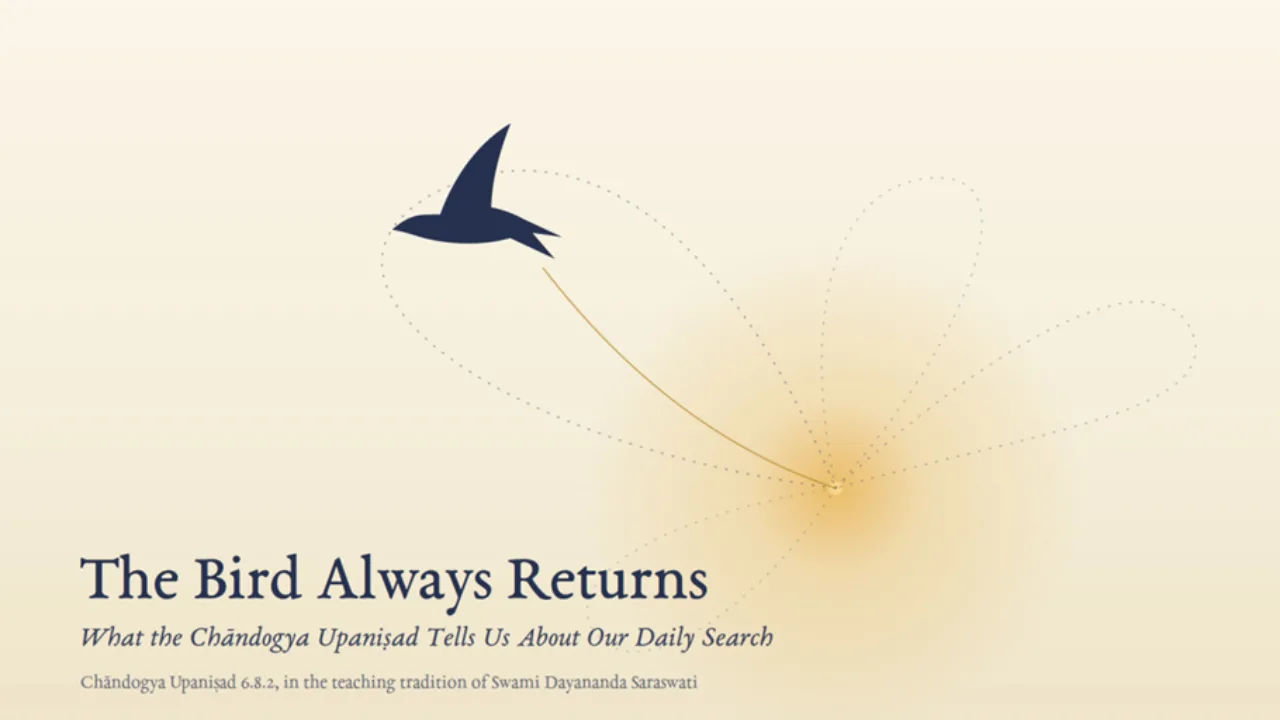
There is an image in the sixth chapter of the Chāndogya Upaniṣad whose simplicity conceals a remarkable diagnostic rigour. Uddālaka Āruṇi is teaching his son Śvetaketu and, to make him understand what happens in deep sleep, he takes the example of a bird tied by a string:
Just as a bird tied by a string, having flown in every direction and having found no resting place anywhere else, settles down at the very place where it is bound — so too the mind, my dear, having travelled in every direction and having found no rest anywhere else, settles down in prāṇa, for the mind is bound to prāṇa.
I would like to follow this image step by step — not as a philological curiosity, but as an exact description of our most ordinary experience.
The bird is our mind
The bird is the mind (manas). The string that holds it is made of our tendencies and desires (kāma-karma, vāsanā), which launch it toward objects in every direction (diśo diśaḥ). And the point of attachment (āyatana) — that to which the bird necessarily returns when it is exhausted — Śaṅkara, in his commentary, specifies with care: this prāṇa does not here mean the breath taken in isolation, but Sat, pure Being, the unborn cause of which the entire chapter has been speaking since its opening, sad eva saumya idam agra āsīt: “in the beginning, my dear, this was Being alone.”
The bird’s return to its string therefore stands for deep sleep. Just as the bird, finding no true rest anywhere else, returns to its point of attachment, the mind — having exhausted its wanderings in experience — resolves each night into its source, Being. It is a daily fact: every night, we enter Sat.
But ignorance does not sleep
Here we must resist a false consolation. If we touch Sat every night, why are we not already free?
Because deep sleep is a resolution, not a destruction of ignorance by knowledge. In deep sleep, ignorance (avidyā) is not destroyed; it is merely unmanifest, in seed form. That is why experience resumes intact upon waking: the seed was there. One enters Sat without knowing it as Sat.
Swami Dayananda formulates this with precision: in deep sleep, one is Brahman but does not know it; in liberation, one is Brahman and knows it. The nature does not change — Sat does not become more Sat. What changes is solely the status of ignorance: unmanifest in the one case, destroyed in the other.
Hence the necessity of the teaching. If mere rest were enough, every sleeping being would be liberated each night. But in the morning, the bird takes off again — precisely because the string has not been cut, only slackened for the length of a night.
The structure of our search
And it is here that the image touches our everyday life. As long as ignorance of our own nature persists, the search for fullness continues where it is not to be found: in the experience of desirable objects, again and again.
The flight is not an error in itself. The desire for rest, for completeness, for “enough” (pūrṇatva) is legitimate and profound. What is mistaken is the direction. For what the mind seeks in objects has never been in any object: every object is finite, and no sum of finitudes ever makes the infinite. The bird “finds no resting place anywhere else” — this admission is that of all experience: it never delivers what it was undertaken for.
Observe the mechanics. I obtain the desired object; a moment of fullness arises; and I conclude, mistakenly, that the fullness came from the object. Yet in that instant, what subsided was the desire itself — and it is in that momentary silence of desire that the fullness which is already my nature is reflected. The happiness comes from the momentary cessation of the search, never from the thing obtained. But ignorance attributes the happiness to the object. So I begin again. I take off again. Each object gained engenders, through this false attribution, the pursuit of the next.
This cycle has a name: saṃsāra. Not as punishment, but as the simple logical consequence of an error of attribution.
The only possible break
The solution, therefore, is never to fly better, nor to fly elsewhere, nor to stop flying by constraint. All of that remains within the register of action (karma), and all action produces the finite.
The only break is of another order: the knowledge that the perch is already beneath our feet. What the bird seeks, exhausting itself in every direction, it already is. It is not an object to be reached by one more flight; it is the very subject that flies. One cannot fly toward oneself.
That is why liberation is never presented as the acquisition of something new, but as the recognition of what was never missing — prāptasya prāptiḥ, the gaining of the already gained. The error is not an absence to be filled; it is a false knowledge to be corrected. And false knowledge is corrected only by true knowledge, born of the teaching — not by more experience, which would only renew the error in a new form, even a “spiritual” one.
The step that completes the diagnosis
One last step remains, the most demanding. It is not enough to recognise that I am the perch. One must see that the perch is the sole reality of everything else: the bird, the string, the directions, the space traversed, the time of the flight.
The entire sixth chapter is governed by a causal teaching: modification is only a name, a handle for speech; the cause alone is real. Clay alone is true; the pots, the jugs, the jars are only names-and-forms resting upon it, with no existence of their own apart from the clay. In the same way, the bird is not a real thing returning to another real thing. The bird, the string, the directions are themselves Sat in the form of name-and-form. The “return” is not a movement from one real to another — it is the resolution of name-and-form into its sole ground, which had never ceased to be what it is.
That is why the “without a second” (advitīyam) of the root verse is total. There is not Sat and the world, Sat and time, Sat and the birds that would return to it. The space the bird crosses, the duration of its flight, the multiplicity of directions all borrow their “is” from Sat. Remove Sat, and nothing remains — neither the bird, nor the sky, nor the movement.
And this completes the diagnosis of our search. As long as the world — objects, others, the space of possibilities — retains in our eyes a reality of its own, autonomous, there always remains something to reach over there. Residual duality leaves an outside in which to search, a real sky to traverse, and the flight can resume indefinitely.
The break is complete only when the knowledge is no longer limited to “I am Sat” but extends to “all this is Sat.” At that moment alone there is no longer a there distinct from a here, no object endowed with a separate existence that could promise fullness. Not that the world is negated — it continues to appear, as the pots keep their forms — but it is seen for what it is: name-and-form upon the one Sat that I am.
Then the bird, the string, the directions and the perch turn out never to have been four. There was no flight, no return, no distance crossed. The image undoes itself — which is precisely its function. Like the finger pointing to the moon, withdrawn once the moon is seen.
Coming back to oneself, today
You do not need to wait for the night to observe all this. Look at your own day. Each desire that arises launches you in a direction; each object obtained gives you a brief rest, then a new take-off. Ask yourself, in the instant of satisfaction that follows a fulfilled desire: where does this calm really come from? From the object — or from the fact that, for the space of a moment, you were no longer seeking anything?
This inquiry can be given a form. The following practices do not produce the knowledge — no practice can, since the problem is one of self-ignorance, not of an unfinished action. But they prepare the mind to receive the teaching and help what has been heard become one’s own.
- Catch the moment of landing. Once a day, when a desire is fulfilled — the coffee is in hand, the message has arrived, the task is done — pause for a few seconds before the next take-off. Ask the question above, in real time: was the fullness in the object, or in the momentary silence of seeking? This is not analysis after the fact; it is inquiry conducted at the very site of the error.
- Trace one flight from beginning to end. Choose a single desire and follow its full arc through the day: its arising, the pursuit, the gain, the brief rest, the appearance of the next desire. Seen once, whole, the mechanics of saṃsāra cease to be a doctrine and become an observed fact of one’s own mind.
- Notice the fullness that arrives unearned. A sunset, a burst of laughter, a moment of quiet in which nothing is wanted — here fullness is present although no desired object was gained. These moments are evidence, available daily, that the fullness belongs to you and not to things: nothing was acquired, yet nothing was lacking.
- Loosen the string through karma-yoga. Act with full commitment, and receive what comes — welcome or unwelcome — as prasāda, the given order of things rather than a verdict on yourself. This attitude does not cut the string — only knowledge does — but it slackens its pull. Desires lose their power to command, and the mind gains the composure (antaḥkaraṇa-śuddhi) without which the teaching, even when heard, cannot land.
- Expose yourself to the teaching. Since the error is a false conclusion about oneself, it is resolved only by a means of knowledge — the systematic hearing of the words of the Upaniṣad (śravaṇa) unfolded by a teacher of the tradition, followed by resolving one’s doubts (manana) and dwelling upon what has been seen (nididhyāsana). Observation prepares the ground; the pramāṇa alone removes the ignorance.
The bird does not free itself by flying better. It frees itself by recognising that what it sought far away was the very ground beneath its feet.
About the faculty

Surya Tahora
Surya Tahora is a professor in the area of general management at SPJIMR. He teaches Spirituality and Leadership to around six hundred MBA and Executive MBA students annually and conducts workshops for various organisations in India, Europe, and Asia.
More from Surya Tahora
-
Intelligence on trial: What Kafka, Sternberg, and Advaita Vedānta can teach us about possibility
Read more -
Flow vs. wisdom: What happens when the Zen monk meets the jazz saxophonist?
Read more -
The whole we belong to: A Vedāntic exploration of reality as the Total physical, subtle, and causal
Read more -
If I already trust life, what role does Īśvara play?
Read more -
Do we really need Īśvara? A dialogue with a secular humanist
Read more
Recent faculty blogs
-
Intelligence on trial: What Kafka, Sternberg, and Advaita Vedānta can teach us about possibility
Read more -
Why your library’s AI future depends less on technology than on your boss!
Read more - Read more
-
Flow vs. wisdom: What happens when the Zen monk meets the jazz saxophonist?
Read more -
From MBA to Entrepreneur: Investment Advisory is an opportunity!
Read more
Most read faculty blogs
-
Organisational responses to hybrid work—Rethinking culture and civility in India
Read more -
When Amazon arrived late to India’s quick commerce party
Read more -
The 2013 RBI FCNR(B) Swap Window – Review & Takeaways
Read more -
Reimagining travel through AI: Making every journey smarter and more personal
Read more -
Budget 2025: Unlocking opportunities for the private sector
Read more