




The professional landscape of 2026 is defined by a paradox: while we are more technologically advanced than ever, the shelf life of our professional expertise is shrinking. For professionals with four or more years of experience, the challenge is to remain relevant in an economy undergoing structural ‘churn’.
According to the World Economic Forum’s (WEF) Future of Jobs Report 2025, the pace of change is relentless, with 39% of professional core skills expected to be transformed or become outdated by 2030. Notably, the extent of skills disruption is not uniform across economies and industries. Lower-middle and upper-middle-income economies, and those affected by conflict, tend to expect greater disruption, while high-income economies foresee less instability.
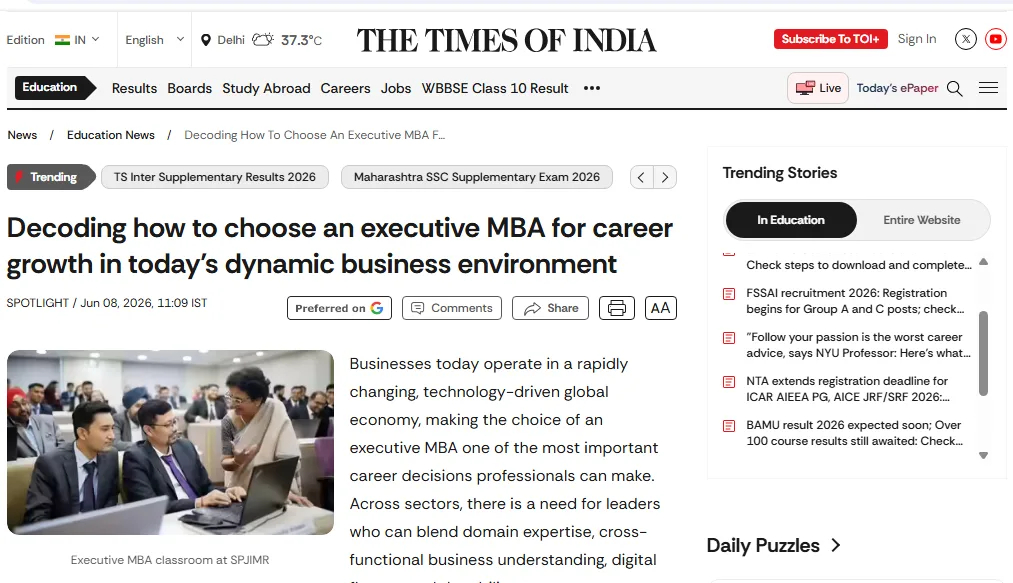
Image credit: Times of India
The implications of this shift are increasingly visible across industries. As organisations rethink workforce development and leadership readiness, executive education is emerging as an important pathway for professionals seeking to remain competitive and prepare for larger responsibilities. This growing relevance was also highlighted in a recent Times of India article, which explored how executive management programmes are helping working professionals accelerate career growth and navigate changing career demands.
As businesses pivot towards AI and the green transition, the ‘Learning Coefficient’, the ability to acquire new knowledge rapidly, has become the ultimate leadership currency.
The expiring shelf life of professional knowledge
We have moved far beyond the era where a degree could carry a professional through a 30-year career. Prasad Kurup, Vice President and Senior Partner at IBM Consulting and an SPJIMR alumnus, has spoken about a dramatic compression in the longevity of expertise.
“With every passing five years, the shelf life of learning is dropping significantly. What we learn today may remain relevant for only two to three years,” Kurup notes.
The most valuable professionals of the coming decades may not be specialists or generalists, but adaptive learners capable of navigating constant change. This practitioner-led insight is mirrored in global data; the WEF report highlights that 85% of organisations now prioritise upskilling their workforce as their primary strategy to combat skills gaps.
Watch Prasad Kurup share his
leadership insights
Why attitude is outperforming technical brilliance
In a world where technical content can be superseded by a new AI model in months, leadership potential is being redefined. When identifying ‘High-Potential’ (Hi-Po) talent, Kurup argues that attitude and accountability carry more weight than technical mastery.
“If I had to choose between someone who is brilliant and someone who has a great attitude, everything else being equal, it is usually the attitude that wins,” he suggests.
This is not merely a qualitative preference; the WEF Report 2025 ranks resilience, flexibility, and agility as the second-most-essential core skills for the future, with 67% of companies identifying them as critical.
High-potential leaders are often spotted in the ‘10-second pause’, in those moments of crisis where an individual chooses to step forward and say, “This is my problem… give me 24 hours, and I’ll fix it”.
The power of a senior cohort: solving for ‘here and now’
For mid-career professionals, aspiring to do an Executive MBA, SPJIMR’s Post Graduate Programme in General Management (PGPGM-Executive) provides significant value-add due the highly experienced faculty, many of whom have industry experience as well as highly diverse and experienced cohort which ensures that classroom discussions are grounded in reality rather than theory.
Kurup emphasises that experienced professionals bring a “far more practical set of problems to solve” to the table. This seniority enables solutions that are feasible for a CEO to implement ‘here and now’, bridging the gap between the academic framework and boardroom execution. This emphasis on practical problem-solving is what makes executive education particularly relevant for working professionals. The ability to immediately apply classroom insights to workplace challenges creates a stronger connection between learning and leadership. The WEF report supports this focus, noting that analytical thinking and complex problem-solving remain the top sought-after core skills in 2025.
This is where executive education becomes a catalyst for career growth. With participants in the cohort varying in experience from 4+ to 20 years, SPJIMR’s PGPGM (Executive) creates an environment where they are able to learn from peers facing leadership challenges. Rather than focusing solely on theory, the programme encourages participants to apply frameworks to real business problems, helping them build the analytical and strategic capabilities required in an era of rapid change.
Managing complexity through a 30-year career
Careers generally evolve through three distinct phases:
- Phase one: Acquiring functional skills.
- Phase two: Contributing bold decisions and taking risks.
- Phase three: Clearing the way for the next generation.
Executive education helps professionals move beyond a rigid, black-and-white technical outlook and develop the ability to navigate ambiguity and complexity, whether arising from geopolitical uncertainty, supply chain disruption, technological change, or financial instability.
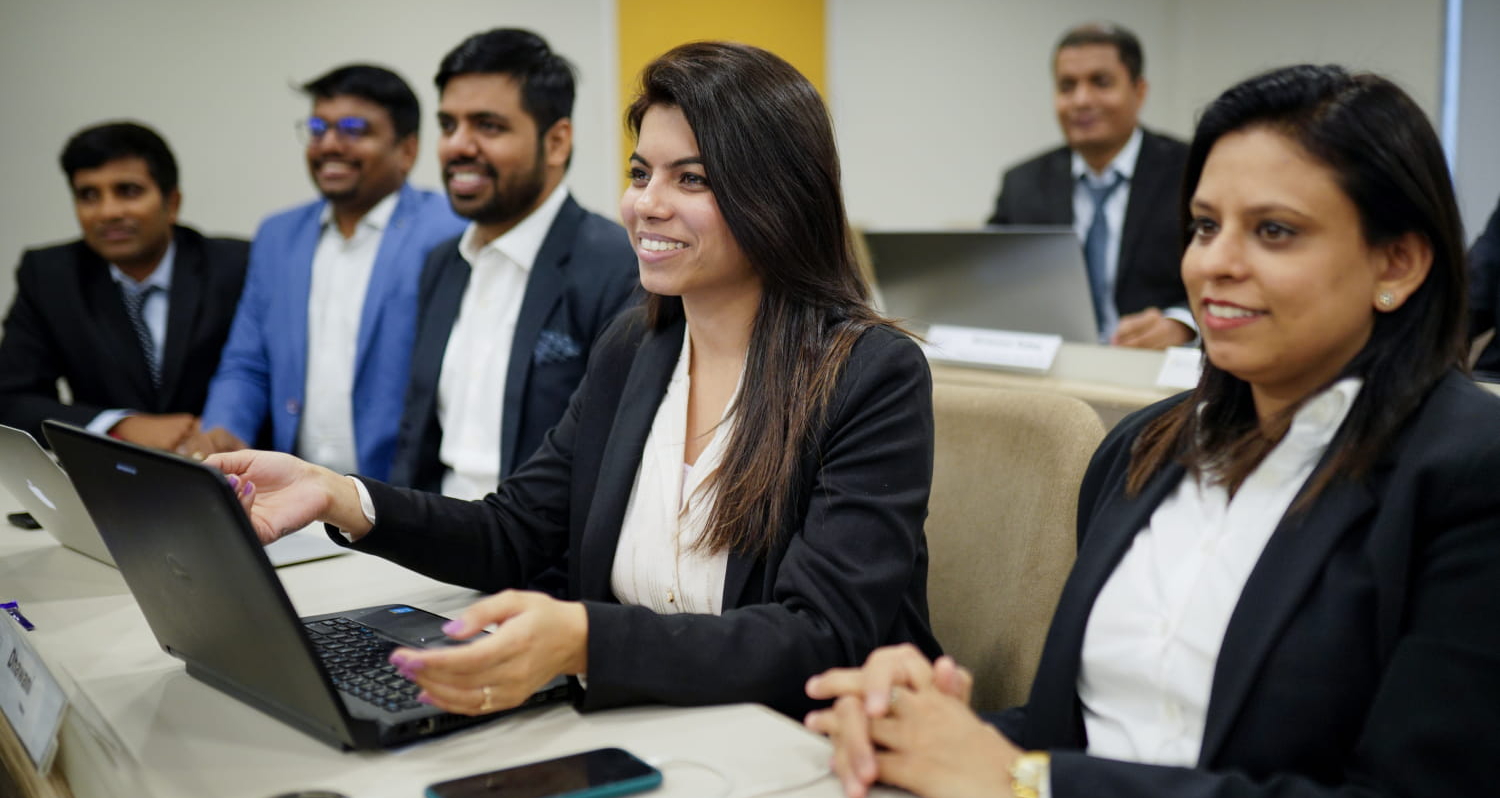
As professionals move through these phases, the challenges they face become increasingly complex. Success depends not only on technical knowledge but also on the ability to manage ambiguity, understand business interdependencies, and make decisions in uncertain environments. Executive education helps professionals make this transition by broadening their perspective beyond functional expertise and preparing them for enterprise-level leadership.
Career transformation through SPJIMR PGPGM (Executive)
While leadership insights provide the framework, the real value of executive education lies in how professionals apply these lessons to their careers.
For many PGPGM (Executive) participants, the programme becomes a catalyst for career reinvention, broader leadership responsibilities, and greater confidence in navigating change.
One such example is Dhawani Khatri, Sourcing Specialist at Ralph Lauren and PGPGM (Executive) alumna, who shares, “PGPGM has actually shaped me into the professional that I am today. The programme helped me develop leadership and managerial skills, understand how to approach larger business problems, and work with bigger clients. By the end of my PGPGM journey, I joined a reputed global luxury brand, Ralph Lauren.”
Watch Dhawani share her PGPGM
(Executive) experience
Her experience highlights how executive education can help professionals connect learning with real-world application, build the confidence to take on larger responsibilities, and prepare for opportunities in global organisations.
Why SPJIMR PGPGM (Executive) is designed for working professionals
SPJIMR’s Post Graduate Programme in General Management (PGPGM-Executive) is a two-year weekend MBA option for those who cannot afford to take a career break but recognise the urgent need to relearn.
Delivered in SPJIMR’s Mumbai and Delhi campuses, the programme awards an AICTE-approved diploma (PGDM–Executive Management Programme).
Through an application-oriented pedagogy, participants are encouraged to continuously connect classroom learning with workplace challenges. This enables professionals to absorb new concepts, test them in real-world situations, and develop stronger leadership capabilities.
Discover how SPJIMR’s PGPGM (Executive) can help you navigate complexity, build future-ready leadership capabilities, and stay relevant in a rapidly evolving business landscape.