



Samavesh 2026: GCC 3.0 — From cost arbitrage to enterprise ownership
11 September 2026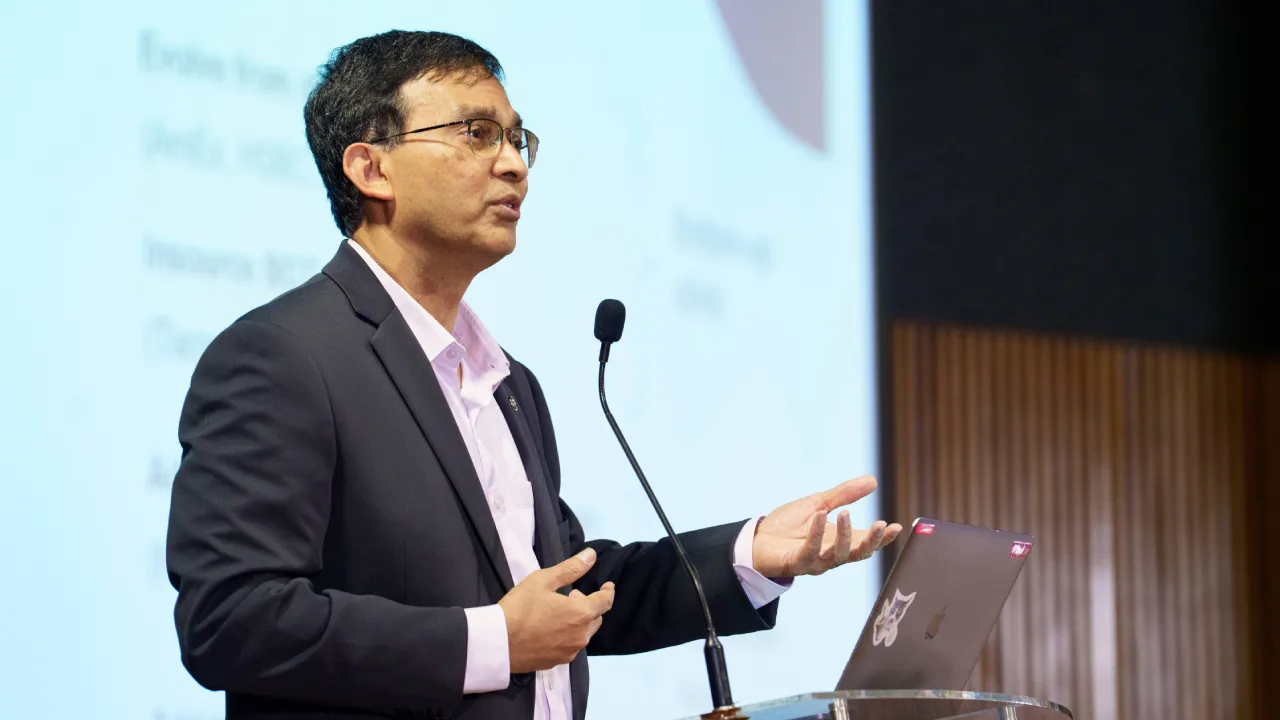


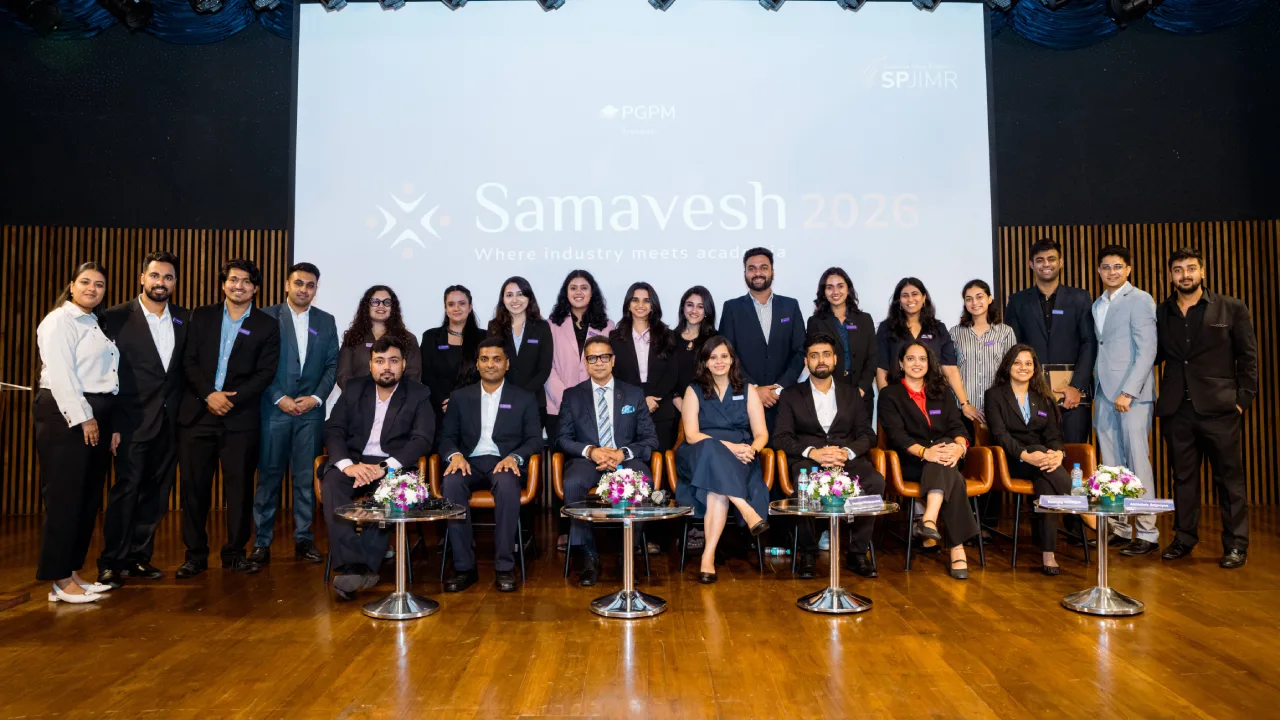


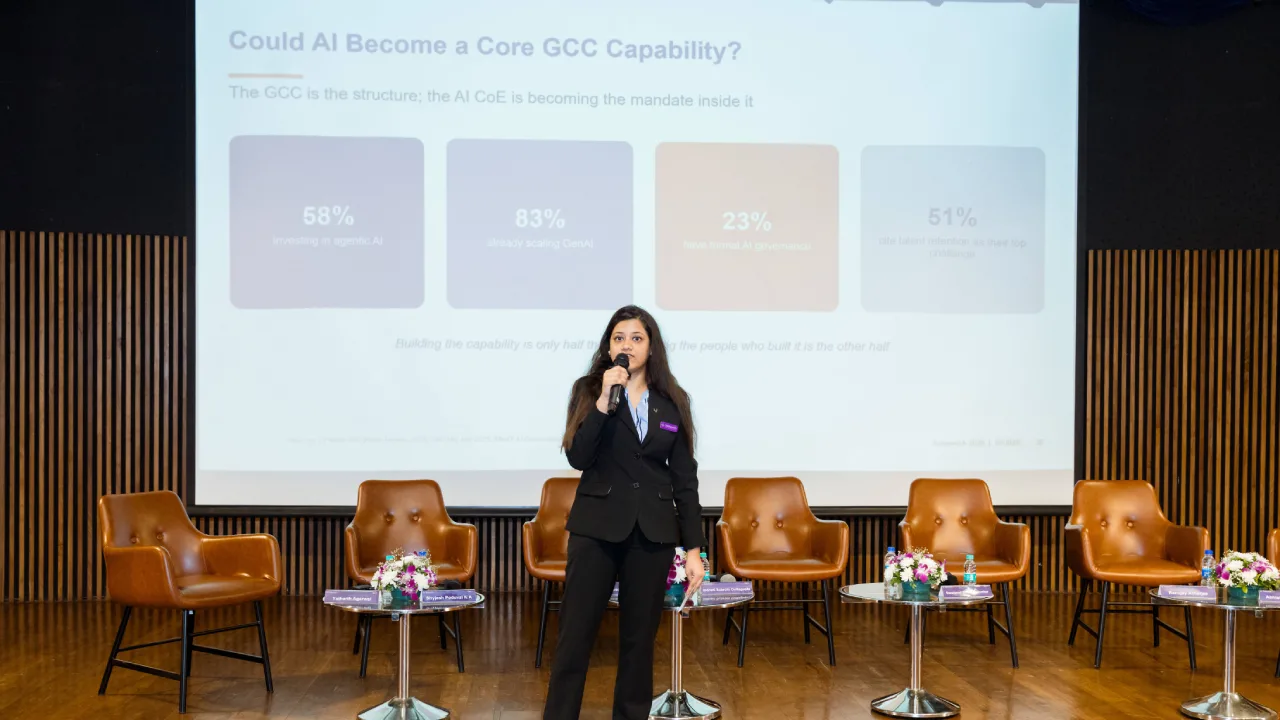
Samavesh 2026, the annual business-academia conclave hosted by the Post Graduate Programme in Management (PGPM) at SPJIMR Mumbai, convened top industry voices and leading scholars to address one central question: has India’s Global Capability Centre (GCC) story graduated from cost arbitrage to enterprise ownership? Through a framing address, two student presentations, a keynote from KPMG and two expert panels, the day built a consistent argument that capability in India has scaled dramatically and decision-making authority must match its pace.
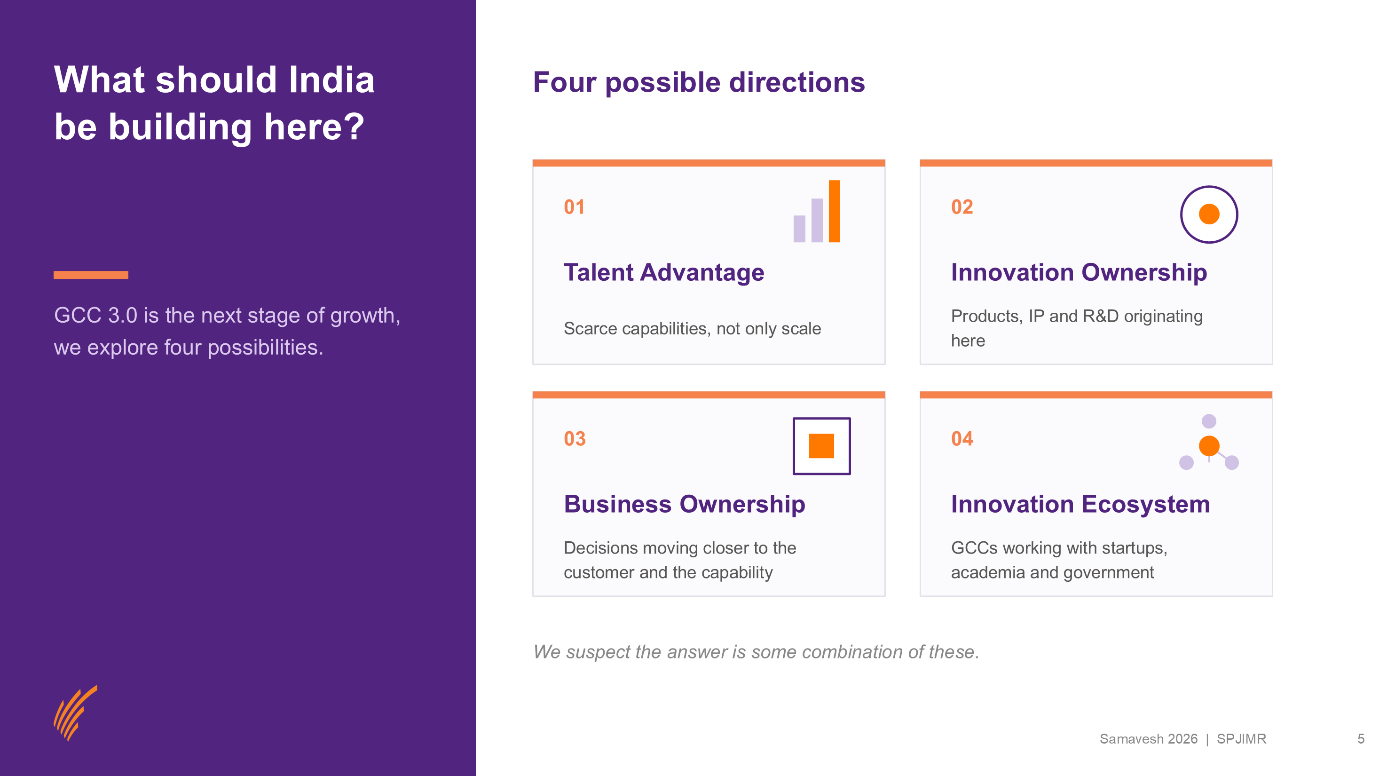
The four pathways that shaped every conversation
Prof. Varun Nagaraj, Dean, SPJIMR, opened the day with a diagnostic lens, urging the students to carry it through every session. GCCs, he explained, reach ownership by two broad routes:
- Global product ownership
- Global process ownership
Prof. Nagaraj then set students a task for the day: “Past trajectory, past history, sets the context of the environment you walk into. Use this framework as an organising lens for who you’re talking to, where they came from, and, therefore, what might actually matter to them — even if they don’t bring up their origin story directly. Be ready to deal with second-order issues.”

Artificial intelligence (AI), talent acquisition and autonomy from headquarters, he pointed out, mean very different things depending on which pathway a GCC has travelled.
Student presentation 1: The evolving role of consumer and product GCCs in driving global innovation
The student presentation delivered by Sachin Kapoor and Pranav Madan, PGPM 2027 participants traced the evolution of India’s GCC landscape, from its emergence as a low-cost execution hub in the 1990s to the development of deeper capabilities and integration with global value chains. It examined the shift from GCC 1.0/2.0 to GCC 3.0, driven by talent, technology and increasing business complexity. It also outlined four shifts needed for India to build and sustain its advantage, before posing key questions to the think tanks in the room on India’s next phase of growth:
- Which decisions should stay with the GCC and which should remain at HQ?
- What needs to be in place for a global product mandate to be owned end-to-end in India?
- Why is India currently unable to properly value and account for the IP built here by GCCs?
- By 2030, what would make a global product or consumer company choose not to select India as its next GCC destination?
Samavesh 2026 keynote: Shalini Pillay, India GCC Leader, KPMG
In her keynote address, Shalini highlighted that while the GCC model has moved well beyond cost savings, India is still early in that shift.
Her advice to students: Keep skilling up and stay agile. The next four to five years are a strong window.

The market is bigger than the published numbers
- By her estimate, India already has a GCC market worth about $120 billion.
- One to two new GCCs open in India every week, across sectors from banking, financial services and insurance (BFSI) to energy, life sciences, aviation and real estate.
- More than 60% of GCCs still do operations and delivery work largely. Only 10–15% do true AI-led, innovation-driven work.
From headcount to capability
- The largest GCCs, such as JPMorgan Chase (about 70,000 people) and HSBC (about 55,000), represent the old model. New centres are smaller and built for deep capability rather than scale.
- She outlined a four-stage maturity path: operations centre, delivery centre, capability unit and transformation hub. At the last stage, the GCC becomes a strategic partner with a seat at the table.
- The examples ranged from banking platforms built and run entirely from India to digital twins for oil rigs and pipelines, to end-to-end AI transformation in insurance.
Cost still matters
She pushed back on the idea that cost is now secondary. GCCs that took their eye off cost have shut down. Growth, capital efficiency, risk reduction, customer and brand, and people and culture add to the cost lever. They do not replace it.
Is the GCC the ‘brain’ of the enterprise?
Not yet. Headquarters (HQ) remains the prefrontal cortex, which sets the vision. GCC 2.0 is the brainstem and cerebellum, which handle execution. GCC 3.0 and beyond is the hippocampus, which does deep cognitive work. The edge will come from technology combined with deep domain knowledge, because technology alone will commoditise.
Looking ahead
- Global headwinds such as US tariffs and the West Asia crisis have strengthened the case for India. She sees India as neutral, safe ground.
- The biggest untapped opportunities are AI readiness (especially data engineering) and digital trust.
- She expects the GCC model to look very different within a year, with more done with less, a blended human and digital workforce, and sector-level impact.
Key takeaways from the Q&A with Shalini Pillay, India GCC Leader, KPMG
- Consulting: She prepared a NASSCOM workshop overnight using an AI prompt and had the slides in 30 minutes. Clients now pay for outcomes, judgement and ecosystem relationships, not for anything that can be automated.
- Decision-making: New GCCs skip the long climb. They arrive with experienced leaders, a clear AI vision and secondees from global leadership.
- GIFT City: It serves a different purpose, which is to enable foreign fund repatriation rather than build deep capability.
- Talent: She named it the number one risk. The issue is deployability, not quantity. Graduate jobs are shrinking faster than most people realise. New GCCs also cluster near competitors to hire trained resources, so the current pace of one to two new GCCs per week is unlikely to continue.
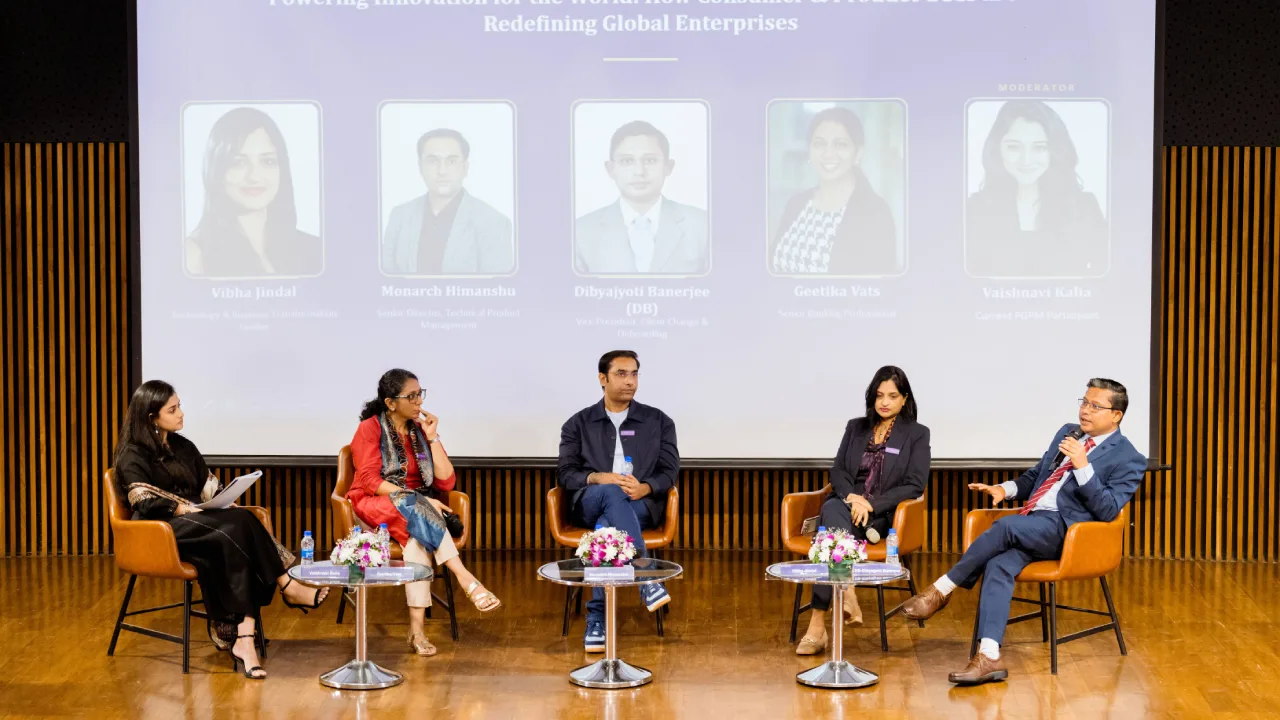
Panel I: Powering innovation for the world: How consumer and product GCCs are redefining global enterprises
The first panel explored what it takes for GCCs to move from capability building to genuine ownership. Moderated by Vaishnavi Kalia, PGPM 2027 participant, the discussion brought together perspectives from technology, product management, banking and business transformation.


Monarch Himanshu, Senior Director, Technical Product Management, Nike, drew a clear distinction between having a title and having real ownership: “Ownership is not about title. Ownership is about decision rights.” He suggested three practical tests: whether a GCC can shape and defend its product roadmap, control hiring for its team, and, importantly, say no to headquarters when required.

Geetika Vats, Senior Banking Professional, highlighted the evolution of GCCs in financial services, from payroll and back-office functions to treasury, sanctions monitoring, regulatory work and M&A integration. Her observation captured the progression: “Capability builds, responsibility follows, decision-making eventually moves with it.”

Vibha Jindal, Technology & Business Transformation Leader, emphasised that innovation should not be measured simply by technology adoption. The discussion cited examples such as ONDC and Zara to illustrate how innovation can come from reframing a business problem rather than applying a new technology.

Dibyajyoti Banerjee (DB), Vice President, Client Change & Onboarding, HSBC Markets Securities Services, brought the conversation back to the broader evolution of GCCs, noting that their role has expanded from traditional back-office support to increasingly complex, globally integrated work. His perspective reinforced the importance of combining functional expertise with technology and client understanding.
Student presentation 2: Enablers, talent, infrastructure and skills
Delivered by Aparajita Mahanty, Manisha Rijhwani and Urvi Agarwal, SPJIMR PGPM 2027 participants, the session highlighted that GCC 3.0 will judge what India owns, not what India delivers.
The team’s argument was that Global Capability Centres (GCCs) in India have moved from working for global enterprises to being owned here. What determines the next phase is not headcount but who holds the intellectual property (IP) and decision rights.
SPJIMR’s view: Next big leap
“Global Capability Centres have grown well past their old role as delivery and support arms. They now sit at the centre of innovation, product development, digital transformation and AI adoption, often shaping enterprise decisions rather than just carrying them out. This is GCC 3.0: centres that actively shape the future of the businesses they serve, not merely enable it.”
Why India, and why now
- The number of centres has grown from about 1,600 to more than 2,000 in five years, and it is spreading beyond the metros into tier-2 cities.
- Companies keep choosing India for talent depth, the breadth of adopters, ownership, work beyond technology and reach beyond the metros.
- The team framed the day around four dimensions: consumer GCCs, product GCCs, enablers and ecosystem partners, and skills and talent.
Idea 1: a GCC-owned talent marketplace
The team proposed a platform that the GCC owns and spans its global footprint, rather than a single business unit. It maps skills, project demand and capacity, then matches people to work across organisational lines. That stops firms from hiring externally for skills they already have and prevents spare capacity from becoming a permanent bench. Unilever and Schneider Electric already run internal talent marketplaces. The proposal moves ownership of that view into the GCC, which is best placed to see the whole picture.
Idea 2: AI as a core GCC capability
- 83% of GCCs are already scaling generative AI and 58% are investing in agentic AI.
- Only 23% have formal AI governance.
- 51% name talent retention as their top challenge.
- Their takeaway: building the capability is only half the job, and keeping the people who built it is the other half.
Idea 3: Reverse innovation cycle
The team proposed a five-step loop: sense a constraint specific to the Indian market, codify it into an operating model, simulate it, transfer it to a target global market and measure the outcomes. The gains compound with every cycle. They argued India can do this because it has:
- about 1.5 million engineers, including roughly 250,000 AI professionals, graduating every year;
- GCCs that took 42% of office space take-up in Q2 2026;
- more than 63,000 patents filed a year, the sixth-largest volume globally;
- a need for human resources (HR) to reward people for filing IP and owning outcomes.
Questions for the panel
- Of talent, infrastructure and partnerships, which enabler is furthest behind?
- What separates an AI centre of excellence (CoE) from a team that simply uses AI tools?
- What keeps people when every firm in the city is bidding for them?
- Should GCC 3.0 be judged by what India delivers or by what it owns?
Panel 2: Enabling GCC 3.0: Talent, technology, infrastructure and partnerships
The second panel examined the talent, technology, infrastructure and partnerships needed to help GCCs move from capability to enterprise value creation. Moderated by Yatharth Agarwal, PGPM 2027 participant, the discussion brought together perspectives from technology, AI, consulting and business transformation.
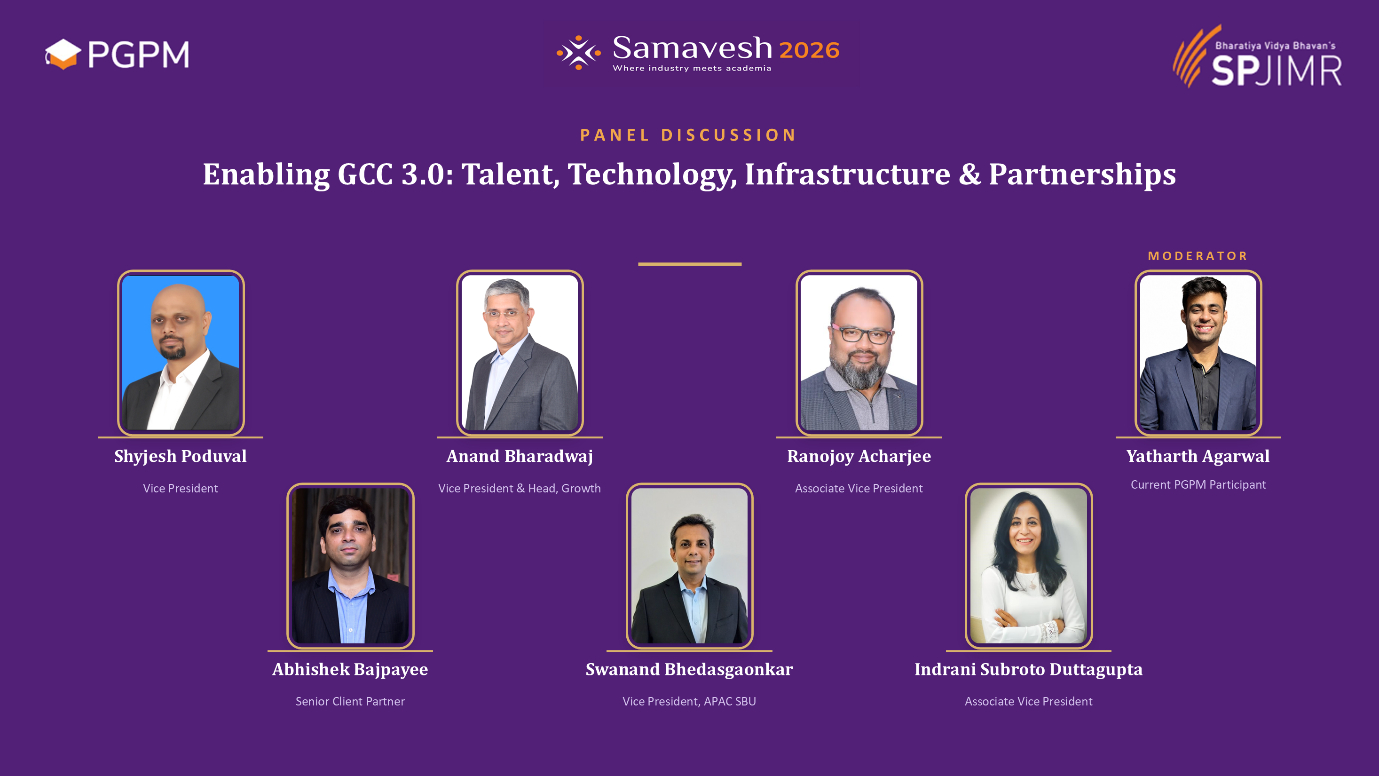

Shyjesh Poduval, Vice President, ANSR, emphasised that the next phase is not simply about adding talent or infrastructure, but creating the conditions for people to take on bigger challenges. “The evolution of GCCs is not about more talent or better infrastructure. It is about creating the conditions for talent to solve bigger problems, innovate faster and shape the global enterprise.”
Anand Bharadwaj, Vice President & Head, Growth, Tiger Analytics, highlighted the growing importance of AI fluency across the GCC ecosystem. “The future of GCCs is about embedding AI fluency across the entire ecosystem, talent, technology, infrastructure, et al., to drive transformative business outcomes globally.”

For Ranojoy Acharjee, Associate Vice President, AIONOS, being future-ready requires judgement, not just technical proficiency. “Future-ready talent is not only about knowing the latest tool. It is the judgment to tell what genuinely works at scale from what is just noise, and in a world of democratised AI, to choose what should be done over what can be done.”

Indrani Subroto Duttagupta, Associate Vice President, Sutherland, focused on building the systems needed to prepare GCCs for their next stage of growth. “I believe the readiness of GCC 3.0 requires a deliberate focus on building future-ready talent, investing in digital-first infrastructure, and continuously upskilling the workforce.”
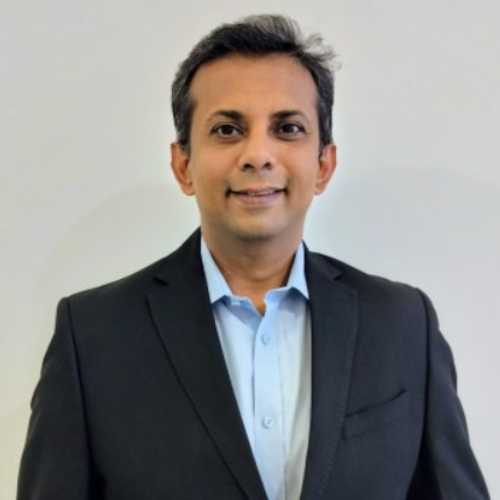
Swanand Bhedasgaonkar, Vice President, APAC SBU & Package-Based Solutions Leader, Capgemini, brought together the different enablers needed to create enterprise value. “The future-ready GCC will be one that seamlessly combines domain expertise, digital technologies including AI, and transformation execution at scale to accelerate enterprise value creation.”

Abhishek Bajpayee, Senior Client Partner, Quantiphi, pointed to the changing mandate of GCCs, from cost and labour arbitrage towards innovation and talent arbitrage, noting the opportunity for India to build on its growing AI talent base and innovation focus.

The discussion brought the different pieces together: talent depth, AI and digital capabilities, infrastructure, leadership and ecosystem partnerships. As Yatharth Agarwal, the moderator, summarised: “Infrastructure can get you in the door, but talent, capability, and the right partnership model are what let India keep the seat.”
The unresolved question
Samavesh 2026 did not resolve nor pretend to resolve its central tension. Ownership, defined across the day as decision rights over roadmap, hiring and the ability to say no, remains capped by structural realities. Technology GCCs mostly report to Chief Information Officers rather than Chief Executive Officers, intellectual property is still often filed abroad, and headquarters frequently controls hiring. Dr Nagaraj’s opening lens proved its worth here: each speaker’s view of these barriers traced back to the pathway their GCC had travelled.
The question the day leaves open, posed first by the students and echoed through both panels, is the one worth carrying forward: should the success of GCC 3.0 be measured by what India delivers, or by what it owns?