



SPJIMR’s Prof. Tulsi Jayakumar contributes to global report on family business sustainability
27 October 2026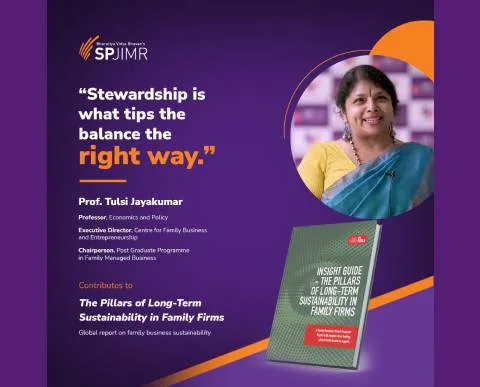
‘The Pillars of Long-Term Sustainability in Family Firms’, a global report published by Family Business United (FBU), draws on international perspectives to examine what helps family firms endure beyond individual generations. It identifies 21 traits associated with long-term sustainability in family firms, with communication, adaptability, shared values and purpose, stewardship, and governance emerging as the five leading traits.
Prof. Tulsi Jayakumar, Professor of Economics and Policy, Executive Director of the Centre for Family Business and Entrepreneurship (CFBE), and Chairperson of the Post Graduate Programme in Family Managed Business (PGPFMB) at SPJIMR, has contributed to the report’s section on stewardship and custodianship, which examines how family businesses can balance emotional ownership with the responsibility to sustain an enterprise across generations.
According to her, “The same emotional ownership that makes a family proud of what it has built can just as easily make it risk-averse or nepotistic. Stewardship is what tips the balance the right way.”
Her insight highlights a defining challenge for family enterprises: balancing the pride of ownership with the responsibility to adapt, make objective decisions and sustain the business across generations. Stewardship offers a way to approach ownership as a responsibility to employees, communities and future generations, rather than simply as control of an asset.
Founded in 2011, FBU is a global platform that connects and champions family businesses through research, thought leadership and industry engagement. The report brings together insights from 137 family business advisers, academics and practitioners across 35 countries and six continents.
SPJIMR’s contribution to family business education
Since establishing the Centre for Family Managed Business in 1997 and launching the PGPFMB, SPJIMR has been among the pioneers of formal management education for family businesses in India. Through CFBE and PGPFMB, the institute equips current and next-generation family business leaders to navigate succession, professionalisation, governance and the changing demands of ownership.
Family business continuity is not simply about passing an enterprise to the next generation. It is about preparing leaders to balance business performance with family values, responsible ownership and the ability to adapt. SPJIMR’s work in family business education reflects this long-term view: building the judgement and capabilities that help enterprises remain resilient, relevant and responsible across generations.
Prof. Jayakumar’s contribution to the FBU report extends this engagement into a wider international conversation. It brings an Indian management education perspective to a global discussion about the conditions that enable family firms to sustain their businesses, values and contribution to society over time.