



How management education can innovate while staying true to its purpose
29 October 2026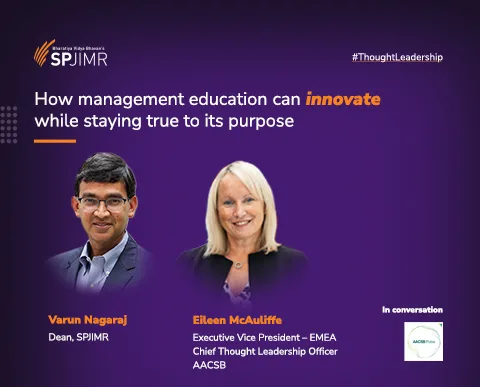
How can business schools remain relevant in a world shaped by artificial intelligence, changing workforce needs and rising expectations of societal impact? For Prof. Varun Nagaraj, Dean, SPJIMR, the answer lies in rethinking established methods while staying true to the purpose of business education.
In an episode of AACSB Pulse, hosted by Eileen McAuliffe, AACSB’s Executive Vice President of EMEA and Chief Thought Leadership Officer, Prof. Nagaraj explores three questions: what makes India’s business education landscape distinctive, how organisations can innovate to create business and societal value, and where business schools need to evolve to remain relevant and impactful.
The conversation draws on his experience in industry and academia, as well as his perspective as an AACSB Board member.
From responsible innovation to wise innovation
Prof. Nagaraj distinguishes wise innovation from approaches focused primarily on managing risk. While responsible innovation seeks to balance economic, environmental and societal needs, wise innovation aims for something more ambitious: human and societal flourishing. It also calls for judgement that takes account of context, recognising that a decision that works in one situation may not be right in another.
For organisations, this means embedding responsibility into everyday processes and decision-making, asking not only how quickly something can be done, but why it should be done in the first place.
Cultivating a paradox mindset
Leadership often involves navigating competing priorities. Prof. Nagaraj argues that these should not always be treated as an either-or choice. In many situations, the answer may be to pursue alternatives that appear to be in conflict.
This paradox mindset can be cultivated. Business schools can help students develop it by placing them in ambiguous, unstructured situations where there is no single obvious answer, encouraging reflection and providing a safe space to practise judgement before they encounter similar challenges in their careers.
Making management research matter
The conversation also examines the relevance of management research. Prof. Nagaraj calls for research to begin with problems of practice, rather than focusing only on gaps in existing literature. Researchers should consider the potential downstream impact of their work from the outset and develop ways to demonstrate the value it creates for industry and society.
This approach can help strengthen the connection between academic inquiry and the challenges organisations face, while making the case for the wider value of investment in management research.
Rethinking the future of business education
As AI and alternative learning platforms reshape how people access knowledge, Prof. Nagaraj argues that business schools must sharpen their distinctive contribution: helping people develop judgement through experience, reflection and engagement with complex problems.
He suggests taking a life-cycle view of management education. Early in their careers, learners need safe spaces to build critical thinking and judgement. Throughout their working lives, they need opportunities to keep learning and applying new knowledge. Business schools must therefore rethink established programme models and strengthen the connection between academic learning and professional practice.
The central challenge is to innovate in how business education is delivered without losing sight of its purpose: creating impact through students, research and engagement with industry and society.