


The whole we belong to: A Vedāntic exploration of reality as the Total physical, subtle, and causal
My previous article From isolation to belonging: Seeing life as an intelligent whole. explored the movement from isolation to belonging by seeing life as an intelligent whole.
This piece takes that inquiry further. What exactly is this “whole”?
Human inquiry, guided by rationality and science, begins with a simple but powerful discovery: the universe is not random. Across disciplines—physics, biology, and the study of mind—we encounter patterns that are consistent, repeatable, and intelligible. These patterns are what we call laws.
This recognition is transformative. It replaces unpredictability with structure and allows us to engage meaningfully with the world. Yet, as inquiry deepens, an important question arises: Are these laws isolated to their respective domains, or do they point to a deeper, unified understanding of reality?
Vedānta takes this inquiry further. What science recognises as laws, Vedānta understands as expressions of a universal, intelligent order that pervades everything. This order is not fragmented into separate compartments such as physical, biological, or psychological. It is one, appearing differently at different levels of manifestation.
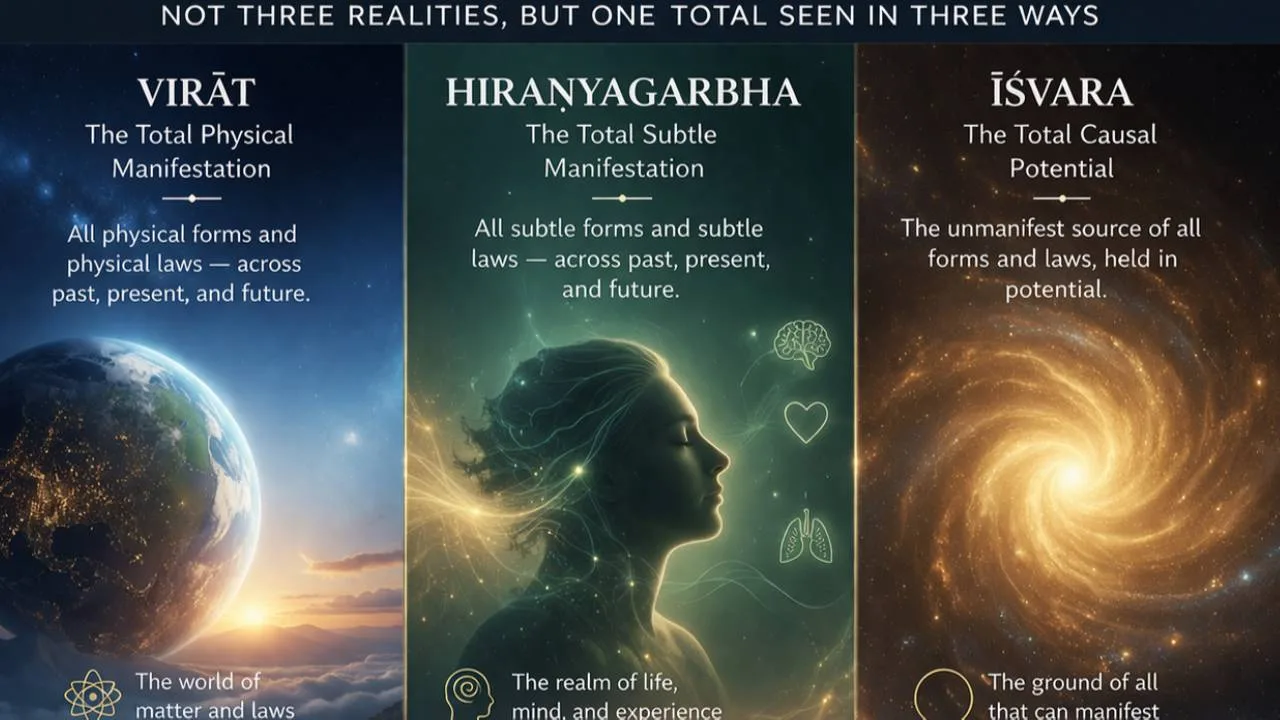
The Māṇḍūkya Upaniṣad provides a powerful framework to unfold this vision through A–U–M, corresponding to three standpoints: Virāṭ (gross), Hiraṇyagarbha (subtle), and Īśvara (causal). These are not three separate realities, but three ways of understanding the same totality.
Virāṭ: The total physical manifestation
At the level of Virāṭ, we encounter the fully manifest physical universe—everything available to perception. This includes matter in all its forms, from subatomic particles to galaxies, as well as all physical bodies and systems.
This is the domain most thoroughly explored by science. Here, order is visible as physical laws:
- Laws of motion describe how objects move under forces
- Gravitational laws explain the structure and stability of planetary systems
- Thermodynamic laws govern energy transformation and entropy
- Electromagnetic laws explain light, electricity, and communication systems
- Atomic and quantum laws describe matter at its most fundamental level
These laws reveal a universe that is not arbitrary but deeply structured. A falling object behaves predictably; planetary motion follows precise trajectories; energy transformations occur within defined constraints. Even at the quantum level, where outcomes are probabilistic, the probability distributions themselves follow consistent rules.
A crucial clarity here is that Virāṭ is not merely the domain of physical laws. It is the total physical manifestation—all forms and all laws. This includes every physical object, every body, and every system—human, animal, plant, and material—across past, present, and future.
From a Vedāntic standpoint, these laws and forms are not independent. They are expressions of Īśvara as Ṛtam—the intelligent order manifest in the physical universe. What physics describes as “laws” are the observable expression of this order.
Hiraṇyagarbha: The total subtle manifestation
While Virāṭ represents the outer world of objects, Hiraṇyagarbha represents the subtle order governing life and mind. This includes cognition, emotion, physiological regulation, behavioral patterns, and the dynamics of experience.
At first glance, this domain may appear less structured than the physical world. Thoughts seem unpredictable, emotions fluctuate, and behavior appears complex. However, a deeper examination reveals that this domain too operates under consistent and intelligible principles.
First, there is an epistemological order—an order governing how knowledge takes place. Perception follows a structure: sense organs connect with objects, the mind processes the input, and knowledge arises in a recognisable form. What we know, how we interpret it, and even how errors arise are governed by this order. The very possibility of shared understanding and correction reflects this underlying structure.
Second, there is a psychological order governing emotions and desires. Emotions are not isolated events; they arise within an interconnected system of thoughts, beliefs, desires, and behaviors. What one thinks and believes shapes what one desires; desires influence emotional responses; emotions drive actions; and actions reinforce underlying patterns. Within this interplay, rāga (likes) and dveṣa (dislikes) play a central role, giving structure to attraction and aversion. This explains why responses are patterned rather than random.
Third, there is an order governing life processes, which can be understood as the biological order. Respiration, circulation, digestion, metabolism, and neural regulation function with remarkable coordination across all living beings. These processes maintain equilibrium and continuity of life. Vedānta refers to this as prāṇa, recognising it as an expression of a universal biological order that links body and mind.
Fourth, there is an order governing behavior and habit formation. Behavioural sciences show that habits arise through identifiable mechanisms: repetition strengthens neural pathways, reinforcement stabilises behaviour, and feedback loops sustain patterns. Change also follows an order—through awareness, deliberate intervention, and consistent practice. Personality and tendencies are thus shaped through lawful processes of conditioning and reconditioning.
A crucial clarity here is that Hiraṇyagarbha is not only the domain of subtle laws. It is the total subtle manifestation—all thoughts, emotions, tendencies, and subtle bodies across all beings, spanning past, present, and future.
Seen in this way, the inner and life domains are not chaotic. They are governed by subtle laws, forming a coherent and interconnected field.
Īśvara (M): The total causal potential
The third level, associated with M, is the causal level, where the universe exists in an unmanifest condition. Here, all differentiation—objects, thoughts, and experiences—is resolved into a unified state without distinct names and forms.
This is not an absence, but a condition in which everything exists in potential form. The entire universe—physical and subtle—is present in an unexpressed condition, ready to manifest in an ordered manner.
The causal level includes the entire past, not merely as memory but as an accumulated field of causes. Every action, interaction, and process leaves behind a potential, which becomes part of this causal order. The future unfolds from this accumulated causal base through a continuous series of cause-and-effect relationships operating across all domains.
A key aspect of this causal order is karma as stored potential (sañcita). Every action produces not only an immediate result but also leaves behind a residual potential. These accumulated potentials remain in an unmanifest condition, forming part of the causal order.
When conditions become appropriate, these potentials express themselves:
- At the physical level, as circumstances, environments, and events
- At the subtle level, as tendencies, inclinations, preferences, and responses
In this way, karma is not an isolated mechanism but is deeply integrated with all orders. It interacts with physical laws, biological systems, and psychological patterns, ensuring that the unfolding of events is neither arbitrary nor disconnected.
A crucial clarity here is that Īśvara is not only the seed of laws but also the seed of all forms and objects yet to manifest. Every possible physical and subtle expression exists here in an unmanifest condition.
One reality, seen in three ways — A final reflection
The unfolding from Virāṭ to Hiraṇyagarbha to Īśvara is not a movement in space or time; it is a shift in understanding.
At one level, we recognise a universe governed by physical laws, precise, measurable, and consistent. At another level, we recognise that life processes and the mind are also governed by equally consistent, though more subtle, laws. At a still deeper level, we understand that all these laws exist in an unmanifest, causal condition from which manifestation arises.
A final clarity completes this vision.
Virāṭ is the total physical manifestation—all physical forms and all physical laws, across past, present, and future.
Hiraṇyagarbha is the total subtle manifestation—all subtle forms and all subtle laws, across past, present, and future.
Īśvara is the total causal potential—the unmanifest condition that includes all forms and all laws yet to manifest.
Seen in this way, what we usually take as separate—objects, bodies, life processes, thoughts, and causality—are not independent domains.
They are one unified whole, one single reality, understood from three different standpoints:
- As fully manifest (Virāṭ)
- As subtle and dynamic (Hiraṇyagarbha)
- As unmanifest potential (Īśvara)
These are not three separate realities, but three ways of understanding the same total.
The implication is both simple and profound: The universe is not random. Life is not arbitrary. The mind is not chaotic.
There is no “outside” to this total. All forms, including myself—and all laws, manifest or unmanifest, belong to one indivisible reality.
And I am not separate from this total. What I take to be “me” is not apart from the whole— it is included in it, sustained by it, and non-separate from it.
To recognise this is to see clearly: I am not an isolated individual in the universe. I am part of the total and not separate from it.
About the faculty

Surya Tahora
Surya Tahora is a professor in the area of general management at SPJIMR. He teaches Spirituality and Leadership to around six hundred MBA and Executive MBA students annually and conducts workshops for various organisations in India, Europe, and Asia.
More from Surya Tahora
-
Intelligence on trial: What Kafka, Sternberg, and Advaita Vedānta can teach us about possibility
Read more - Read more
-
Flow vs. wisdom: What happens when the Zen monk meets the jazz saxophonist?
Read more -
If I already trust life, what role does Īśvara play?
Read more -
Do we really need Īśvara? A dialogue with a secular humanist
Read more
Recent faculty blogs
Most read faculty blogs
-
Organisational responses to hybrid work—Rethinking culture and civility in India
Read more -
When Amazon arrived late to India’s quick commerce party
Read more -
The 2013 RBI FCNR(B) Swap Window – Review & Takeaways
Read more -
Reimagining travel through AI: Making every journey smarter and more personal
Read more -
Budget 2025: Unlocking opportunities for the private sector
Read more