Programme genesis

In an era defined by data abundance and AI-powered analytics, financial intelligence is no longer the exclusive preserve of finance professionals. Non-finance managers across manufacturing, services, and project-driven industries are expected to make decisions that are commercially sound, strategically aligned, and data-backed. Yet most managers have had limited formal exposure to finance — and even less to the AI tools that are now reshaping how financial data is analysed and acted upon.

Finance 2.0: Leading with Data & AI is designed for exactly this need. It goes beyond traditional financial literacy to equip managers with practical skills to use AI tools—including generative AI, dashboards, and automation—for financial analysis, forecasting, and business decision-making. This programme creates a new breed of data-informed managers who can bridge the language of finance and the power of technology.

Programme goals

This programme aims to equip managers from non-finance functions with the financial intelligence and AI fluency to make sharper, commercially sound decisions. The key outcomes include:

  • AI-augmented financial intelligence: Use AI tools to analyse financial statements, generate insights, and build scenario models — without writing a single line of code.
  • Data-driven decision confidence: Read and interpret key financial metrics and KPIs to make informed decisions in their domain.
  • Cross-functional financial communication: Engage effectively with CFOs, finance teams, and business partners using a shared financial vocabulary.
  • Operational finance mastery: Understand how day-to-day decisions in manufacturing, services, and projects affect the P&L, balance sheet, and cash flows.
  • Business forecasting & planning: Leverage AI-powered tools for budgeting, variance analysis, and rolling forecasts.

Pedagogy

Finance 2.0 is built on the conviction that financial intelligence is best acquired through doing, not watching. Every theme combines conceptual clarity with immediate application. The pedagogical approach integrates:

  • Live AI labs: Every theme includes a structured, guided hands-on activity using real or simulated financial data with AI tools — building practical fluency, not just awareness.
  • Industry-anchored case studies: Cases are drawn from services, core manufacturing, and project management domains to ensure relevance across the participant cohort.
  • Cross-industry peer learning: Structured group work across industries creates rich dialogue — a services manager learning from a plant head, a project manager exchanging frameworks with an HR leader.
  • Financial simulation exercises: Gamified exercises on cost decisions, working capital management, and investment choices build intuition in a risk-free environment.
  • Personalised AI prompt library: Participants develop their own library of AI prompts for financial analysis tasks — a take-home toolkit for immediate application back at work.
  • Reflective practice and action planning: Each day closes with structured reflection, ensuring learning is connected to each participant’s specific role and context.

Programme coverage

The programme is structured around seven integrated themes spread across two days. Each theme combines conceptual grounding with a live AI component, ensuring participants build both financial understanding and practical AI fluency simultaneously.

  • Theme 1: The language of finance and financial statements

  • Theme 2: Financial ratios as a management compass

  • Theme 3: Cost intelligence and break-even thinking

  • Theme 4: Capital investment and business case decisions

  • Theme 5: Budgeting, forecasting and variance analysis

  • Theme 6: Working capital, cash flow and operational finance

  • Theme 7: Financial dashboards and data-driven storytelling

Programme Director

Anshul Verma, Professor, Finance and Economics Chairperson, PGPM.

Anshul Verma

Professor, Finance and Accounting
Chairperson, Post Graduate Programme in Management

Anshul Verma holds a double doctorate from Dr. B.R. Ambedkar University, with specialisations in Management and Applied Business Economics. Over the course of his 20-year academic career, he has served as a faculty member in finance at leading graduate management institutions in India.

He has also held administrative responsibilities, including serving as the programme head for flagship academic programmes.

Who can attend

This programme is designed for managers who are analytically curious but have had limited formal exposure to finance. Ideal participants include:

  • Senior and middle-level managers from non-finance functions: operations, supply chain, engineering, HR, marketing, and IT.
  • Project managers in core industries such as EPC, infrastructure, and manufacturing seeking to understand project P&Ls, cost controls, and variance reporting.
  • Business unit heads and functional leaders seeking to align their decisions with financial strategy.
  • Entrepreneurs and SME owners who need to manage business finances and engage with investors and lenders.
  • Professionals from service industries — IT, consulting, BPO, and BFSI — wanting to improve their business case and profitability analysis skills.

Programme dates and fee details

Date Time Fees
Batch 1: September 25-26, 2026
Batch 2: January 22-23, 2027
Friday – 9:00 am to 6:00 pm
Saturday – 9:00 am to 6:00 pm
₹ 25,000 + GST
(10% early bird and group discounts available)

Certificate of participation

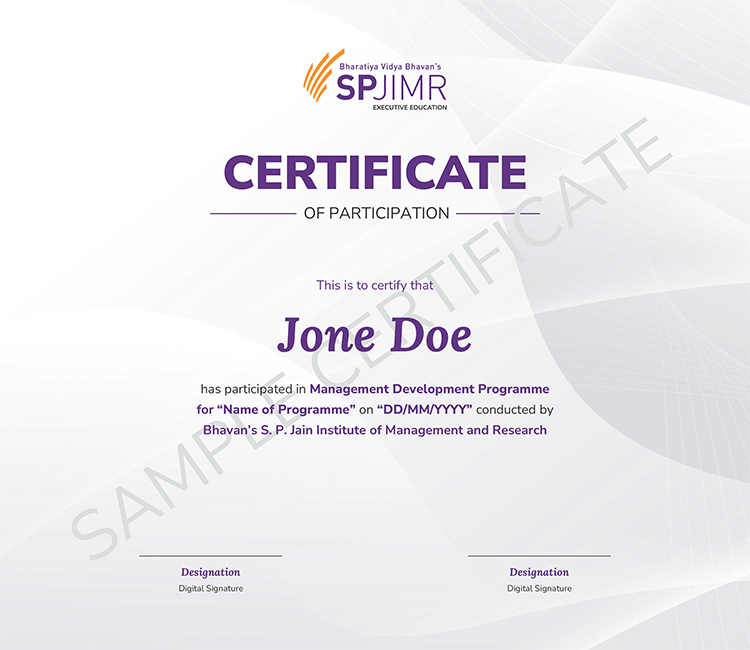
A certificate of successful participation by S.P. Jain Institute of Management and Research (SPJIMR) will be issued to each delegate at the completion of the programme.

SPJIMR’s Open MDPs certificate of participation.

Contact details

Get in touch with our team to explore world-class learning opportunities that can help you achieve your goals and create a lasting impact.

Enquire now
  • Website
  • Email
  • Phone
AppLy Now