



Within the Indian economic landscape, where family-run enterprises constitute 90% of all businesses, a profound structural evolution is underway. For decades, succession followed a rigid, patriarchal lineage, often relegating women to the status of ‘silent assets.’ While these women — sisters, wives, daughters, and daughters-in-law frequently held informal authority in finance or operations, their contributions remained largely untapped and unacknowledged in formal governance.
Today, we are witnessing a transition from patriarchal lineage to meritocratic governance. The paradigm is shifting from ‘predictable inheritance’ to ‘earned leadership,’ as women move from the periphery to the centre of strategic decision-making. This is not merely a change in personnel; it is a fundamental redefinition of how power is accessed and institutionalised within the family firm.
The drivers of change: Prioritising competence over lineage
As global competition intensifies and regulatory pressures demand higher standards of professional governance, family enterprises can no longer afford to overlook their ‘hidden gems.’ The drive toward capability-led leadership is propelled by several converging forces:
Advanced academic specialisation
Women are entering the family ecosystem with elite global education and specialised technical backgrounds.
External professional exposure
Diverse experience outside the family firm provides the objective perspective necessary to challenge stagnating legacy processes.
Strategic adaptability
In a volatile market, families are recognising that diverse thinking is a prerequisite for organisational resilience.
Financial autonomy
A shift toward individual agency and independent risk assessment within the family structure.
Redefining succession: A process, not an event
In the traditional model, succession was viewed as a single, symbolic handover event. Today, expert consultants view it as a long-term process of credibility building. For the modern woman leader, ‘readiness’ has replaced ‘birthright’ as the primary metric of transition.
The case of Reliance Industries: Isha Ambani
Isha Ambani’s trajectory at Reliance Industries exemplifies this shift. By spearheading the expansion of Reliance Retail and driving critical digital initiatives, her leadership has been defined by anchoring future relevance rather than merely presiding over legacy assets. Her role illustrates how women are increasingly leading ‘new growth engines,’ ensuring the business remains competitive in emerging sectors well before any formal title transition occurs.

Image credit: Fortune
Mastering the levers of influence and power
In the complex ecosystem of a family enterprise, authority rarely aligns perfectly with official designations. To navigate this, women are mastering specific levers that allow them to ‘institutionalise the informal’ and build influence:
- Strategic capital allocation: Moving beyond ‘managing the books’ to mastering financial literacy, allowing for active steering of corporate investment committees and risk assessments.
- Governance legitimacy: Securing consistent visibility within formal decision-making forums and boards to transition from observer to influencer.
- Multigenerational relationship capital: Cultivating deep-seated trust with long-term stakeholders and employees, bridging the gap between traditional values and modern professional demands.
Strengthening continuity through a professional lens
The entry of women into formal leadership often introduces a subtle but transformative shift toward structured professionalism. By championing clearer role definitions and collaborative conflict resolution, women leaders introduce a level of organisational stability that protects the enterprise from the emotional volatility often found in family dynamics. This ‘female lens’ does not dilute authority; it strengthens the firm’s sustainability through more transparent governance.
Real-world impact: Insights from the LiFE alumni network
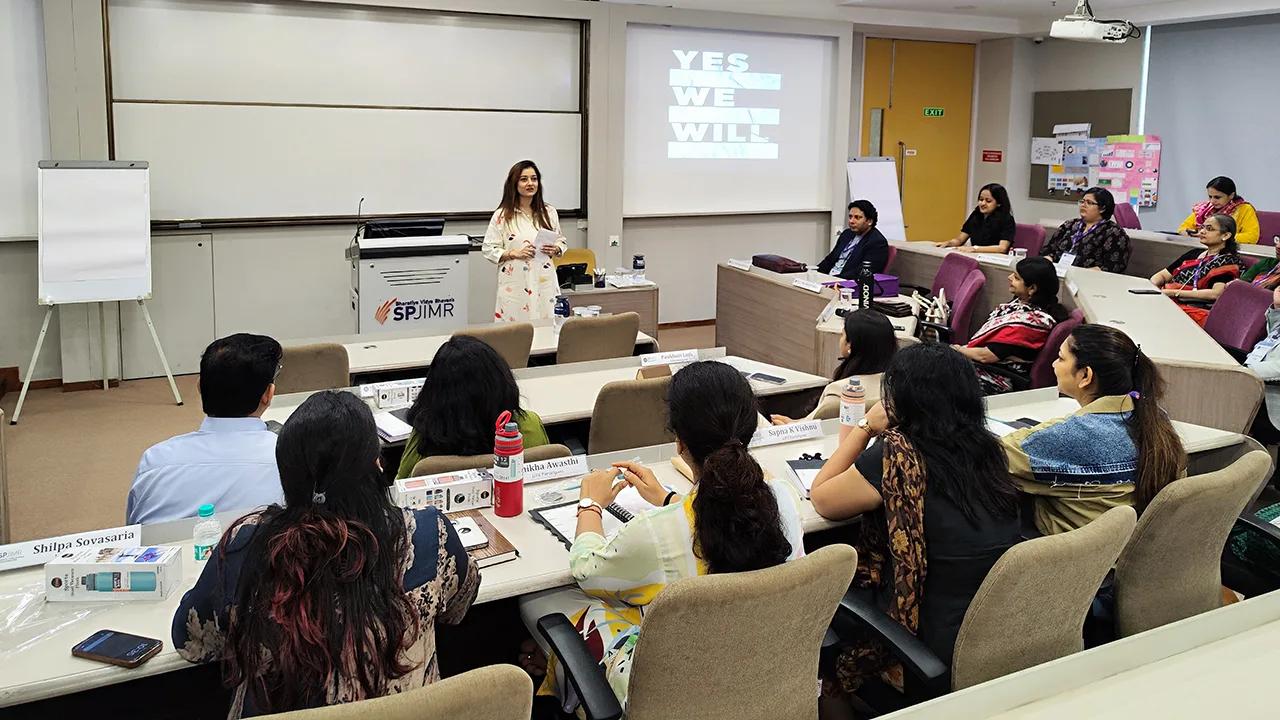
The shift from access to agency is best illustrated by the women who have navigated this journey through the SPJIMR LiFE programme:
Pankhuri Lath (Lucknow)
‘The programme was a turning point, helping me rediscover my sense of self and purpose. This clarity translated into greater confidence and more active participation in business decisions.’
Sapna Vishnu (Bengaluru)
‘LiFE helped me find my voice in family discussions. Structured business understanding gave me the confidence to speak up in meetings where decisions were being made, rather than simply observing.’
Shikha Awasthi (Jaipur)
‘I recognised my entrepreneurial potential through the programme. It gave me the confidence to explore new ideas and expand how I viewed my contribution to the family business.’
Overcoming cultural and emotional barriers
Despite the evident benefits of inclusive leadership, cultural norms and implicit biases remain. Authority does not always follow capability automatically in the family context; it requires a deliberate development strategy. Formal education serves as a critical tool for navigating these complexities, providing the self-assurance and technical vocabulary required to claim a seat at the table.
Transforming ‘Hidden Gems’ via the SPJIMR LiFE Programme
The Ladies in Family Enterprise (LiFE) programme is designed to catalyse this transformation, moving participants from unstructured involvement to organised governance. The programme focuses on six transformative outcomes:

Command the boardroom
Master the foundations of finance and strategy to lead discussions on capital allocation and growth.

Navigate ownership systems
Gain clarity on ownership dynamics and intergenerational roles to understand how power is effectively utilised.

Institutionalise participation
Transition from informal roles to structured participation in governance and review forums.

Amplify leadership presence
Build the self-assurance to resolve multi-generational conflicts and negotiate roles with professional authority.

Drive diversification
Translate classroom theory into practical business assistance across new and existing ventures.

Strengthen decision-making
Build structured approaches to evaluate opportunities and contribute meaningfully to business decisions.
If you are a woman within a business family — whether a wife, daughter, daughter-in-law, or mother — ready to redefine your role and build lasting leadership credibility, the time to prepare is now. Join a network of empowered leaders and transform your potential into a meaningful legacy.
SPJIMR LiFE Programme: Key details
| Feature | Details |
|---|---|
| Designed for | Wives, daughters, daughters-in-law, mothers, sisters and other women in business families |
| Duration | 4 months |
| Format | Hybrid (Sessions two days a month) |
| Offered by | SPJIMR’s Centre for Family Business & Entrepreneurship (CFBE) |
Register your interest for this programme
Please fill in the following details