





Are you someone who is passionate about making a real difference but unsure how to structure that passion into a meaningful career? Do you often ask yourself, ‘How can I create lasting change in communities?’ If these questions resonate with you, then development management might just be your calling.
Development management is not just a buzzword. It is a structured, interdisciplinary approach that empowers professionals to tackle social, economic, and environmental challenges with clarity, compassion, and competence.
In this blog, we explore in detail who should consider studying development management, what makes a good candidate, and how it prepares you for meaningful work in the real world.
What is development management?
Development management combines social science, management practices, field knowledge, and policy insights. It enables professionals to plan, implement, monitor, and evaluate development programmes efficiently.
It is about:
- Understanding systems and institutions
- Engaging communities and stakeholders
- Managing change in dynamic social environments
- Designing interventions that are both impactful and sustainable
Unlike traditional management, this discipline focuses on people over profit and impact over output.
Why is development management important now?
India’s development story is filled with both promise and complexity. On one hand, we are making strides in digital access, urban growth, and infrastructure. On the other hand, we face deep-rooted challenges in areas like gender equality, education, healthcare, rural development, and climate change.
According to the NITI Aayog SDG India Index, several states still lag in health, gender parity, and climate action. Meanwhile, India ranks 134 out of 193 on the UN’s SDG Global Index, a call to action for those ready to bridge the gap between vision and reality.
Development management equips changemakers with tools to navigate this evolving landscape.
So, who should study development management?
Not everyone is meant to pursue development management, but for some, it is the path that brings sense, together with values, vision, and vocation. If you see yourself in any of the following profiles, this field might be your next step.
Professionals already working in the social sector
If you are employed by an NGO, trust, foundation, or any grassroots organisation, this programme is built for you. You likely have firsthand experience with:
- Community engagement
- Programme implementation
- Resource challenges on the ground
Development management provides the theoretical foundation, strategic planning skills and management lens to scale your impact effectively. It turns action into strategy.
Corporate professionals seeking purposeful careers
Many mid-career professionals in finance, marketing, operations, or HR feel a growing desire to do work that matters.
- Perhaps you volunteer regularly
Maybe you have supported the cause and considered working in CSR
A structured programme helps reframe your professional experience in a development lens, preparing you for roles in non-profits, CSR divisions, or public-private partnerships.
CSR and sustainability practitioners
Working in a company’s Corporate Social Responsibility (CSR) or Environmental, Social and Governance (ESG) unit requires an understanding of:
- Community needs
- Compliance frameworks
- Outcome measurement
Development management equips you to design high-impact, sustainable initiatives that align business with social value. It also helps in evaluating impact and enhancing reporting standards.
Public sector and government employees
Development management is highly relevant to professionals in departments such as rural development, health, education, and social welfare. You learn to:
- Apply participatory methods
- Design policies grounded in evidence
- Collaborate with NGOs and private partners for better delivery
Aspiring and practising social entrepreneurs
If you have started or want to start a social venture, development management offers the operational and ecosystem insights you will need.
Why it matters:
- Helps in designing context-sensitive business models
- Teaches financial sustainability and scaling
- Connects you with like-minded peers and funders
Academics and researchers seeking practical exposure
For those in academia or policy research, the field component of development management brings your theories to life.
Why it matters:
- Engage directly with communities
- Build interventions backed by real-time data
- Publish action-oriented, impact-driven research
International development professionals and consultants
Working in agencies like UNDP, the World Bank, or bilateral donor organisations demands a deep understanding of both local and global development paradigms.
Why it matters:
- Learn participatory frameworks
- Gain cultural and contextual sensitivity
- Understand policy-to-practice transitions
Youth leaders and change agents
Young professionals with 2–3 years of work experience and a strong inclination towards impactful work may find this programme a great stepping stone.
Why it matters:
- Offers mentoring and career pathways for development
- Builds foundational knowledge and networks
- Encourages experimentation with on-ground projects
Must-have qualities in a development management aspirant
| Quality | Why it matters |
|---|---|
 2+ years of experience 2+ years of experience |
Enables peer learning and practical relevance |
 Strong intent Strong intent |
Development work needs commitment, not just curiosity |
 Willingness to unlearn Willingness to unlearn |
Complex problems need flexible, open minds |
 Interpersonal sensitivity Interpersonal sensitivity |
You’ll work across caste, class, gender, geography |
 Field readiness Field readiness |
This isn’t a desk job; you’ll engage on the ground |
Does this sound like you? If yes, you are already halfway there.
What do you learn in development management?
Here is a peek into what a structured programme might offer:
Core areas of learning
- Participatory rural appraisal (PRA) and community mobilisation
- Project design and evaluation
- Financial and operational planning
- Systems thinking and theory of change
- Policy frameworks and governance structures
- Social entrepreneurship and innovation
These are not just academic concepts — they are skills you will use every day on the job.
What is the benefit of formal education in development?
Isn’t passion enough?
Unfortunately, no. The problems are too big and too systemic. Passion is the fuel, but you need a roadmap.
Here’s why structured learning matters:
Benefits of a Development Management course
- Helps you scale your work beyond intuition and trial and error.
- Exposes you to cross-sectoral perspectives
- Builds a network of mentors, experts and like-minded peers
- Encourages reflection and learning from the field
Most importantly, it gives you the language of impact — something that funders, government agencies, and communities respect.
Real-world relevance: Why India needs development managers
India is at a unique crossroads balancing the demands of a rapidly growing economy with the complexities of social inequality, climate risk and demographic diversity. In this landscape, development managers are not just desirable; they are essential.
India’s development needs are not linear. Whether we look at malnutrition, digital literacy, or sustainable agriculture, the solutions are rooted in cross-disciplinary thinking.
Development managers:
- Translate policies into grassroots action
- Coordinate among the government and private and civil sectors
- Build sustainable, inclusive systems that empower communities
Without trained professionals to manage, evaluate and steer interventions, well-meaning projects often fail to scale or sustain.
Traditional top-down approaches often miss the nuances of local realities. Development managers, especially those trained in participatory methods, ensure that community voices are heard and respected.
They are equipped to:
- Navigate cultural complexities
- Manage stakeholder dynamics
- Lead with empathy and strategic insight
This decentralised leadership ensures that solutions are more adaptable and long-lasting.
Where are development managers urgently needed?
| Issue | Why development management professionals needed |
|---|---|
 Climate change Climate change |
Localised adaptation, resilience planning, and behaviour change |
 Urban inequality Urban inequality |
Inclusive urban planning, housing rights, and public service delivery |
 Education reform Education reform |
Needs contextualised pedagogy, tech integration, and equity mechanisms |
 Water and sanitation Water and sanitation |
Demands infrastructure and behaviour change models |
 Gender justice Gender justice |
Requires policy awareness, cultural sensitivity and programme design |
 Public health Public health |
Needs cross-sector planning, outreach and systems strengthening |
 Livelihoods and skill-building Livelihoods and skill-building |
Involves aligning community needs with market realities |
The development sector is no longer a side space. It is central to national progress. These areas are not just problems; they are opportunities for trained development leaders to create a lasting impact.
Bridging passion with purpose: The SPJIMR approach
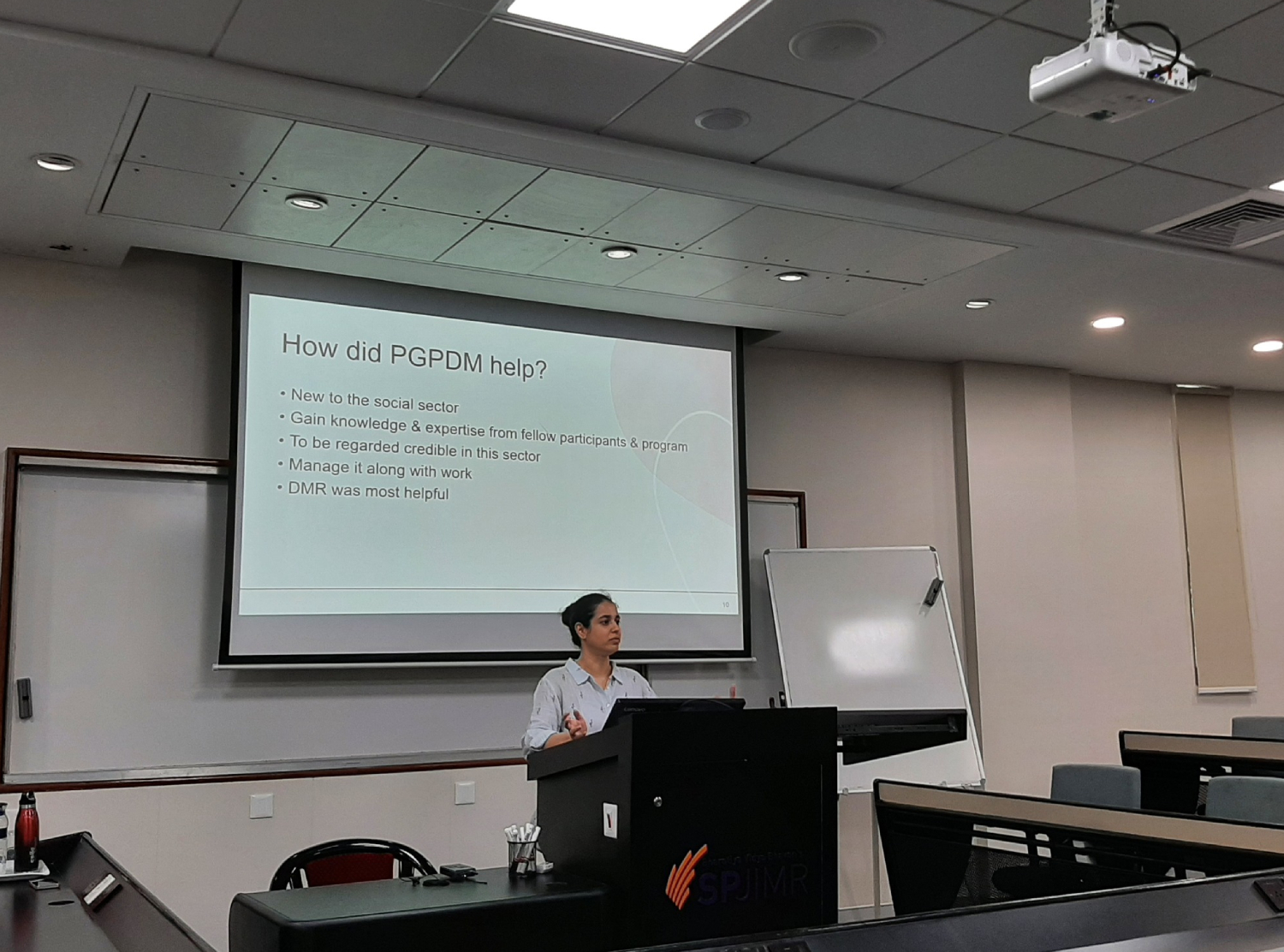
For those who are serious about building their competence in development work, the Post Graduate Programme in Development Management (PGPDM) at the S.P. Jain Institute of Management & Research (SPJIMR) offers the perfect launchpad.
It is a part-time, hybrid programme designed to accommodate working professionals. With a curriculum that blends classroom learning, field-based projects, and peer-to-peer exchange, it prepares you to lead in complex development contexts.
You also learn from real-world practitioners, interact with grassroots leaders, and get hands-on experience through participant-led projects.
Ready to step into your purpose?
If you are ready to take your passion and turn it into structured impact, this is your moment. Change does not happen on its own. It needs leaders like you – prepared, grounded, and ready to act.
Explore how SPJIMR’s PGPDM can shape your development journey
Register your interest in this programme
Please fill in the following details