





To grasp development management, it’s important first to understand development. Development is a continuous process, aiming for societal progress, emerging through increased productivity, economic freedom, and social liberty. Development that creates lasting impact requires an integrative approach—one that moves beyond isolated projects to build interconnected systems fostering long-term, scalable, and sustainable change.
Development management emerges from the application of management principles to development activities. To manage development and address complex societal issues, including economic growth and social progress, a process-based management system evolved into development management, offering a more agile, responsive, and tailored approach.
 PGPDM
PGPDM
Learn. Lead. Impact.

12-month
modular programme
Balance work and learning

For social sector
professionals
NGOs, CSR, Govt, Social enterprises

Programme management
Plan, execute, and maximise impact
Speaking of ‘customised approach to complex situations’, take a look at how this programme helped provide customised solutions to complex situations.
The PGPDM is a 12-month modular programme provided by one of India’s top-ranked B-schools in Mumbai for professionals already in or wanting to make a difference by entering the social sector. This includes NGOs, foundations, corporate CSR functions, government social policy or welfare departments, and social enterprises specialising in development management. The programme is split into three terms, focusing on different facets of the development sector.
In the development sector, where resources are often limited and societal needs are pressing, effective time management is crucial. Professionals who plan well, execute projects efficiently, and deliver services on time can maximise impact. The modular aspect of the PGPDM programme trains working professionals to manage their schedules and balance both their professional obligations and the programme.

The journey to winning the Tata Social Enterprise Challenge
“The programme made me a believer.”
Satendra believed that an organisation’s core values, vision, missions, and aims on the website were just there without much significance. He observed that these ideas changed too frequently to be definitive statements, prompting many organisations to outsource the task. However, after completing the PGPDM programme at SPJIMR, he gained the confidence and insight to reinforce his organisation’s core values and translate them into actionable strategies. He founded Bastar Se Bazaar Tak, an organisation dedicated to empowering rural tribal forest-dwelling farmers by connecting them to wider markets. It facilitates post-harvest management, enabling farmers to sell their produce efficiently while creating additional income and employment opportunities. By bridging the gap between remote forest communities and consumers, the initiative promotes sustainable livelihoods and economic independence for local producers. Bastar se Bazaar Tak went on to win the Tata Social Enterprise Challenge 2020-21!
~ Satendra Singh Lilhare, Co-founder and CEO, Bastar Se Bazaar Tak
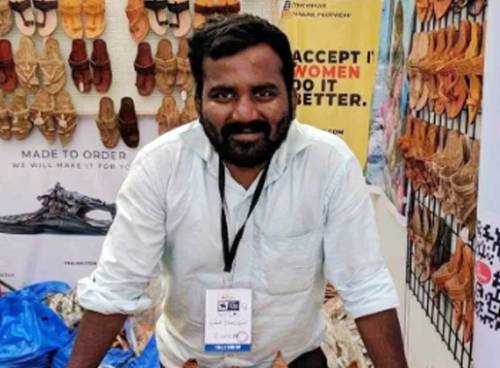
Artisanal brand – ‘Vhaan’
“The course taught me everything I needed to know about becoming a social entrepreneur. I learnt how to think clearly, take care of accounting & finance, undertake surveys, build a team, design a project, gauge where we are headed as a team, and most importantly, incorporate previous learnings into new assignments.”
~ Bhushan Kamble, Founder, Vhaan
Having grown up in Mumbai’s chawls, Bhushan felt a deep connection to the countryside artisans. He believed they share the history of their regions through the stories embedded in each stitch and design. In 2023, Bhushan Kamble discovered his leadership potential during the PGPDM programme by SPJIMR, and founded his artisanal brand, ‘Vhaan’. This brand sells the finest handcrafted leather products made by traditional craftsmen from various villages in Western Maharashtra. Vhaan aims to preserve the authenticity of this art form, ensuring that genuine storytellers reclaim the spotlight and receive dignified treatment.
Bhushan emphasises that the PGPDM programme includes assignments covering a range of courses such as Theory of Change, Programme Design, Fundraising, Evaluation, Impact Assessment, Public Policy, Advocacy & Networking, and Management. These diverse tasks equip students to navigate the evolving landscape of social development and effectively apply their learnings in real-world situations.
Impressive how a programme can help students move mountains!
Let’s dive into the details of the PGP in Development Management offered by a consistently ranked top B-school in Mumbai, India.
Let’s understand what makes the PGPDM programme offered by SPJIMR one of its kind and how it outshines all other development management programmes and schools recognised for their social impact.
 Rankings
SPJIMR has been acknowledged as a top-tier school by the Positive Impact Rating (PIR) Association at the UN PRME Global Forum. Among 71 business schools across 25 countries, SPJIMR achieved the highest ‘pioneering school’ rating for its innovative community initiatives, environmentally and socially responsible practices, and commitment to teaching responsible leadership. This marks the fourth consecutive year of SPJIMR receiving this prestigious recognition.
 Location
The institute’s location is crucial because being close to business hubs or specific industries can provide practical experiences and potential job connections. For instance, in Mumbai, India’s financial hub, students in Development Management can benefit from the thriving social sector, public policy entities, and corporate CSR activities. This setting encourages meaningful industry engagements, offering hands-on learning for those aspiring to drive social change.
 Flexibility
PGPDM combines online efficiency with in-person sessions, allowing participants to work while studying. The modular programme spans six two-week contact periods, three of which are residential.
 Eminent faculty
The programme features a remarkable faculty, including core, adjunct, and visiting members from esteemed institutions like Oxford, Harvard, UC Berkeley, and more. This diverse faculty brings both theoretical and practical expertise to the classrooms, covering management, development, and real-world experience for a comprehensive learning environment.
 Innovative pedagogy
Emphasising interactive learning, the programme blends theory with real-life problem-solving. Field assignments and projects test knowledge relevance in practical settings.
 Impact
Over 14 years and 22 cohorts, SPJIMR’s PGPDM has impacted 350 organisations across 27 Indian states. Alumni serve as founders, leaders, trustees, and directors of NGOs, as well as social entrepreneurs, CSR managers, programme officers, and consultants in diverse social sector organisations.
Industry connect
PGPDM’s extensive network of alumni at esteemed organisations to which participants can be connected. These include –
| Abhivyakti Foundation | Narayana Superspeciality Hospital | Aditya Birla Group | Om Creations Trust |
| Alert India | Piramal Foundation | Alkem Laboratories | Pratham Education Foundation |
| Ambuja Cement Foundation | Praveenlatha Sansthan Foundation | Americares India Foundation | Purnata |
| ASHRAY-AKRUTI | Quality Education Support Trust (QUEST) | Association for Democratic Reforms | Reliance Digital Retail |
| ATMA | SATHI | BAIF | Snehalaya |
| Basic Paradigm | Shantilal Muttha Foundation | CARE India | Shri Ganesh Gramin Vikas Shiksha Sansthan |
| Chambal Fertilisers and Chemicals Ltd | St. Jude India Childcare Centre | Claylab Education Foundation | Sterlite Technologies Ltd |
| Cummins India | Swades Foundation | Deesha Group | Tata Trusts |
| Dr. M. L. Dhawale Memorial Trust | Tata Power | E-Vidyaloka Education for All Network Foundation | Tata Institute of Social Sciences |
| Excel Industries Ltd | Tarun Bharat Sangh | Hand in Hand | The Askhay Patra Foundation |
| Habitat for Humanity India | Urban Management Centre | Haqdarshak | Utkal Alumina International Ltd |
| Head Held High Foundation | Verizon Data Service Pvt Ltd | Hero MotoCorp Ltd | Vodafone Idea Ltd |
| IDSP Foundation | Vigyan Ashram | Intelehealth | Vasudhaiva Shikshana Foundation |
| JSW Foundation | Vivekanand Research & Training Institute | Kotak Education Foundation | Vichar Samiti |
| Lupin Human Welfare & Research Foundation | Volunteers for Village Development | Magic Bus India Foundation | World Health Organization |
| Mauna Dhwani Foundation | Mahindra & Mahindra | UN Women | Vowel of the People Association (VOPA) |

View the entire list of participating and sponsoring organisations.
Register your interest in this programme
Please fill in the following details
Student testimonial
Maulik Sisodia, PGPDM participant from the 20th batch and Executive Director of Tarun Bharat Sangh, Rajasthan shares his experience.