

#PMStrategiesAndExecution: The cost of ‘fix later’: Why responsibility can’t be an afterthought in product design
Naman Jain, PGDM 2024-2026


Ever since ancient times, products have shaped civilisations — from the earliest hand axes (arguably the first-ever product ) to the latest cutting-edge innovations like DeepSeek AI. While products have always influenced human progress, three key shifts have magnified their impact:
- Predominantly digital: Most impactful products today are digital, much like physical products shaped societies in the past.
- Faster innovation cycles: The time taken to release newer and more innovative products continues to decline steadily.
- Global impact: The scale of impact now crosses borders, affecting the global population instead of being locally confined.
However, whether a product is ‘responsible’ towards society or the environment is often determined through guardrails and intent discussions, typically after the product is built and deployed. This reactive approach is unsustainable given the current pace of innovation; we will always be playing catch-up.
The problem with ‘build first, fix later’
Take Facebook or similar social media platforms. Initially designed to connect people, they unintentionally fuelled issues like misinformation and mental health concerns. The response? Reactionary fixes like content moderation and algorithm adjustments were applied after significant harm had already occurred.
This ‘build first, fix later’ approach is complacent with social debt, embedding harm into the product by default. The downsides of this model show that there is merit in responsibility being baked into the product design process from the outset rather than retrofitted or patched on afterward. The degree and quickness of negative impact further attest to it.
The principles for responsible design
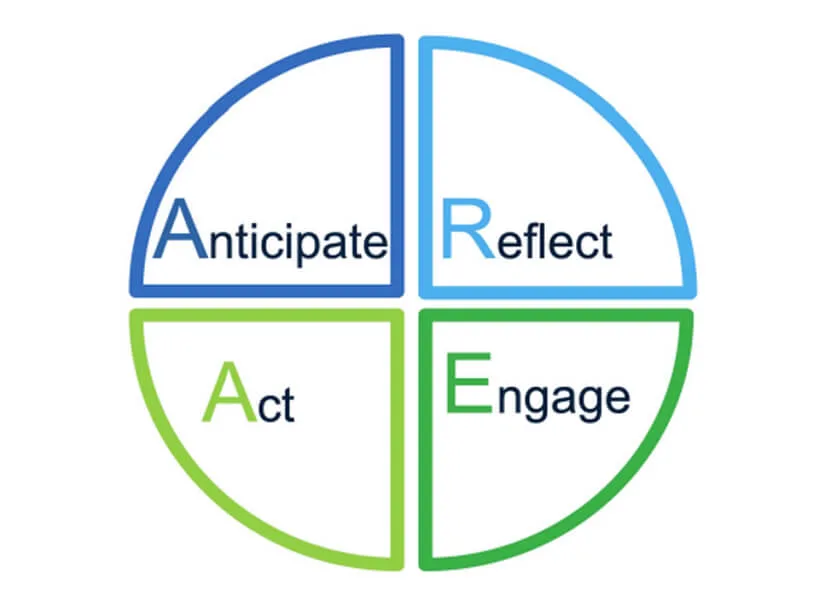
One way to proactively integrate responsibility into product design is by applying the AREA principles:
- Anticipate and look beyond immediate requirements to foresee long-term consequences. Tools like scenario planning or causal loop diagrams (CLDs) can help visualise risks early on, for example, predicting the addictive nature of infinite scrolling.
- Reflect at all organisational levels, and incorporate regular checkpoints in review meetings to assess evolving product impacts on the 3Ps: Planet, People, and Profits, and make course corrections.
- Engage diverse voices to uncover blind spots and better understand how the product might affect various stakeholders.
- Act against emerging risks by employing techniques like market scanning, discussing social debt in sprints, and aligning incentives with long-term impact to encourage accountability.
These principles go beyond adding ‘feel-good’ features. While companies like Zomato champion sustainability and Duolingo drive positive habit formation, there is room for deeper, more systemic responsibility integration. A responsible product manager strives to prioritise privacy, sustainability, inclusion, or a combination of these in their product.
A ‘Brave’ story!
In appreciation of this topic, I recently started using Brave as my go-to web browser due to its commitment to user privacy and ethical design:
- Blocking trackers and ads: Enhances browser performance, saves time, and reduces internet consumption.
- Privacy-focused advertising: Uses locally stored data (only with permission) instead of tracking web usage.
- Consent-based ad system: Users opt in or out, and ads appear as notifications or within the interface, not as intrusive pop-ups.
- User attention rewards: Earn Basic Attention Tokens (BAT) — a cryptocurrency that supports content creators or can be exchanged for other cryptocurrencies. I like the intent, and the fact that I can use it readily is a plus.
Brave is a brilliant example of how a for-profit company (product) focused on a faster, more private, and secure browsing experience while revolutionising digital advertising has embedded responsibility into the product itself, not as an afterthought. It is a small but powerful example of how responsibility can be a core feature, not just a patch applied later.
The path forward
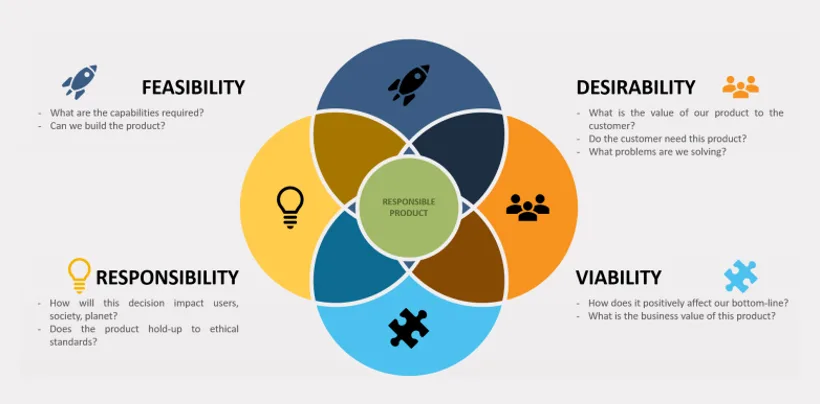
If more products embraced this mindset, we would be closer to innovation that elevates humanity without leaving harm in its wake. It’s high time that responsibility becomes the 4th circle in the Venn diagram when discussing desirability, feasibility and viability. In an age where products can change humanity at scale, building responsibly from the start is not just good practice — it is a necessity.
About Post Graduate Diploma in Management (PGDM)
SPJIMR’s Post Graduate Diploma in Management (PGDM) is a two-year, full-time residential programme equivalent to an MBA. PGDM is approved by AICTE, accredited by NBA and AMBA, UK and consistently rates among India’s top 10 management programmes. The programme offers a holistic approach to leadership development with its innovative blend of classroom learning and thoughtfully curated immersive experiences.