Lead enterprise finance. Shape strategy. Drive value.
About the programme
According to Korn Ferry, fewer than 30% of senior finance leaders who aspire to the CFO role successfully make the transition. *
*Source: CFO Readiness research 2025. The constraint is not financial expertise, but the shift to enterprise leadership. The role demands the ability to set strategy, govern with integrity, navigate global risks, and influence board-level decisions.
The Chief Financial Officer Programme from S. P. Jain Institute of Management and Research is a 9-month blended learning programme that prepares finance professionals with deep functional expertise to move into high-stakes leadership roles. Delivered by SPJIMR faculty, the programme is built on a rigorous, case-intensive curriculum spanning financial strategy, corporate valuation, risk, governance, forensic accounting, and AI-enabled finance leadership. It progresses from strengthening core finance foundations to building the boardroom readiness and enterprise-wide perspective that define the modern CFO role.
The programme is delivered through a combination of live sessions led by SPJIMR faculty, executive sessions with industry leaders, and hands-on projects. Learners engage with real-world business case studies and financial scenarios to sharpen judgment under uncertainty and influence decisions in complex organisational environments. Two on-campus immersions at SPJIMR in Mumbai deepen this experience through faculty interaction, peer exchange, and cross-industry dialogue. Upon successful completion, learners receive a Certificate of Completion and ‘Executive Alumni Status’ from SPJIMR.
Key highlights
Designed and delivered by SPJIMR faculty
Industry-relevant curriculum designed and delivered through live sessions by SPJIMR faculty and executive masterclasses from senior finance leaders.
On-campus immersions
Participate in two campus immersions at the SPJIMR, Mumbai campus for deeper learning, in-person faculty engagement, and peer networking.
Flexible learning delivery format
Delivered in a blended format combining SPJIMR-led live sessions, self-paced learning, and on-campus immersions requiring ~5–7 Hours of effort per week.
Case-based pedagogy
Build capability across financial leadership, enterprise strategy, and decision-making through a structured curriculum grounded in real-world Indian and global case studies from top B-schools.
No-code AI and data analytics modules
Build understanding of AI and data analytics applications in finance through no-code modules designed for business leaders.
Capstone project
Apply learning through an applied Capstone Project focused on real-world business challenges, integrating learning across financial, strategic, and analytical concepts.
Executive alumni status
Gain the opportunity to earn Executive Alumni Status from SPJIMR.
Recognised certifications
Earn a Certificate of Completion from SPJIMR upon successful completion of the programme.
Peer learning and networking
Engage with senior professionals across industries to exchange perspectives and build meaningful cross-industry connections.
Learning support
Receive dedicated support from a programme manager throughout the programme.
Programme goals
Objectives
Prepare finance professionals with deep functional expertise to transition into modern CFO and enterprise leadership roles — by building capability across financial strategy, governance, valuation, risk, and AI-enabled finance leadership, grounded in real-world case-intensive learning.
Outcomes
Upon successful completion of the programme, learners will be able to –
Lead as a strategic CFO
Develop the vocabulary, frameworks, and expertise to make informed decisions across strategy, risk, and capital allocation.
Drive value creation and capital allocation
Design capital structure, investment, and value creation strategies; evaluate M&A transactions, LBO structures, and restructuring options through a sophisticated finance lens.
Navigate global financial risk and volatility
Translate macroeconomic signals into informed hedging, financing, and cross-border treasury decisions; manage currency, liquidity, and country risk with confidence across jurisdictions.
Govern with integrity and steward ESG responsibilities
Build robust enterprise risk frameworks, strengthen audit committee relationships, and embed ESG and sustainability considerations into financial governance and capital allocation decisions.
Build agile financial planning and treasury operations
Lead strategic FP&A, scenario planning, and rolling forecasts; optimise working capital and treasury operations and align financial planning with enterprise priorities in dynamic environments.
Detect and prevent financial misrepresentation
Apply forensic accounting techniques and earnings quality diagnostics to identify potential manipulation, safeguard organisational credibility, and advise boards in line with financial and regulatory standards.
Leverage AI and data analytics for finance
Evaluate AI and fintech investments with strategic and financial rigour; lead digital transformation in finance and utilise data analytics to strengthen executive decision-making and stakeholder communication.
Communicate with executive presence
Craft compelling financial narratives for boards, investors, and C-suite stakeholders; manage investor relations, and handle boardroom discussions with confidence and composure.
Participant profile: Who is it best suited for?
The programme is designed for finance professionals transitioning into the modern CFO role, shifting from functional expertise to AI-enabled strategic leadership.
Ideal participants include:
CFOs and executives – CFOs and finance leaders who aim to operate as enterprise leaders, driving strategy, capital allocation, and cross-functional decision-making, while building depth across key areas of finance.
Emerging finance leaders – Deputy CFOs, Vice Presidents, Associate Vice Presidents, Directors, Controllers, and FP&A leaders seeking to build a comprehensive finance playbook to accelerate their progression to the CFO role, while strengthening their strategic and enterprise leadership capabilities.
Senior finance, strategy, and investment professionals – Corporate finance, strategy, M&A, and investment professionals seeking a structured learning journey and a CFO lens across valuation, deal-making, risk, and governance.
Business leaders and entrepreneurs – Finance heads in growth-stage organisations, founders, business owners, and functional leaders transitioning into P&L roles who aim to build strong financial leadership across capital structure, value creation, and enterprise risk.
Faculty
The programme is designed and delivered by SPJIMR faculty, with executive sessions led by senior industry leaders.
Prof. Vinay Goyal
Programme Director Professor and Director of Academic Operations, SPJIMR
The Chief Financial Officer Programme is designed as a progressive journey, moving from strengthening core financial and reporting foundations to advancing into corporate finance, global markets, and strategic decision-making. As learners build this base, the programme expands into governance, risk, and digital capabilities, culminating in AI-enabled finance leadership and enterprise strategy.
Learners develop a comprehensive understanding of finance as both a functional and a strategic discipline, enabling them to operate as future-ready CFOs across financial and business domains.
The programme is delivered through a combination of live sessions from SPJIMR faculty, executive sessions from industry leaders, hands-on projects, and two on-campus immersions at SPJIMR, Mumbai.
Module 1 | The strategic CFO and finance leadership
This module reframes the CFO from a controller of numbers to an enterprise strategist, trusted advisor, and board-facing leader. Learners examine the modern CFO mandate, the architecture of a high-performing finance organisation, and the skills required to operate across the CEO’s office, the board, investors, and global partners.
Key topics
The evolving role of the CFO
Building and leading the modern finance organisation
CFO decision frameworks and leading future-ready finance teams
Module 2 | Accounting excellence, financial reporting integrity, and forensics
Building on the strategic context of the CFO role, this module strengthens the technical reporting backbone expected of CFOs. It covers contemporary statement analysis, evolving accounting standards, forensic techniques for detecting manipulation, and the CFO’s role in insolvency and restructuring. The emphasis is on protecting credibility and connecting accounting quality to strategic decision-making.
Key topics
Contemporary financial statement analysis
Accounting developments: Ind AS and global standards
Earnings management, financial reporting manipulation, and fraud detection
Bankruptcy, insolvency, and corporate restructuring
Module 3 | Corporate finance and value creation
This module builds on the foundation of reporting and financial integrity and shifts the focus to how CFOs drive value. It concentrates on a CFO’s core corporate finance agenda, combining capital structure, investment decisions, and enterprise value into a single decision framework. The emphasis is on finance-led value creation, capital deployment, and sophisticated investment judgement.
Key topics
Corporate financial strategy and value-based management
Advanced capital budgeting and strategic investment decisions
Real options and corporate restructuring
Private capital, infrastructure, and growth financing
Module 4 | Strategic financial planning, budgeting, and treasury leadership
Extending from corporate finance decisions, this module brings together the planning and liquidity responsibilities at the core of day-to-day finance leadership, connecting forecasts, cash visibility, working capital, and banking decisions within an integrated operating finance lens.
Key Topics
Financial planning and budgeting
Modern FP&A, modelling, and decision support
Treasury management
Working capital strategy
Module 5 | Global economics, international finance, and forex risk management
This module builds on a strong foundation in internal finance operations and expands the CFO perspective to global financial exposure. It connects macroeconomic intelligence, international financial markets, foreign exchange risk, and multinational financing choices, enabling learners to navigate volatility across geographies.
Key Topics
Global economics for CFOs
International financial markets and financing choices
Currency risk management
Cross-border treasury management and transfer pricing
Module 6 | Corporate valuation, deals and restructuring
Building on global finance and investment perspectives, this module equips learners to value firms, assess transactions, and support growth or turnaround decisions. It spans valuation of private companies, IPO readiness, and the deal mechanics of mergers, acquisitions, and restructuring, strengthening judgment in board-level investment situations.
Key topics
Corporate valuation foundations
Relative, transaction, and advanced valuation
Strategic corporate valuation
Mergers, acquisitions, and corporate restructuring
Module 7 | Enterprise risk, governance, compliance, and ESG stewardship
As financial and strategic responsibilities expand, so does the need for oversight. This module addresses the control, oversight, and stewardship responsibilities expected of CFO-ready leaders, connecting enterprise risk frameworks, governance mechanisms, compliance responsibilities, and sustainability expectations into one coherent leadership agenda.
Key topics
Enterprise risk management for the CFO office
Board governance, compliance, and regulatory stewardship
Crisis readiness and governance under stress
ESG and responsible stewardship
Module 8 | AI and data analytics for finance
This module builds on a strong grounding in finance and governance and extends into digital transformation. It modernises the finance curriculum by integrating digital capabilities and combining analytics, AI, and fintech, enabling CFO-track leaders to evaluate technology opportunities, manage risk, and drive adoption within the finance function.
Key topics
AI for finance
Data analytics for decision support
Evaluating AI and fintech investments
Cybersecurity, data security, and governance
Module 9 | Strategic management and design thinking for CFOs
Bringing together finance, risk, and digital capabilities, this module positions the CFO as a contributor to enterprise strategy, competitive advantage, and resource allocation, developing the strategic vocabulary and frameworks required to operate as a true business co-pilot.
Key topics
Strategic management frameworks for CFOs
Competitive advantage, portfolio choices, and resource allocation
Design thinking for strategic problem solving
Strategy execution through finance
Capstone project
The Capstone project provides learners with an opportunity to integrate learning across modules by working on a real-world business challenge. It focuses on applying financial, strategic, and analytical concepts to develop structured recommendations and present them in an executive-ready format.
*Note – The above curriculum is under the purview of the academic team and is subject to change to ensure alignment with evolving industry requirements.
The Chief Financial Officer Programme is built on a case-based pedagogy. Across all modules, learners engage with multiple real-world cases, drawn from global and Indian companies, that put them in the decision-maker’s seat. Rather than surveying theory, cases force learners to exercise judgement, navigate incomplete information, and defend their positions.
Case study sources
Cases are sourced from the world’s leading B-schools and purpose-built Indian contextual cases developed for this programme. Global sources may include providers such as Harvard Business School (HBS), Ivey Business School, and Indian contextual case studies from varied sources.
Representative case studies
IL&FS: Shadow banking, off-balance-sheet risk, and the CFO’s blind spots
Netflix: Data analytics and the CFO’s content investment framework
Bombardier Inc.: CFO decisions in a multi-crisis environment
Essar Steel: CIRP under IBC – The CFO’s role in a ₹42,000 crore resolution
Microsoft’s finance transformation under Satya Nadella
×
*Note – These case studies are indicative only. The full case study list is curated and updated on an ongoing basis.
Campus immersion at SPJIMR
The programme includes two thoughtfully designed campus immersions at SPJIMR, Mumbai, each spanning three days, scheduled around the second month and at the conclusion of the learning journey.
The first immersion begins with a campus orientation, offering learners a closer look at the institute’s learning environment and facilities, followed by in-person engagement with senior faculty, peer networking, and foundational sessions that establish the programme’s strategic context. Curated interactions with industry leaders further provide early exposure to real-world perspectives and contemporary business challenges.
The second immersion, conducted towards the end of the programme, is designed as an integrative experience that brings together learning from across modules. It emphasises the Capstone Project through focused mentoring, peer discussions, and review sessions. Learners return to campus to refine their project approach, receive support from faculty and industry experts, and present their work with an emphasis on practical application, strategic thinking, and business impact.
*Note – Please note that these particulars are indicative and subject to change.
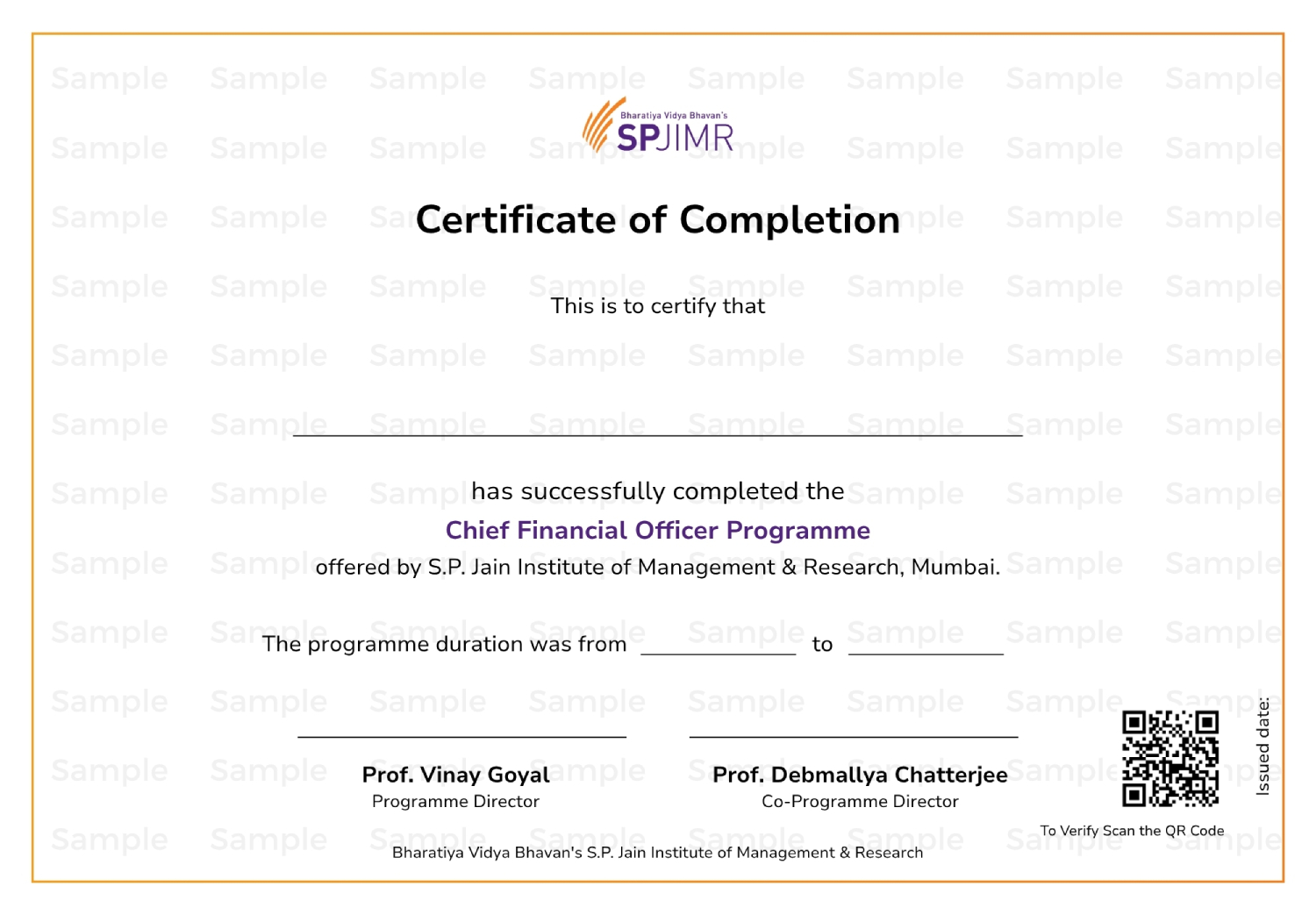
Certificate
On successful completion of the programme, participants will get the following certificate:
Note: The certificate is subject to change and will be awarded only upon successful completion of the programme.
In addition to the Certificate of Completion, participants who meet the eligibility criteria will receive the prestigious Executive Alumni Status from SPJIMR.
Admissions and finances
Eligibility
Candidates should have a minimum of 8 years of relevant work experience.
S. P. Jain Institute of Management & Research (SPJIMR) has partnered with Great Learning to offer the Advanced Management Programme in AI Leadership. Great Learning is a leading global ed-tech company for professional and higher education, serving over 14 million learners across 170+ countries, with 500 million+ learning hours delivered, a 91% course completion rate, and a 4.8/5 learner rating, supported by 8,200+ industry mentors.
Great Learning manages enrolments and delivers end-to-end learner support, programme management, and industry-led mentorship. The programme draws on SPJIMR’s academic rigour and practice-oriented approach, combining faculty-led insights with real-world application to enable professionals to drive AI-led business transformation.