



Family businesses have long been a cornerstone of economies worldwide, with women playing crucial yet often under-recognised roles. While many women contribute significantly to their family enterprises, they frequently hesitate to take on leadership positions. This hesitation stems from deep-rooted societal expectations, internal self-doubt, and structural barriers within the business. Addressing this confidence crisis is essential to unlocking their full potential and ensuring sustainable, inclusive business growth.
Understanding the confidence crisis

Societal expectations and traditional roles
Cultural norms and traditional expectations often place women in supporting rather than leadership roles. Even when they are highly capable, societal pressures may push them toward administrative or background responsibilities rather than strategic decision-making. This conditioning makes it difficult for women to assert themselves as leaders in family businesses.

Imposter syndrome in family businesses
Despite their experience and expertise, many women in family businesses struggle with impostor syndrome—the persistent feeling that they do not deserve their success. This self-doubt can prevent them from speaking up in meetings, making bold business decisions, or taking the lead in succession planning.

Limited decision-making power
Family dynamics can sometimes reinforce gender-based biases, limiting women’s influence in key decisions. They may be involved in operations but kept away from critical financial or strategic roles, leading to a lack of confidence in their ability to lead.

Lack of mentorship and representation
The absence of strong female role models in family businesses can further erode confidence. Without mentors who have navigated similar challenges, women may feel isolated and uncertain about their ability to break traditional barriers.
Breaking free: How women can overcome confidence barriers
Building self-belief and leadership identity
Confidence grows when women recognise their unique strengths and contributions. Developing executive presence, seeking leadership training, and actively participating in strategic discussions can help shift perceptions, both personal and external.
An exemplary case of a woman building self-belief and a strong leadership identity within a family business is Roshni Nadar Malhotra, chairperson of HCL Technologies. As the first woman to lead a listed Indian IT company, Roshni has demonstrated exceptional leadership by actively engaging in strategic decision-making and fostering an environment of equal opportunity within the organisation. Her journey underscores the importance of developing executive presence and seeking leadership training to shift both personal and external perceptions.
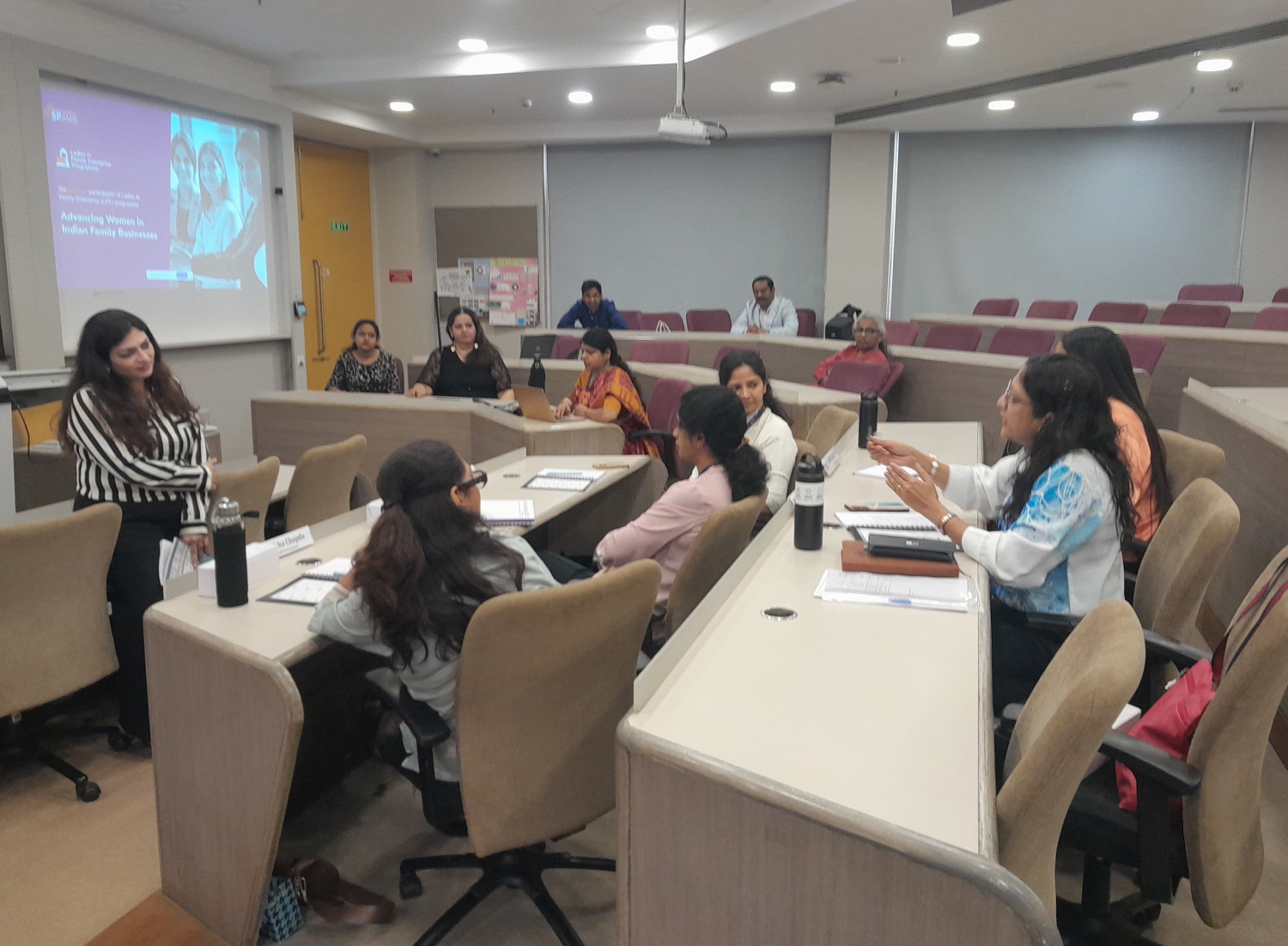
Image credit: SPJIMR
Gaining financial and operational expertise
A key factor in leadership confidence is financial literacy and operational know-how. Women who equip themselves with business acumen, such as managing P&L statements or strategic growth plans, feel more empowered to make informed decisions. An inspiring example is of sisters Schauna and Nadia Chauhan, who have played a transformative role in Parle Agro’s success. As CEO, Schauna Chauhan focused on strengthening operations, expanding manufacturing capacity, and driving financial growth.

Image credit: SPJIMR
Meanwhile, Nadia Chauhan, who joined the company in 2003, leveraged her business acumen to diversify Parle Agro’s portfolio beyond Frooti to include Appy Fizz, a massive success, and India’s first packaged nimbu pani. Under their leadership, they drive strategy, sales, and marketing, steering Parle Agro towards its ambitious ₹20,000 crore revenue target by 2030.
Establishing influence in a male-dominated space
Women leaders must develop strong communication and negotiation skills to assert their presence. Creating a leadership brand within the family business and proving value through measurable contributions can shift perceptions. The story of Vinita Gupta, CEO of Lupin Pharmaceuticals, is a testament to how women can rise in a male-dominated business landscape through resilience and strategic influence. Under her leadership, Lupin expanded globally, successfully entered the U.S. generics market, and achieved multi-billion-dollar revenues, proving that expertise and vision can break barriers.

Image credit: SPJIMR
Creating support networks and mentorship opportunities
Building a strong network of mentors and peers provides women with guidance and encouragement. Joining business forums, industry groups, or leadership programmes designed for women in family enterprises can be transformative.
A notable example is Valli Arunachalam of the Murugappa Group, who challenged traditional norms by advocating for women’s leadership in governance. Her push for representation sparked crucial discussions on inclusivity in family businesses, highlighting the role of mentorship and structured leadership pathways in breaking barriers.

Image credit: Livemint
How SPJIMR’s LiFE programme empowers women in family businesses
Women seeking to overcome these barriers and step into leadership roles can benefit from structured learning programmes. The Ladies in Family Enterprise (life) programme at SPJIMR is designed to equip women with the skills and confidence to thrive.
Register your interest for this programme
Please fill in the following details
With a focus on strategy, finance, negotiation, and leadership development, the programme empowers women to take charge of their family businesses while preserving their unique values. Many participants have transitioned into confident decision-makers, driving their businesses forward with renewed conviction.
Women in family businesses possess immense leadership potential, yet many hesitate to claim their rightful place. By addressing confidence barriers, acquiring essential business skills, and building a strong support system, they can step into leadership with conviction. The time to embrace leadership is now – are you ready to take charge?