Register your interest in this programme
Please fill in the following details



SPJIMR Marketing and Communications Dept.
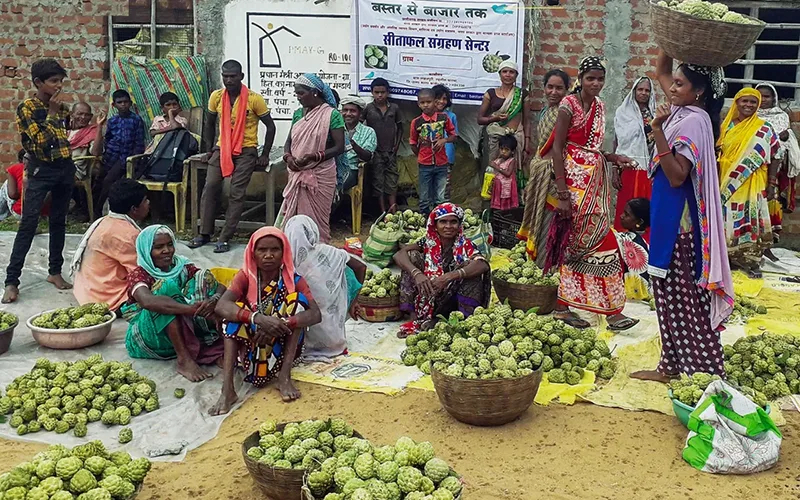
In Bastar, the end of a harvest rarely brings certainty. What follows instead are a series of decisions, often made quickly and with little room for error, that shape livelihoods long after the crop has left the field.
Working closely with tribal communities over several years, Satendrasingh Lilhare observed how these moments repeated themselves across seasons. The outcomes changed little, even as effort remained high, revealing constraints that were not always visible at first glance.
These patterns began to take clearer shape during the Post Graduate Programme in Development Management (PGPDM) at SPJIMR, where classroom discussions, field-based assignments, and peer learning encouraged him to examine decisions more closely and question which constraints truly mattered.

The question was no longer whether to intervene, but where intervention would have the greatest effect. This shift reflected the programme’s emphasis on diagnosing root constraints and treating instability as a design challenge rather than a failure.
Applying this thinking, Satendrasingh founded Bastar Se Bazaar Tak, an enterprise that invested in local processing capacity.
Along the way, he also refined his thinking by observing others operating in the same space, a practice reinforced through peer discussions during the programme. Watching what similar organisations did well, as well as where they struggled, helped refine decisions.

As operations stabilised, informal arrangements began to show their limits, making questions of organisational structure unavoidable.
PGPDM’s emphasis on sequencing and trade-offs helped him frame this as a practical decision rather than an ideological one. Consensus-driven decision-making slowed progress at moments when speed was essential. Responsibility was diffused at a time when quality control, compliance requirements, and buyer commitments demanded clarity. For an enterprise absorbing inventory and price risk, these delays carried tangible costs.

Choosing a private limited structure was therefore a sequencing decision. The immediate priority was to stabilise procurement, processing, and market relationships before transferring operational complexity to farmers. For a period, this distance created the stability needed for the system to function.
As systems took shape, risk began to shift. Inventory, quality, logistics, and cash-flow risks were absorbed by the organisation rather than passed back to farmers. Payments became more predictable, standards were enforced earlier, and delivery timelines improved.
By positioning itself between producers and markets, the enterprise absorbed volatility that had previously been borne by those least equipped to manage it. While this work is rarely visible, it sits at the core of responsible development practice.
With stronger systems in place, Bastar Se Bazaar Tak expanded its reach. Today, the enterprise works with over 1,100 tribal women across 17 villages, operates three processing centres, and supplies products under the Forest Naturals brand to multiple cities. The approach has also received external recognition, including winning the Tata Social Enterprise Challenge (2020–21).
For Satendrasingh, the programme’s impact was less about confidence and more about clarity. The programme did not change what he set out to do, but how he made decisions under uncertainty and pressure.
Decisions that once felt instinctive now had to be defended, sequenced, and sustained. PGPDM did not offer ready-made answers or templates. What it strengthened was the capacity to exercise judgement repeatedly, particularly in situations where there were no obvious right answers and only trade-offs to be managed over time.
As Satendrasingh reflects, “The programme made me a believer.” Not only in ideals, but in the discipline required to design systems that can hold under pressure.
Looking ahead, his focus remains on extending this work to more communities through adaptable models rooted in local ownership. Encouraging entrepreneurship among rural youth and women remains central to long-term independence.
In the end, the real measure of impact was not scale alone, but the ability to build systems that could endure.
Please fill in the following details