





Serious scholarship does not grow from volume. It grows from the quality of inquiry behind it. In management research, that inquiry shapes how organisations function, how leaders decide and how policy evolves. Doctoral education, therefore, must do more than teach theory. It must cultivate judgement, independence and responsibility.
At SPJIMR, the Fellow Programme in Management (FPM) develops scholars within a research ecosystem grounded in purpose, relevance and academic rigour. Recognised by the Association of Indian Universities (AIU) as equivalent to a Ph.D. and approved by AICTE, the programme prepares researchers who influence both academic discourse and management practice.
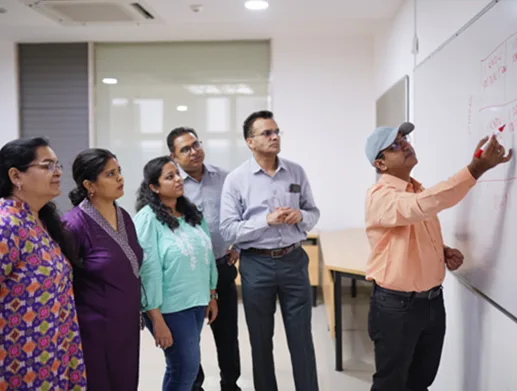
Flipping the script: Relevance backed by rigour
In this interview, Prof. Varun Nagaraj, SPJIMR Dean, noted,
“While traditional academic models often prioritise rigour for its own sake, it is an ‘obsession’ that can lead to research with no bearing on society.”
He added, SPJIMR intentionally flips this hierarchy. The institute focuses on relevance backed by rigour rather than producing rigorous output that lacks practical application.
Typically, doctoral studies focus on addressing the gaps in the literature. SPJIMR’s FPM encourages its fellows to derive their research questions (RQs) from a problem of practice (PoP) to address a real organisational or societal challenge. This inversion ensures that research does not become an abstract exercise detached from context. Instead, it remains anchored in questions that matter to managers, institutions and communities.
At SPJIMR, this belief informs a research ecosystem grounded in purpose, relevance, and academic rigour. This research philosophy is reflected in the breadth of faculty scholarship and directly shapes the design of the Fellow Programme in Management (FPM). The programme is structured to nurture novel inquiry, methodological judgement, contextual sensitivity, and sustained engagement with real organisational contexts.
This approach strengthens both theoretical contribution and practical impact. For prospective applicants searching for a Ph.D. in management in India that connects theory with practice, this distinction is significant.
Shaping research through process and practice
SPJIMR’s research culture is rooted in advancing wise innovation for societal impact. This philosophy shapes both how research is conducted and what it ultimately produces.
The process: Scholars adopt inclusive and reflective methods. They examine multiple stakeholder perspectives and consider ethical implications at every stage of inquiry.
The outcome: Research must contribute positively to organisations, society and the planet. It questions innovations that ignore unintended consequences.
This orientation encourages value-based growth. FPM scholars learn to evaluate the broader impact of their work rather than viewing publication as the sole objective.
A structured doctoral journey
The FPM journey follows a carefully sequenced design that supports intellectual progression.
Intensive coursework
The programme begins with an essential coursework phase reviewed by international scholars to align with the highest global standards in academic research.
Scholars engage deeply with management theory, research traditions and diverse methodologies.
This stage develops conceptual clarity and the ability to frame original research problems, and often leads to publishable research proposals.
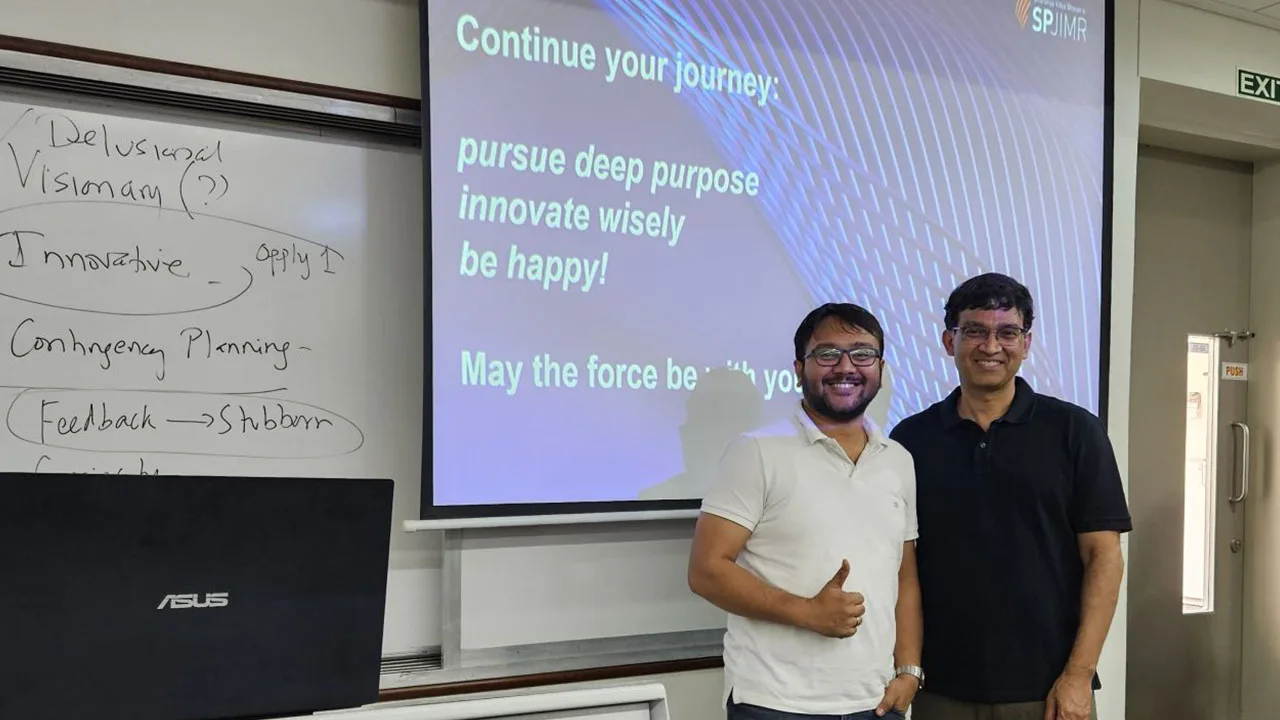
MRes: The mini-thesis
In the second year, scholars undertake a mini-thesis. They collect and analyse data, confront methodological trade-offs and refine research design choices. This experience prepares them for the full dissertation and strengthens research confidence.
Dissertation and scholarly positioning
As scholars advance, they move from methodological prescription to informed judgement. They learn to select and adapt research methods suited to their context. Publication becomes an outcome of sustained scholarly engagement rather than a mechanical target.
Throughout this process, peer dialogue plays a central role. Cohort-based learning ensures that scholars debate, critique and refine ideas collectively, reducing the isolation often associated with doctoral work.
FPM scholar specialising in marketing, Kunal Doshi, reflects on how the programme strengthened his ability to connect theory with practice. Through sustained engagement with faculty and peers, he developed greater clarity in positioning his research within existing scholarship while remaining attentive to real-world marketing contexts.
Multidisciplinary exposure
SPJIMR’s Mumbai campus offers a distinct ‘university feel’, supported by proximity to institutions such as the S.P. Institute of Technology. This creates opportunities for interdisciplinary collaboration, especially on complex problems that extend beyond a single management lens.
The institute’s Centres of Practice further differentiate the ecosystem. Unlike inward-facing Centres of Excellence, these platforms actively engage specific practitioner communities — including family businesses, NGOs and leadership development professionals. This ensures a strong alignment between research insights and practitioner needs.
Supported by a strong alumni network of over 18,000 professionals and institutional partnerships, FPM scholars gain access to a broad ecosystem that amplifies their research impact.
In effect, scholars test their ideas against lived organisational realities rather than hypothetical scenarios.
Mentorship that shapes thought leaders
Doctoral education depends heavily on the quality of mentorship. At SPJIMR, scholars are assigned faculty mentors from the outset, beginning with the coursework phase. FPM scholars have the flexibility to choose their guides and even shift research directions if their inquiry evolves.
The faculty ecosystem blends accomplished academics with industry-oriented practitioners. This mix exposes scholars to both theoretical debates and practice-led questions.
Faculty accessibility remains a defining feature, enabling sustained engagement and timely guidance. This also supports interdisciplinary research outcomes.
Career outcomes: from inquiry to influence
FPM 2020 scholar Mitthi Jyoti Sharma highlights that FPM helps its graduates pursue diverse portfolio careers. After completing the programme, scholars can pursue:
- Academic roles at leading institutions
- Research-led consulting engagements
- Policy and advisory positions influencing governance and industry frameworks
Their work contributes to scholarly publications, practice-oriented research and policy discourse. More importantly, they emerge as thinkers who can bridge theory and action.
A doctoral experience with purpose
Doctoral study is often described as a solitary journey. At SPJIMR, it becomes a collective intellectual enterprise. Scholars engage in sustained dialogue, test assumptions, refine arguments and develop the resilience required for high-quality research.
The result is not merely a doctoral degree. It is the formation of a scholar who is methodologically rigorous, contextually grounded and ethically conscious.
If you are ready to pursue doctoral research that shapes management thought and organisational practice, explore the domains and eligibility criteria on the SPJIMR FPM admissions page.
Register your interest for this programme
Please fill in the following details