

Programme objective

AI is not just automating tasks; it is reshaping leadership authority, influence, judgment, and accountability.

This program helps executives re-examine their leadership practices, understand how AI alters decision-making and people management, and build new leadership competencies and styles required to lead credibly in AI-enabled organisations.

Learning outcomes

By the end of this 2-day MDP, participants will be able to:

  • Recognise how AI changes the nature of leadership work, not just business processes
  • Adapt their leadership practices to AI-augmented decision environments
  • Identify new leadership competencies required in algorithmic organisations
  • Apply appropriate leadership styles for AI-driven, hybrid, and data-rich contexts
  • Lead ethical, inclusive, and human-centred AI adoption
  • Articulate a personal leadership shift plan for the Age of AI

Programme coverage

Understanding the Leadership Shift Caused by AI
  • From experience-based leadership to data-augmented leadership
  • How AI changes authority, expertise, and power
  • Leadership vs management in AI contexts
  • Myths: ‘AI replaces leaders’ vs reality
  • Why leadership judgment becomes more, not less, important
Digital Fluency for Leaders
  • What AI can and cannot do (GenAI, predictive systems, decision engines)
  • How algorithms learn—and how bias enters
  • Explainability vs accuracy trade-offs
  • When AI confidence is misleading
  • Questions leaders must ask before approving AI-led decisions
Decision-making and Accountability in AI-Augmented Leadership
  • Human judgment vs algorithmic recommendation
  • Automation bias and decision complacency
  • Speed vs responsibility trade-offs
  • Escalation rules: when to override AI
  • Accountability in AI failures (legal, ethical, reputational)
Power, Control, and Surveillance — The Leadership Dilemmas
  • Algorithmic management and digital monitoring
  • Performance nudging vs coercion
  • Psychological safety in AI-tracked workplaces
  • Power asymmetry created by data access
  • Leadership responsibility in AI-enabled control systems
Ethical Leadership and Responsible AI
  • Ethical risks of AI in people decisions
  • Bias amplification and systemic inequality
  • Responsible AI principles for leaders
  • Ethics vs efficiency dilemmas
  • Moral courage in rejecting harmful AI use cases
Leadership Styles for the Age of AI
  • Sensemaking leadership – interpreting AI insights
  • Coaching leadership – enabling human-AI collaboration
  • Adaptive leadership – responding to uncertainty
  • Ethical leadership – values over velocity
  • Participative leadership – preserving human voice
Leading Human–AI Collaboration
  • Human-in-the-loop leadership models
  • Redesigning roles and decision rights
  • Preventing skill erosion and over-automation
  • Trust calibration between humans and AI
  • Coaching employees to work with AI
Talent, Careers, and Identity in AI-driven Organisations
  • Skill disruption and career anxiety
  • Shifting from jobs to capabilities
  • Reskilling as a leadership responsibility
  • Psychological contract in AI contexts
  • Managing resistance and fear
Culture, Inclusion, and Trust in AI-enabled Organisations
  • How culture shapes AI outcomes
  • Inclusion risks in algorithmic systems
  • Fairness, transparency, and voice
  • Hybrid work and AI-mediated collaboration
  • Leadership storytelling around AI adoption
The Future Leader — Redefining Self as a Leader in the AI Era
  • Human capabilities AI cannot replace
  • Letting go of control and expertise dominance
  • Building trust in uncertain environments
  • Personal leadership dilemmas with AI
  • Crafting a personal AI leadership action plan

Programme director

Sushmita Srivastava

Sushmita Srivastava

Associate Professor, Organisation and Leadership Studies
Sushmita Srivastava holds a Ph.D. from XLRI Xavier School of Management, Jamshedpur. Her doctoral research conceptualised the Impact of Mentoring on Role Based Performance. She has over two decades of industry experience with Tata Steel in roles pertaining to Human Resource Management. She joined academics in 2017 and is a faculty in the area of Organisation & Leadership Studies at SPJIMR. Her areas of core teaching interest include Industrial Relations, Talent Management, AI, Digital HR ...

Programme dates and fee details

Date Time Fees
July 23 – 24, 2026 Thursday – 9:00 am to 6:00 pm
Friday – 9:00 am to 6:00 pm
₹ 25,000 + 18% GST
(10% early bird and group discounts available)

Certificate of participation

A certificate of successful participation by S.P. Jain Institute of Management and Research (SPJIMR) will be issued to each delegate at the completion of the programme.
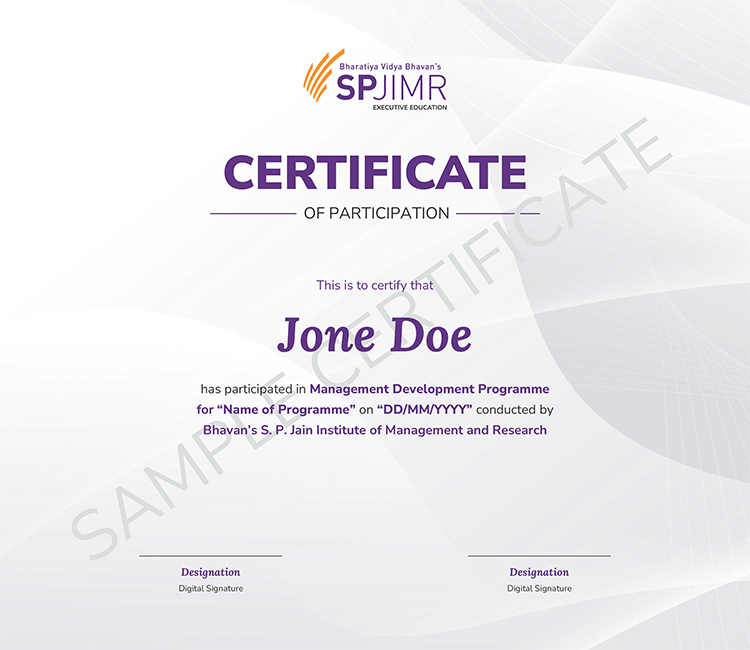
SPJIMR’s Open MDPs certificate of participation.

Contact us

Get in touch with our team to explore world-class learning opportunities that can help you achieve your goals and create a lasting impact.

Enquire now
  • Name
  • Email
  • Phone
AppLy Now