


Organisations today invest significant time, effort and resources in training interventions. Yet, many leaders still struggle with a fundamental question: Did the intervention create impact? Most assessment models prioritise measurable outcomes because they are easier to report. However, the true value of a training intervention often lies beyond numbers, in behavioural shifts that shape long-term organisational performance.
This is where a deeper understanding of both measurable and observable ROI becomes important. While measurable ROI shows direct, quantifiable improvements, observable ROI highlights lasting changes in mindset, capability and culture. Together, they provide a holistic picture of the effectiveness of training.
The evolving expectation from training interventions
Training interventions like Open Management Development Programmes and Custom Management Development Programmes, have moved far beyond classroom sessions and skill-based workshops. In today’s environment, organisations expect learning to translate into business outcomes. They want managers who make better decisions, teams that collaborate more effectively, and employees who demonstrate agility in fast-changing markets.
Learning and development are no longer evaluated only by participation or certifications. It is increasingly judged by the quality of behavioural change and the consistency with which new skills are applied at work. As a result, organisations now look for impact that is strategic, visible and sustained.
What organisations typically measure (measurable ROI)
Measurable ROI refers to quantifiable results that emerge after a training intervention. These outcomes are easy to track, compare and report, making them a standard component of learning assessment.
Common examples include:

Cost per participant

Improvement in productivity or process efficiency

Reduction in time, errors or escalations

Increase in sales numbers or customer feedback ratings

Faster decision-making or shortened cycle times
These indicators matter because they offer clear evidence of value. However, focusing only on measurable ROI gives a limited perspective. Many of the most meaningful outcomes of training are not immediately quantifiable, yet they influence performance in far more sustainable ways.
Leading institutions increasingly adopt structured frameworks to evaluate learning impact beyond attendance and feedback scores. For instance, organisations such as the Reserve Bank of India, PwC, Tata Management Training Centre, and HDFC Life partner with institutions like S.P. Jain Institute of Management & Research (SPJIMR) to assess training effectiveness through clearly defined productivity and leadership metrics.
What organisations often overlook (observable ROI)
Observable ROI reflects the behavioural, cultural and capability shifts that emerge over time. These outcomes may not be captured in spreadsheets but are critical for real, long-term change.
Observable outcomes often look like:
Managers demonstrating better judgement and empathy
Improved collaboration across teams
More proactive problem-solving
Higher accountability and ownership
Greater confidence in decision-making
Employees displaying a growth mindset
These shifts shape organisational culture, influence team dynamics and determine the long-term success of strategy execution. Observable ROI is often where the real transformation happens, even if it takes time to fully manifest.
Organisations that recognise the importance of observable ROI, design learning interventions that intentionally address behavioural and cultural shifts. Leading executive education institutions integrate reflective practice, peer dialogue, and applied leadership frameworks to strengthen judgement and long-term capability.
At SPJIMR, this depth is reinforced through specialised Centres of Practice such as the Centre for Wisdom in Leadership (CWIL) and the Centre for Family Business and Entrepreneurship (CFBE), which focus on leadership judgement, values-based decision-making, and sustainable capability development.
The difference between measuring and observing ROI
While both types of assessment are important, they serve different purposes. Here is a simple comparison:
Measuring ROI
Number-driven
Short-term gains
Easy to quantify
Output-focused
Observing ROI
Behaviour-driven
Long-term capability building
Harder to document but highly valuable
Outcome-focused
Measurable ROI tells you what changed. Observable ROI tells you how and why that change is being sustained. Organisations need to understand the true impact of their training interventions.
A real-world example: Google’s Project Oxygen and the true ROI of leadership development
When Google launched Project Oxygen, the goal was simple: understand what makes a great manager and design a training intervention that could strengthen those behaviours across the organisation. What followed became one of the world’s most cited examples of measuring and observing the impact of leadership development.
The measurable ROI appeared early. Teams led by managers who participated in the intervention showed lower attrition, higher productivity, and stronger performance scores across Google’s eight managerial behaviours. These are outcomes the company could quantify, clear proof that investing in managerial capability translated into tangible organisational gains.

Image credit: Conduit Coaching
But the more powerful impact emerged through what employees and leaders began to observe over time. Managers became significantly better coaches. Conversations shifted from task-tracking to problem-solving. Psychological safety (one of the strongest predictors of team performance at Google) improved noticeably. Collaboration across teams became smoother, and team members reported feeling heard, supported, and trusted.
None of these behavioural shifts showed up immediately in a spreadsheet. They were gradual, lived experiences that accumulated month after month. Yet these ‘soft’ changes later created hard results: stronger team stability, better idea flow, and more consistent delivery on complex projects.

Image credit: Google
Google’s experience shows that the real picture of ROI emerges only when measurable outcomes (like productivity and attrition) are combined with observable shifts (like coaching quality, communication, and trust). Together, they reveal the full value of a well-designed training intervention, what it delivers now, and what it unlocks for years to come.
How organisations can build a holistic impact framework
To unlock the full value of training interventions, organisations can adopt a structured approach to assessing both measurable and observable outcomes:

Define learning outcomes clearly and align them with organisational goals

Measure what is quantifiable using simple, reliable metrics

Observe behavioural change through regular follow-ups and manager inputs

Use 360-degree feedback from peers, customers and cross-functional teams

Track leading indicators (mindset shifts) and lag indicators (business outcomes)

Reinforce learning through coaching, reflection sessions and on-the-job application
A balanced impact assessment framework helps leaders understand not just the immediate benefits but also the long-term organisational effect of their training investments.
Achieving strategic growth through SPJIMR’s executive education and MDPs
S.P. Jain Institute of Management & Research (SPJIMR) designs its Management Development Programmes (MDPs) to create impact at both levels. The programmes combine experiential learning, hands-on exposure and practice-oriented frameworks with reflection-driven interventions. SPJIMR offers Open Management Development Programmes for individual growth and Custom Management Development Programmes for organisation-wide strategic shifts.
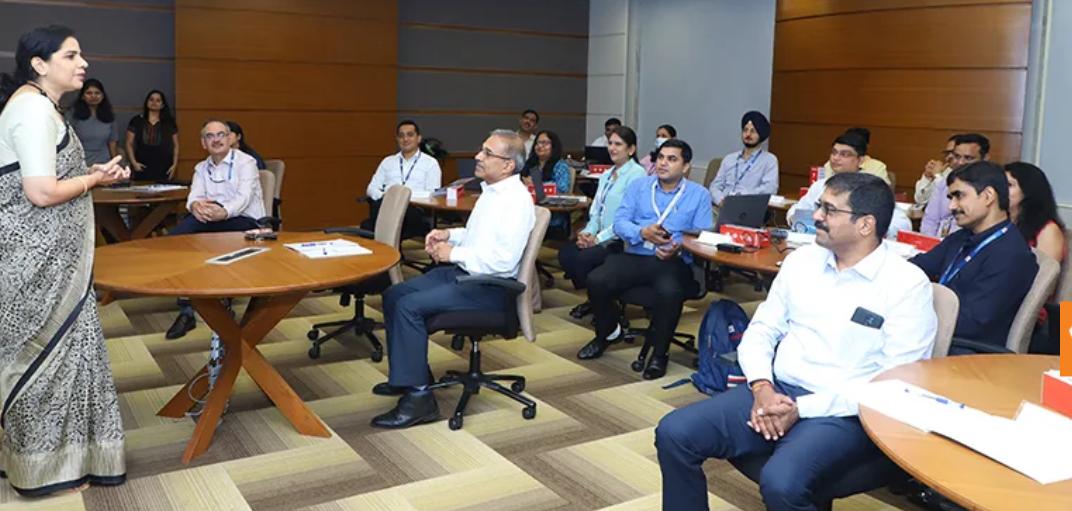
This approach enables organisations to see measurable improvements in performance while also observing deeper behavioural and cultural shifts. SPJIMR’s MDPs are structured to build both capability and confidence, helping participants apply concepts directly to real-world challenges.
SPJIMR’s MDPs offer a pathway to build measurable capabilities and observable leadership impact, ensuring that learning translates into sustained organisational progress. The programmes are offered through SPJIMR’s Mumbai and Delhi centres.
Ready to transform your organisation’s leadership? Enquire now at mdp@spjimr.org or contact the Mumbai (022-62134415) and Delhi (+91 9911941090) centres to explore custom solutions.