


Prof. Amit Jain highlights the significance of prioritising teachers’ mental health
March 15, 2026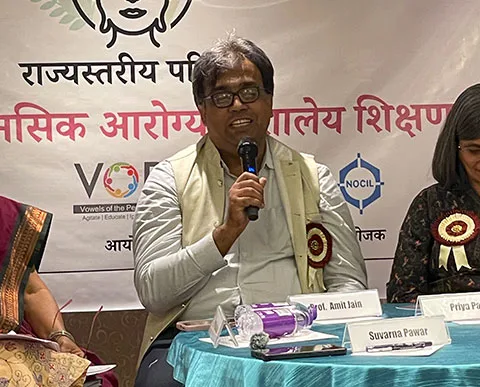
As conversations around education reform deepen globally, teacher mental health is emerging as a critical factor shaping not just educator well-being, but also classroom outcomes and student learning.
At a state-level conference on ‘Teachers’ Mental Health and School Education’ held in Pune on March 15, organised by Vowels of the People Association (VOPA) in collaboration with NOCIL Limited, Amit Jain, Assistant Professor, Organisation and Leadership Studies at S.P. Jain Institute of Management & Research, contributed to a panel discussion examining the relationship between teachers’ mental health and classroom processes.
Bringing a systems perspective to the discussion, Prof. Jain emphasised that teacher well-being extends beyond physical and cognitive demands to include often-overlooked emotional labour; the continuous effort required to manage emotions, build relationships, and create supportive learning environments. “We often recognise the physical and cognitive demands of teaching, but the emotional labour it entails remains underappreciated. This has a direct bearing on teachers’ mental well-being and, in turn, on the quality of classroom engagement and learning,” he noted.
The discussion also highlighted the critical role of school leadership in shaping teacher well-being. Prof. Jain underscored that fostering psychological safety within institutions is essential, not only for supporting teachers but also for enabling meaningful learning environments. “If schools do not create spaces where teachers can question, experiment, and even make mistakes, it becomes difficult to cultivate critical thinking among students. Classroom outcomes are deeply influenced by the environment in which teachers themselves operate,” he added.
The session explored how teacher mental health directly impacts student engagement, learning quality, and classroom culture, reinforcing the need for systemic interventions. Key factors influencing teacher well-being include institutional support, workload structures, leadership practices, and the extent to which educators feel valued and heard.
The conference also called for practical institutional measures, including structured support systems, leadership development, and policies that prioritise educator well-being as integral to strengthening school education.
At SPJIMR, such engagements reflect a broader commitment to advancing research-led, practice-oriented dialogue on critical societal challenges, thereby bringing academic insight to areas like educator well-being that shape long-term institutional and social outcomes.