


Prof. Anirudh Shingal’s research cited in India’s Economic Survey
03 February 2026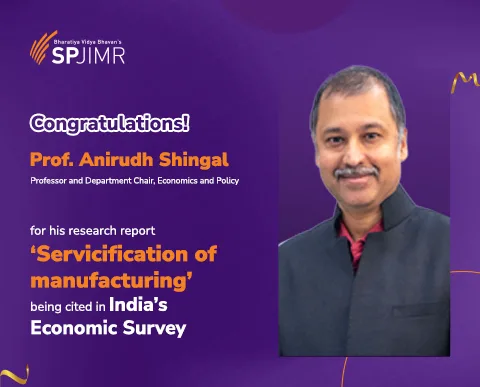
SPJIMR is pleased to share that a research report on ‘Servicification of manufacturing’ by Prof. Anirudh Shingal, Professor of Economics, and Chair, Department of Economics and Policy at SPJIMR, undertaken in collaboration with the Centre for Social and Economic Progress (CSEP), has been cited in India’s Economic Survey this year. The report carries Prof. Shingal’s SPJIMR affiliation, marking an important recognition of faculty research contributing directly to national policy discourse. The citation highlights the growing relevance of academic research in shaping conversations around India’s manufacturing strategy and broader economic transformation.
Reflecting on the citation, Prof. Shingal said: “As an empirical researcher examining policy-oriented questions, it is gratifying to see the relevance of one’s research being recognised and acknowledged in a document of the stature of the country’s Economic Survey.”
The citation is particularly timely in the context of evolving global trade dynamics. Against the backdrop of ‘reciprocal’ tariffs, the Economic Survey’s engagement with this research draws attention to the growing importance of services, which have recorded the fastest growth in global trade over the past two decades—far outpacing merchandise trade—and present significant opportunities for growth and development.
At the heart of the research is the concept of servicification of manufacturing: the increasing use of services as intermediate inputs in and value-enhancing add-ons to manufactured products. Prof. Shingal explains that, as in much of the world, servicification has risen steadily in India, helping firms integrate into regional and global value chains, improve productivity, access foreign markets, and, crucially, create jobs within the manufacturing sector.
One of the report’s most policy-relevant findings address concerns around “jobless” manufacturing growth. The research demonstrates that servicification is positively associated with manufacturing employment, making it an important consideration for policymakers focused on employment generation and structural transformation, besides highlighting complementarities between manufacturing and services.
From a policy standpoint, the findings suggest that removing unnecessary barriers to domestic and foreign trade in services can enhance the competitiveness of Indian manufacturing by lowering input costs and improving service quality. Such reforms can also create employment opportunities, including for low-skilled workers transitioning out of agriculture, thereby supporting India’s broader economic development goals.
For industry leaders, the research underscores the need for stronger advocacy around reducing barriers to services trade, whether through unilateral reforms or preferential trade agreements, to strengthen manufacturing ecosystems.
Speaking about the institutional significance of the citation, Prof. Shingal noted: “I am proud that the report carries my SPJIMR affiliation. It exemplifies the academic freedom that I enjoy at SPJIMR to undertake such collaborative work with a quality think-tank like CSEP.” He further added that such recognition reaffirms the role of academic research in informing public policy and encourages continued engagement with policy-relevant questions.
SPJIMR congratulates Prof. Anirudh Shingal on this achievement and takes pride in faculty research that bridges rigorous scholarship and real-world policy impact. The institute remains committed to fostering an environment where academic inquiry informs practice, influences policy, and contributes meaningfully to India’s economic and social development.