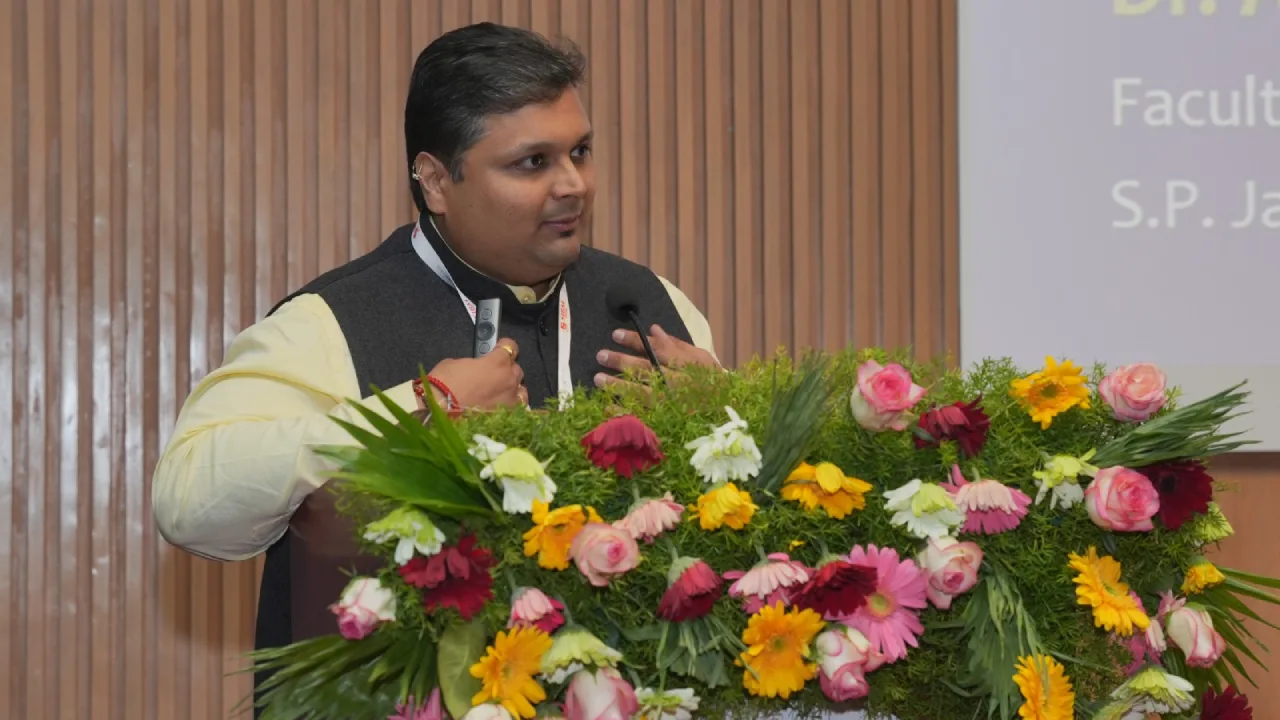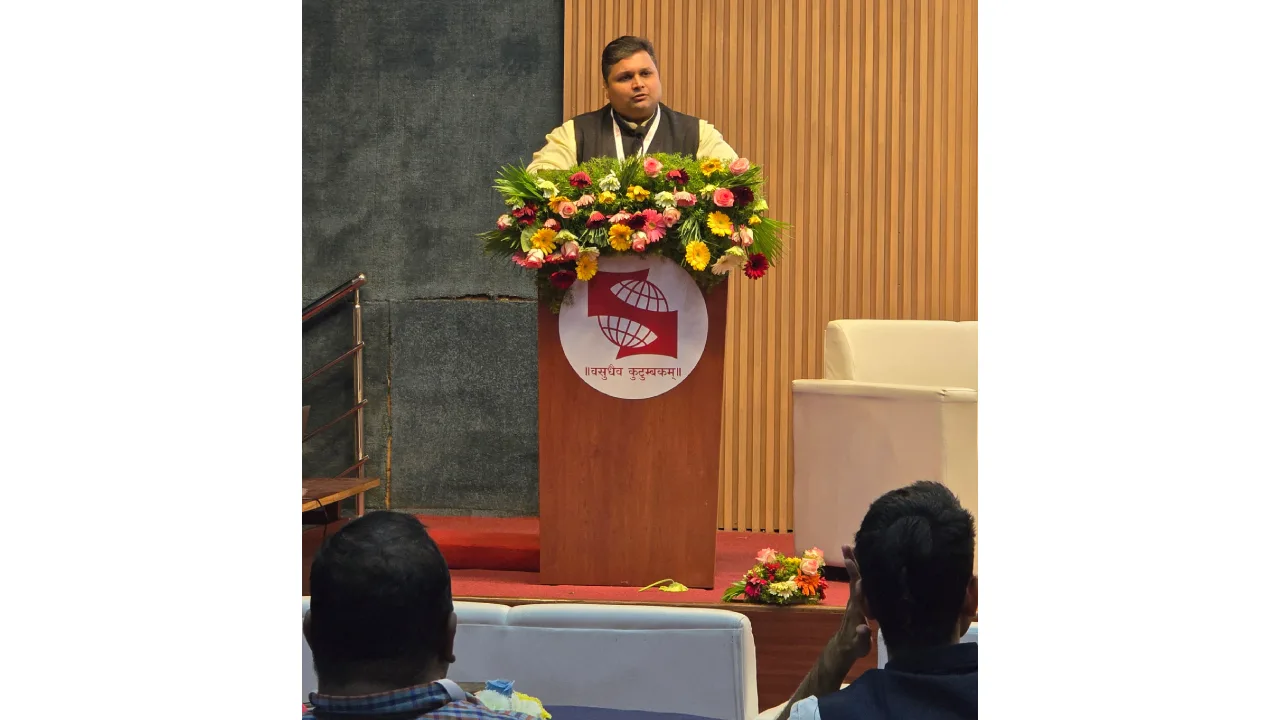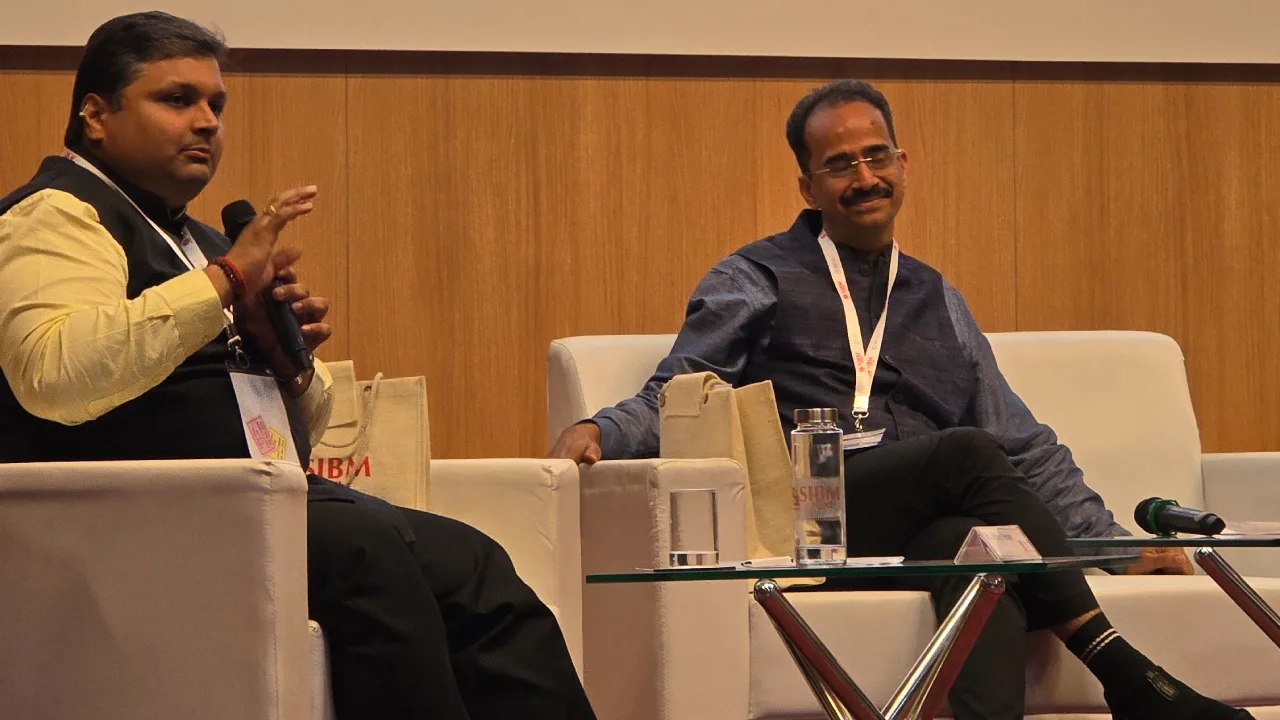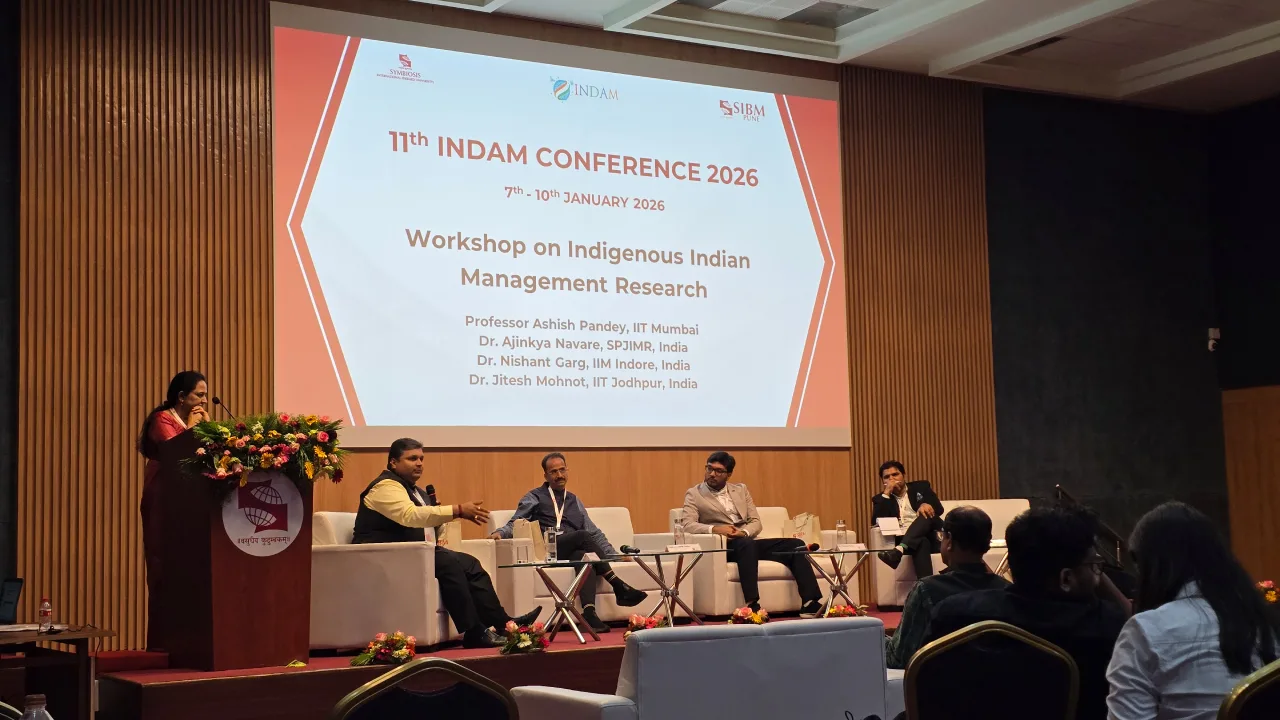


SPJIMR faculty member presents on Karma Yoga at the INDAM 2026 Conference
10 January 2026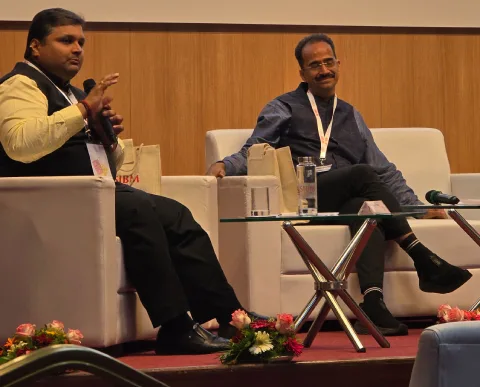
What if leadership excellence isn’t about doing more but about doing things differently?
This question framed a thought-provoking session at INDAM 2026, where Prof. Ajinkya Navare explored how ancient Indian wisdom can meaningfully inform modern workplaces without compromising academic rigour.
In his talk, ‘Decoding Karma Yoga’, he reintroduced Karma Yoga as a workplace-relevant capability, rooted in the Gita’s idea of “योगः कर्मसु कौशलम्”—excellence in action. Anchored in Dharma, Karma Yoga was positioned not as a spiritual abstraction but as a practical lens through which everyday organisational roles can be approached with clarity, accountability, and purpose. As he reflected, “Karma Yoga is a special skill in action. Karma Yoga is not about doing different things; it is about doing the same things differently.”
By interpreting Karma Yoga in a contemporary context, Prof. Ajinkya demonstrated how indigenous concepts can be translated into structured research models and a validated psychometric scale, supported by multiple studies and rigorous construct validation. The work strongly reflects SPJIMR’s philosophy of blending Indian ethos with contemporary management practice. By grounding values-based leadership in empirical research, it advances practice-oriented scholarship and reinforces the relevance of Indian wisdom in organisational contexts where purpose, performance, and ethics increasingly intersect.
Prof. Ajinkya was speaking at the conference workshop on Indigenous Indian Management Research at the INDAM 2026 Conference, organised by the Indian Academy of Management and hosted at SIBM, Pune, alongside faculty from IIT Bombay, IIT Jodhpur, and IIM Indore.